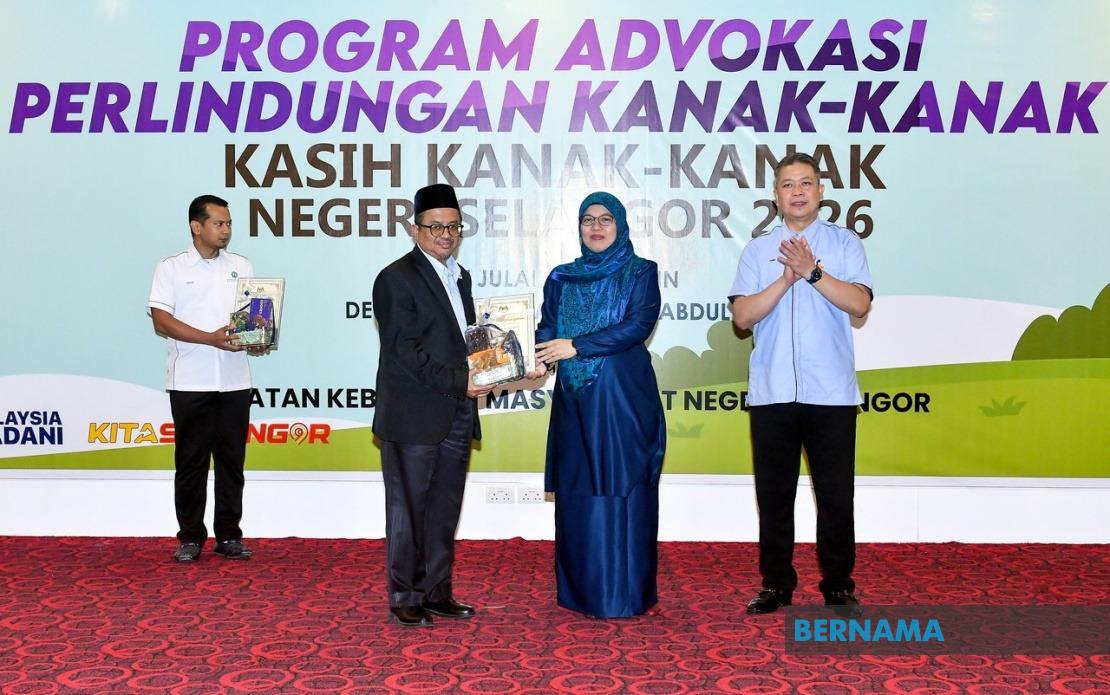
The Selangor state government is launching an aggressive campaign to strengthen protections for its 1.8 million children, recognising that passive responses to child welfare crises are insufficient in an increasingly complex social landscape. The Programme Advokasi Perlindungan Kanak-Kanak: Kasih Kanak-Kanak Selangor, unveiled at the Sultan Abdul Aziz Silver Jubilee Hall in Shah Alam on July 27, represents a shift toward preventative advocacy that engages schools, religious institutions, and enforcement agencies in a coordinated effort to identify and address threats to child safety before they escalate into crimes or humanitarian emergencies.
The urgency of this initiative becomes apparent when examining recent case data from Selangor. Between January and June 2024, the state documented 2,306 child-related cases spanning three broad categories: care and protection matters comprised the largest segment at 1,877 cases, while criminal misconduct against children accounted for 366 incidents, and children deemed beyond control numbered 63 cases. These figures illustrate the multifaceted nature of child welfare challenges, extending well beyond simple criminal prosecution to encompass family instability, institutional neglect, and behavioural difficulties requiring early intervention.
According to Anfaal Saari, chairman of the Selangor Women Development and Social Welfare Committee, the state's high population density and rapid urbanisation create particular vulnerabilities for young residents. Urban environments, while offering economic opportunities, often fragment extended family networks and reduce community supervision—factors that research consistently links to increased child vulnerability. Selangor, as Malaysia's most populous state and economic heartland, faces these pressures acutely, making systemic protection mechanisms essential rather than optional.
The collaboration with Yayasan Islam Darul Ehsan (YIDE) signals an important evolution in how Malaysian state governments approach child protection. Rather than treating the issue as purely governmental, Selangor is leveraging Islamic charitable organisations with deep community roots and moral authority. The partnership has supported over 100,000 students nationwide since 2004, demonstrating sustained commitment beyond electoral cycles. This twenty-year institutional relationship provides credibility when delivering messages about child safety to Muslim-majority populations, particularly within tahfiz institutions and Islamic schools where parallel governance structures exist.
The inaugural programme attracted 250 participants from 52 schools and tahfiz centres operating under the Selangor State Education Department (JPNS), the Selangor Islamic Religious Department (JAIS), and the Selangor Tahfiz Al-Quran Institutions Association (PITAS). The diversity of participating institutions reflects recognition that child protection requires buy-in across the full spectrum of educational and religious spaces where Selangor's young people spend their time. Tahfiz institutions, in particular, have occasionally faced scrutiny regarding supervision standards and safeguarding protocols, making their inclusion in advocacy initiatives strategically important.
Selangor's multidisciplinary approach explicitly rejects the reactive model that dominates much of Malaysia's child protection response. By convening the Royal Malaysia Police (PDRM), the Malaysian Communications and Multimedia Commission (MCMC), education authorities, and Islamic bodies simultaneously, the state creates opportunities for institutional learning and information-sharing that rarely occur in normal governance operations. The MCMC's participation suggests particular concern about online exploitation and digital dangers facing children—a growing frontier in child protection where Malaysian authorities are still developing expertise and policy frameworks.
The structural importance of this initiative extends to care institutions and tahfiz centres, environments where children live in congregate settings with limited parental oversight and where institutional vulnerability can be systematised across multiple cases before detection. By explicitly naming these settings as requiring special protection focus, Selangor acknowledges that formal child safeguarding must penetrate beyond school gates into residential and semi-residential spaces often left to self-regulation. This represents a meaningful expansion of child protection responsibility beyond traditional boundaries.
Anfaal's emphasis on continuous, comprehensive advocacy rather than incident-response reflects emerging best practices in child protection globally. The shift from prosecution-focused models toward prevention-oriented ecosystems recognises that protecting vulnerable children requires cultural change, institutional capacity-building, and early identification mechanisms operating before abuse occurs. This philosophical repositioning, if matched with sustained resource allocation and accountability mechanisms, could distinguish Selangor's approach from less systematic efforts in other Malaysian states.
The programme's sustainability deserves scrutiny, however. Long-term effectiveness depends on whether initial enthusiasm translates into institutionalised protocols, regular training cycles, and genuine inter-agency coordination beyond ceremonial cooperation. Malaysian child protection initiatives have sometimes suffered from launch momentum that dissipates without structural embedding. The two-decade partnership with YIDE provides some basis for optimism regarding institutional durability, though real tests emerge when programmes encounter resource constraints or leadership transitions.
For Malaysian readers beyond Selangor, this initiative offers a template worthy of examination. With child welfare challenges increasingly visible across the country—from institutional abuse scandals to online exploitation—other states might adapt Selangor's multidisciplinary architecture to local contexts. The specific inclusion of religious authorities and Islamic institutions reflects Malaysia's particular institutional landscape and could usefully inform federal-level policy development.
The scale of Selangor's child population and the documented prevalence of welfare cases create a natural laboratory for testing whether coordinated, prevention-focused advocacy can measurably reduce harm. Success would generate compelling evidence for broader national adoption, while failure could illuminate specific implementation obstacles. Either outcome would contribute valuable intelligence to Malaysia's ongoing efforts to create child protection systems adequate to contemporary social challenges.

