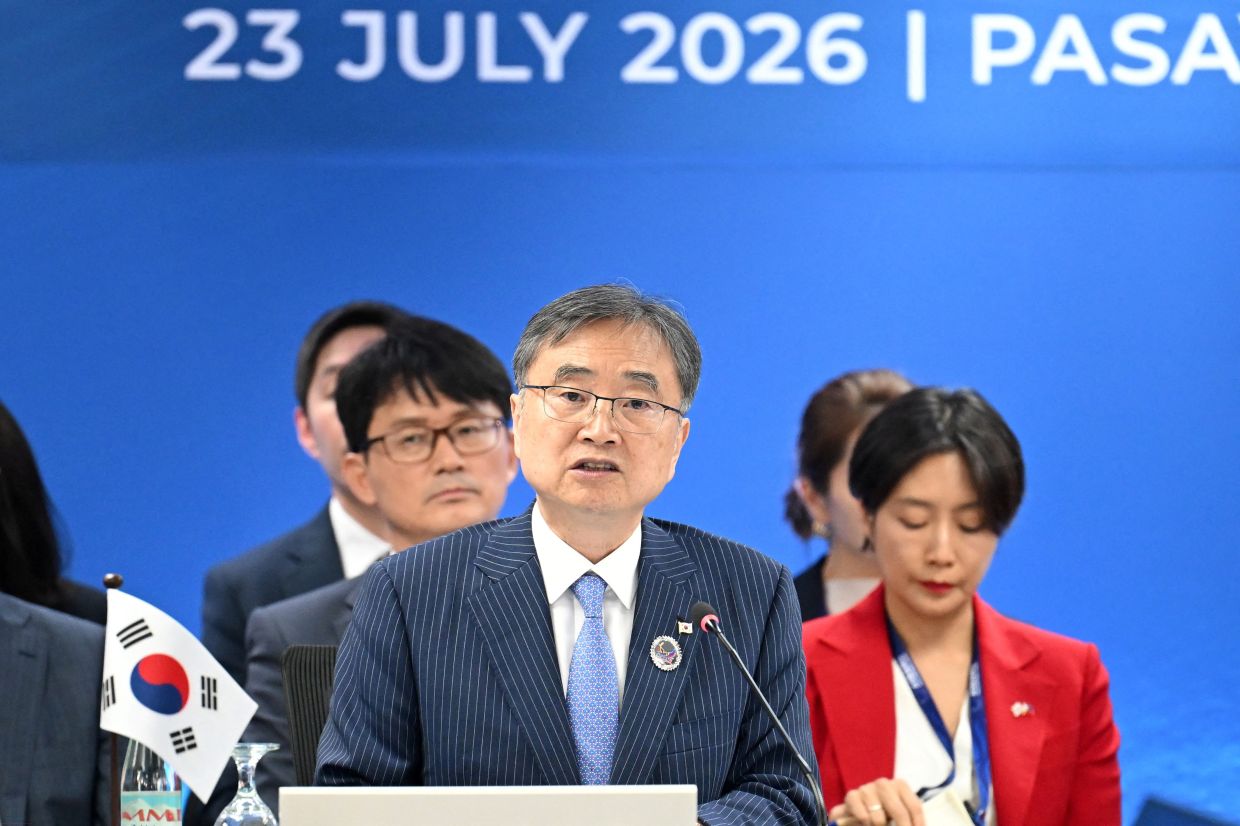
South Korea's diplomatic establishment is fractured over how best to approach North Korea, with Foreign Minister Cho Hyun and Unification Minister Chung Dong-young trading public criticism this week that exposes the fragility of President Lee Jae Myung's reconciliation strategy. The disagreement, which surfaced following a policy meeting with Lee on Wednesday, signals that Seoul's courtship of Pyongyang faces significant obstacles not just from the North but from within the government itself.
Chung's initiatives, presented at the meeting, centred on a four-party dialogue mechanism bringing together the two Koreas, the United States, and China—a proposal Cho swiftly dismissed as lacking grounding in reality. Speaking to journalists, Cho characterised Chung's vision as "idealistic" and suggested that other ministries had not endorsed the approach, effectively undermining his cabinet colleague's standing with the media and public. Chung struck back the following day with a philosophical riposte, arguing that idealism was precisely what was needed to transform entrenched realities. The exchange, while couched in diplomatic language, represented an unusually blunt airing of disagreement at the ministerial level, normally reserved for confidential inter-agency discussions.
The substance of their quarrel reflects deeper uncertainty about the direction of Seoul's North Korea policy. Since Lee took office, his administration has fundamentally reoriented its approach, moving away from the traditional "denuclearisation-first" framework that prioritised dismantling Pyongyang's weapons arsenal as a precondition for engagement. In its place, Lee has championed a "peace-first" strategy that emphasises dialogue and reconciliation over maximalist demands. This shift has included appeals to US President Donald Trump to broker direct talks between Washington and North Korean leader Kim Jong Un, signalling Seoul's hope that American diplomatic overtures might unfreeze a frozen relationship.
Yet the public disagreement between Cho and Chung suggests that consensus remains elusive even among Lee's own cabinet. When both ministries were subsequently asked about their contrasting positions, they offered only a bland statement of continued coordination without clarifying how substantive differences would be resolved. The presidential Blue House similarly declined to offer immediate clarification, a non-answer that itself communicates disarray. For Seoul's diplomatic initiatives, such visible internal division is more than an embarrassment; it is strategically damaging.
Analysts warn that Pyongyang will interpret these cracks in Seoul's united front as evidence that Lee's government cannot deliver on commitments. Lim Eul-chul, a Korea expert at Kyungnam University, noted that the public squabble "exposed internal differences and weakening policy momentum," and suggested that North Korean leadership would view the divisions as an indication that any agreements reached with South Korea could easily be reversed by subsequent administrations or ministerial shifts. This perception, rooted in historical experience of policy reversals whenever South Korea's presidency changed hands, creates a credibility problem that even the most conciliatory gestures cannot overcome.
The context for this diplomatic turbulence is grim. Relations between Seoul and Pyongyang have deteriorated markedly since the COVID-19 pandemic. In 2024, Kim Jong Un announced that North Korea was abandoning the long-standing reunification objective entirely, and subsequently demolished inter-Korean joint projects on its own soil—a powerful symbolic rejection of the possibility of cooperation. Dialogue has largely ceased, and the physical barrier at the border has been tightened with enhanced surveillance systems that have nearly choked off the human escape routes North Koreans historically used to flee South.
The human toll of this isolation is measurable. Just 63 North Korean defectors crossed into the South during the first half of 2026, a precipitous collapse compared to the 1,047 who made the journey in 2019. This sevenfold decline reflects both improved North Korean border controls and the diminished appetite among would-be refugees to risk a crossing when geopolitical prospects look bleaker. Seoul, meanwhile, has made unilateral concessions in hopes of signalling peaceful intent, halting anti-North propaganda broadcasts and dismantling loudspeaker systems that once transmitted messages across the border. Yet Pyongyang has largely ignored these overtures, suggesting that tactical gestures cannot substitute for fundamental breakthroughs in negotiating positions.
Lee's pivot toward engagement over confrontation has also created friction within South Korea's civil society, particularly among human rights advocates who fear that diplomatic pragmatism is being purchased at the expense of principle. While Seoul co-sponsored a United Nations resolution addressing North Korean human rights abuses last year, observers note that the government has gradually downgraded human rights as a policy priority to avoid antagonising Pyongyang. This recalibration has included suspending certain rights monitoring reports and curtailing broadcasts aimed at raising awareness of conditions inside North Korea. Kim Tae-Hoon, former head of the advocacy organisation PSCORE, which campaigns for North Korean human rights, described the shift as devastating to fundraising efforts, with donors increasingly reluctant to support work that the government itself appears to have deprioritised.
This tension between engagement and advocacy reflects a fundamental dilemma embedded in Lee's strategy: reconciliation with Pyongyang may require abandoning or at least subordinating the pursuit of accountability for human rights violations, creating an implicit trade-off between dialogue and justice. Conservative critics of Lee's approach have contrasted his conciliatory stance unfavourably with that of his more hawkish predecessor, who combined engagement with stronger pressure on North Korea over its human rights record. Whether Lee's softer approach ultimately proves more effective remains uncertain, but the public ministerial clash and the erosion of human rights advocacy suggest that the strategy is incurring costs not yet offset by diplomatic breakthroughs.
For Malaysia and other Southeast Asian nations observing Korea's diplomatic stalemate, the episode carries several lessons about the limits of unilateral conciliation when dealing with adversaries motivated by fundamentally opposed strategic objectives. North Korea's explicit rejection of reunification signals that the regime no longer sees value in the ambiguous coexistence that previously characterised inter-Korean relations. Under such conditions, Seoul's attempt to restart dialogue through incremental gestures and policy shifts faces structural barriers that internal coordination and ministerial consensus cannot overcome. Until Pyongyang signals a genuine shift in its underlying strategic calculus, South Korea's diplomatic efforts, however sophisticated in execution or unified in intent, may remain largely ineffective.

