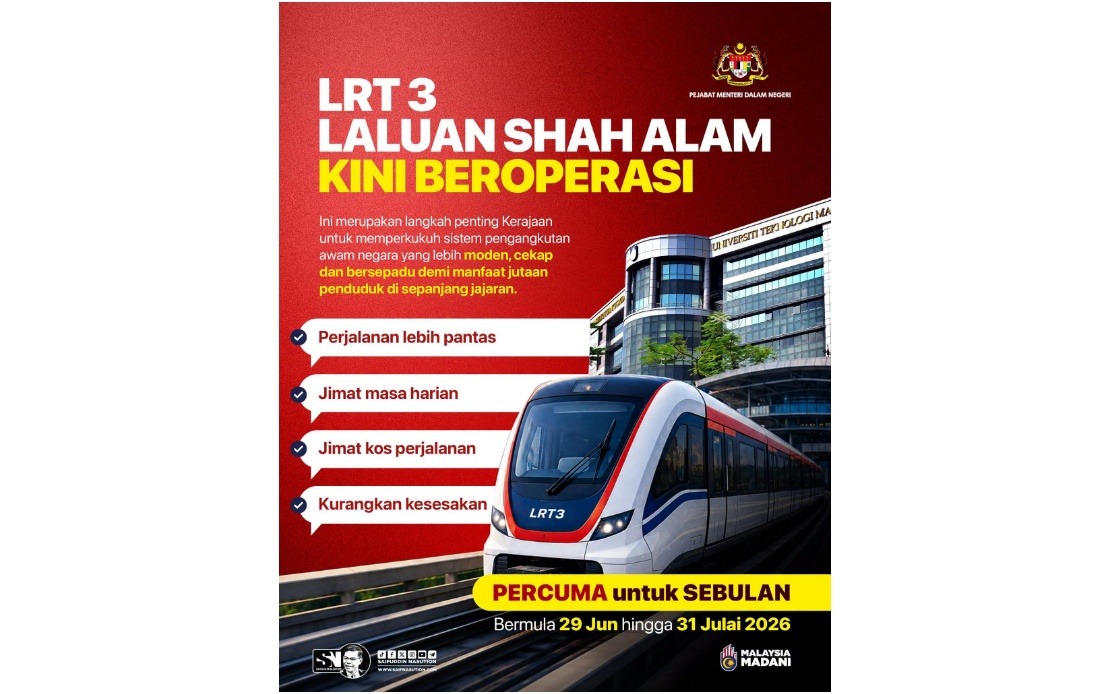
The recently launched Shah Alam Line LRT3 represents a significant milestone in the MADANI Government's infrastructure ambitions, according to Home Minister Datuk Seri Saifuddin Nasution Ismail, who characterised the project as emblematic of the administration's broader commitment to transforming Malaysia's public transport landscape. Speaking from Shah Alam on July 1, Saifuddin underscored how the new line addresses longstanding transportation challenges affecting millions of commuters in one of the nation's most congested urban corridors.
The Klang Valley has long struggled with gridlock during peak hours, creating bottlenecks that waste countless hours of productivity and inflate operating costs for businesses and individual commuters alike. By introducing the Shah Alam Line LRT3, authorities have moved to tackle this structural problem through investment in rail infrastructure rather than relying solely on road expansion, a strategic shift that reflects evolving thinking about urban mobility in Southeast Asia's most developed economies. The project specifically targets the dense travel corridors linking Shah Alam, Klang, and Subang—districts that generate substantial daily commuter flows toward Kuala Lumpur and its business districts.
Beyond merely alleviating congestion, the new line delivers tangible economic benefits to users through reduced travel expenses and time savings that accumulate across thousands of daily journeys. For workers commuting between residential areas and employment centres, students traveling to campuses, and individuals managing errands across the metropolitan region, the LRT3 fundamentally alters the cost-benefit calculation of public versus private transport. Saifuddin emphasised that these improvements directly enhance the quality of life for ordinary Malaysians, a central tenet of the MADANI framework, which prioritises human-centric development.
The government's decision to offer free fares during the inaugural month reflects confidence in the service's eventual viability while simultaneously removing barriers to trial adoption. Prime Minister Datuk Seri Anwar Ibrahim announced this complimentary period, running from June 29 through July 31, during the official launch ceremony, extending the offer to Prasarana Malaysia Bhd's feeder bus services that connect neighbourhoods to LRT stations. This integrated approach recognises that effective public transport requires seamless connections between rail and bus networks, eliminating the fragmentation that historically deterred users in Malaysian cities.
The free-fare strategy serves multiple purposes within the government's broader transport vision. Operationally, it generates usage data that helps planners refine scheduling and service frequency based on genuine demand patterns rather than projections. Psychologically, it removes the single most cited barrier to public transport trial—cost—enabling residents who might otherwise dismiss rail travel as inconvenient or expensive to form personal experience-based judgments. Saifuddin's explicit appeal for residents to temporarily abandon private vehicles demonstrates recognition that behaviour change requires both practical inducements and cultural messaging.
For Malaysia's regional standing, the LRT3 project positions the country competitively within Southeast Asia's evolving metropolitan development landscape. Cities across Thailand, Vietnam, and Indonesia have accelerated rail and rapid transit investments in recent years, and Malaysian authorities appear determined to ensure that domestic infrastructure remains world-class. The Shah Alam Line operates within international standards for safety, comfort, and frequency, potentially influencing future ridership patterns and establishing expectations for subsequent projects across other Malaysian cities.
The feeder bus component deserves particular attention, as it addresses a critical weakness in many Asian metropolitan transit systems: the first-mile and last-mile connectivity problem. Even excellent rail infrastructure becomes inaccessible to substantial populations if bus networks fail to efficiently deliver passengers to stations. By ensuring coordinated service between LRT3 and Prasarana feeder routes, authorities have constructed a more coherent transport ecosystem than would result from rail investment in isolation. This integration proves especially important in Shah Alam and Klang, where residential sprawl necessitates bus connections to concentrate dispersed populations onto rail corridors.
Saifuddin's characterisation of the project as a strategic investment rather than a subsidy reveals the government's framing of public transport as foundational infrastructure deserving public resources. This positioning acknowledges externalities—reduced emissions, lower accident rates, decreased road maintenance demands—that markets alone do not price into private transport decisions. By funding rail expansion through the public purse, the government internalises these benefits across society, an economic logic that underpins infrastructure policy in wealthy nations but remains contested in developing contexts.
The one-month free-fare period also functions as an implicit test of the line's long-term financial sustainability. Usage patterns established during July will inform pricing strategies for August onwards, potentially revealing demand elasticity and ridership composition. If the free period generates sufficient volume and transit authority data suggests operational viability at modest fares, the project strengthens the case for expanded rail investment. Conversely, disappointing uptake would prompt difficult questions about project design and market conditions.
For Malaysians employed or studying in the Shah Alam, Klang, and Subang areas, the LRT3 opening creates immediate practical changes to daily routines. Commutes that previously consumed an hour or more may condense to thirty minutes, freeing time for rest, productivity, or family engagement. Fuel expenditures and vehicle maintenance costs decline correspondingly, directing household resources toward other consumption or savings. These distributional effects matter most for lower-income commuters, who spend disproportionate shares of earnings on transport, making the LRT3 potentially transformative for equity alongside efficiency.
The broader policy implication centres on whether the LRT3's success will trigger accelerated expansion of rail networks to other Malaysian urban corridors. Demand clearly exists for improved public transport across Penang, Johor Bahru, and Selangor's outer regions, yet capital constraints and competing priorities limit simultaneous development. Should the Shah Alam Line establish strong ridership and operational performance, it will provide political and economic justification for subsequent projects, potentially reshaping Malaysian cities toward denser, less automobile-dependent development patterns over coming decades.

