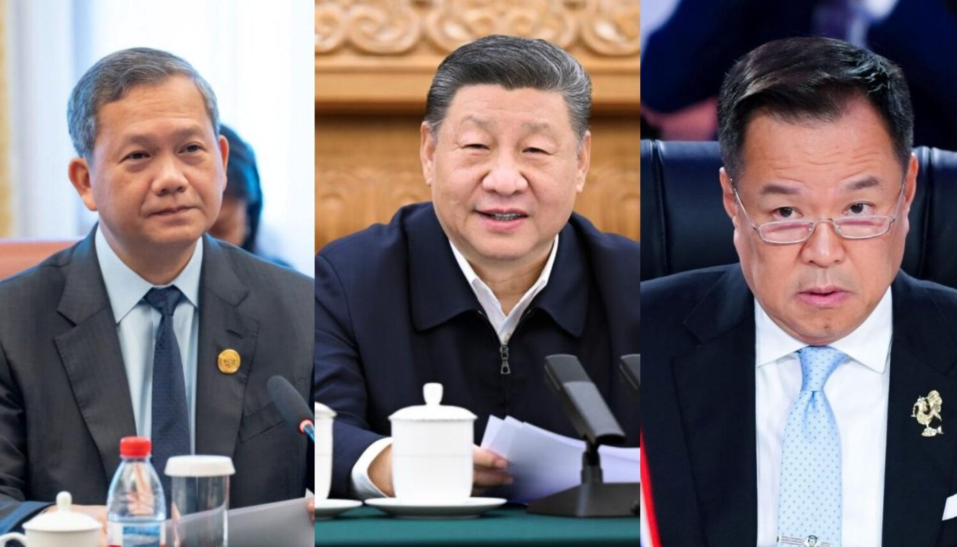
Cambodia and Thailand will send their premiers to Shanghai next month for what could become a pivotal moment in efforts to resolve their lingering border dispute. Hun Manet and Anutin Chanvirakul are both scheduled to attend the opening session of the World AI Conference 2026: WAIC on July 17 at the invitation of Chinese President Xi Jinping, presenting Beijing with a rare opportunity to exert diplomatic pressure on both governments to return to the negotiating table after seven months of silence.
The Cambodian delegation will include some of the country's most senior officials beyond the prime minister. Foreign Minister Prak Sokhonn and Defence Minister Tea Seiha are confirmed to attend the July 15-17 visit, along with Sun Chanthol, first vice-chairman of the Council for the Development of Cambodia (CDC). Thailand's Foreign Minister Sihasak Phuangketkeow is expected to accompany Anutin. Both premiers will separately meet with Xi as well as Chinese Premier Li Qiang, underlining Beijing's commitment to engaging both nations at the highest levels.
For Cambodia, the visit carries significant symbolic weight. Phnom Penh's official statement emphasised the opportunity to deepen the "long-standing friendship" with China and advance the Comprehensive Strategic Partnership of Cooperation, the Diamond Cooperation Framework, and what it described as an "all-weather Cambodia-China Community with a Shared Future." Thailand's readout similarly stressed strengthening bilateral ties through their Comprehensive Strategic Cooperative Partnership. These carefully worded diplomatic statements reveal how both countries view China not merely as a conference host, but as a crucial economic and strategic anchor.
The timing is significant given that Hun Manet and Anutin last crossed paths at the Asean Future Forum in Hanoi during early June, where cameras captured them shaking hands in a brief moment of theatre that masked a complete absence of substantive engagement on their most pressing shared problem. That choreographed encounter highlighted the impasse: the premiers can maintain diplomatic civility, but lack the political will or mutual trust necessary to make genuine progress. The Shanghai conference offers a chance to break that pattern, assuming Beijing is prepared to apply its considerable leverage.
Analysts observing the dispute increasingly believe that China will deploy its position as a major trading partner for both nations to nudge them toward resolution. Cambodia depends heavily on Chinese investment and infrastructure development, while Thailand values Beijing's role as a stabilising regional power. This mutual economic interdependence gives Xi Jinping considerable scope to encourage both leaders to move beyond posturing. The question remains whether quiet corridors and private meetings at the conference will translate into actual diplomatic momentum or merely produce another round of photo opportunities and non-committal statements.
Kin Phea, director of the International Relations Institute at Cambodia's Royal Academy, has identified the core impediment to progress: those who "actually hold power" in Thailand, particularly the military establishment. According to Phea, Thailand's civilian government agreed to measures with Cambodia during earlier negotiations, but the Thai military has refused to implement them and continues to encroach on Cambodian sovereign territory. This civil-military divide within Thailand complicates any diplomatic solution, as agreements reached with civilian leadership may lack enforcement power if military commanders choose to ignore them.
Phea has called explicitly for China to assume a more activist mediating role rather than remaining a passive observer. "China should push for both countries to meet for talks and solve the issue peacefully, through diplomatic paths or other consultation effort, based on international law," he said. Beyond mere encouragement, he urged Beijing to function as an "arbitrator" capable of imposing consequences or incentives that compel compliance. This represents an unusually direct appeal for external intervention in what technically falls within Asean's domain, reflecting the desperation of analysts seeking any mechanism to restart dialogue.
The foundation for such intervention arguably exists in the Fuxian Consensus, a Chinese-brokered agreement reached in December 2025 that laid out principles for managing the dispute. However, the consensus has remained largely aspirational rather than operational. Phea stressed that Thailand must "be forced to respect" that agreement by withdrawing military forces from occupied areas, returning to formal negotiations, and engaging the Joint Boundary Commission (JBC) without further delay. The blunt language reflects frustration that diplomatic niceties have failed to move Thailand toward compliance.
The humanitarian dimension of the standoff cannot be overlooked. Approximately 20,000 Cambodian civilians remain displaced from their homes in territories under Thai military control, representing one of Southeast Asia's most intractable humanitarian crises. These communities have endured years of separation from their land and livelihoods, with little international attention relative to the scale of suffering. A breakthrough in Shanghai could eventually unlock their return, making the conference more than merely another diplomatic gathering.
For Malaysia and other Asean members, the outcome carries implications beyond Cambodia and Thailand. Should China successfully broker a settlement, it would demonstrate Beijing's capacity to resolve intra-regional disputes through sustained diplomatic engagement, potentially positioning China as Asean's preferred mediator for future conflicts. Conversely, if the Shanghai meeting produces only ceremonial gestures while the underlying dispute persists, it would signal that even China's economic leverage cannot overcome the structural obstacles to resolution—a sobering lesson for any regional mechanism attempting to manage contentious territorial questions.
The conference thus represents a testing ground for several competing propositions: whether high-level summitry can revive stalled negotiations, whether military establishments will defer to civilian diplomats, and whether China's regional influence can translate ideological commitment into concrete results. All three questions will ultimately determine not just the fate of two governments' bilateral relations, but the broader question of how Asian powers manage their territorial disagreements in an era of competing great power influence.

