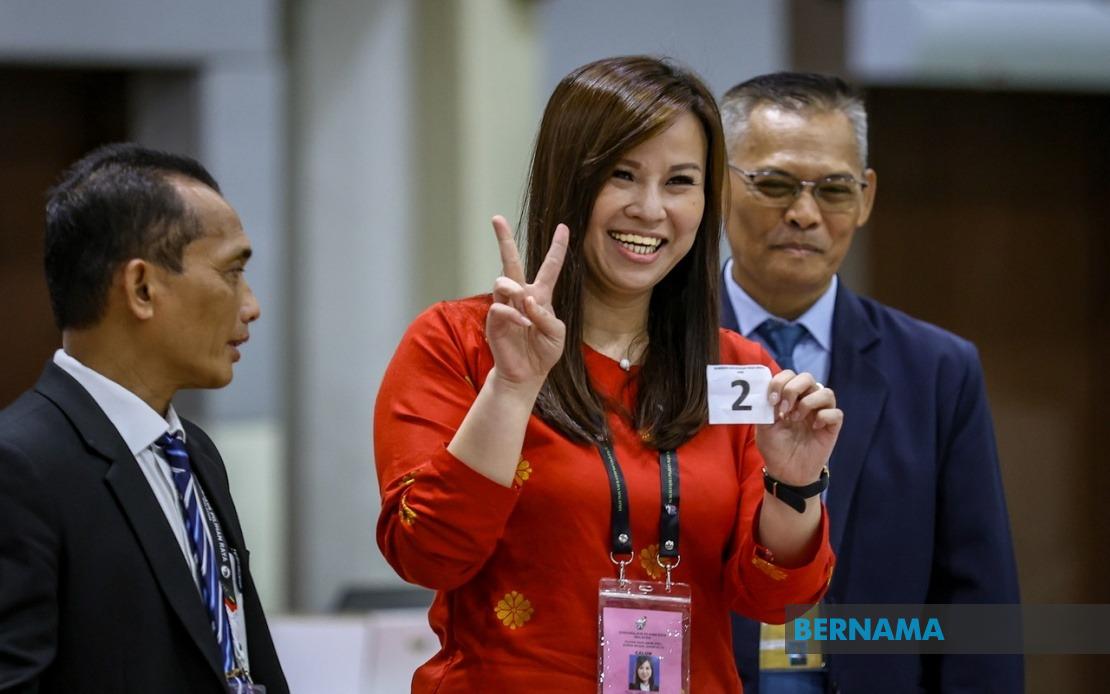
Sharon Teo has launched her campaign for the Permas state seat in Johor's 16th state election by zeroing in on two priorities that resonate across the constituency: improving road conditions and strengthening public welfare support. The Pakatan Harapan candidate, who chairs the Johor Amanah Women's Youth wing, articulated these commitments following the nomination process held at Dewan Muafakat in Taman Mawar, signalling that her platform is rooted in practical concerns raised repeatedly by voters during her ground engagements.
Road safety and infrastructure quality have emerged as central issues in Teo's message to constituents, framing the matter as one of public safety rather than mere convenience. Her emphasis suggests that the current condition of roads in Permas may be a vulnerability for the sitting government, and an opening through which an opposition candidate can build credibility. The strategy reflects a broader pattern among challenger candidates in Malaysian elections, who often focus on locally-felt grievances that national-level successes may overshadow. For residents navigating daily commutes or facing safety hazards, such immediate concerns frequently outweigh broader policy narratives.
Teo's background provides some foundation for her candidacy. She previously worked as an aide in the Pulai parliamentary constituency under Salahuddin Ayub, the late Amanah deputy president, giving her experience within the Amanah machinery and familiarity with parliamentary-level operations. This track record positions her as someone with institutional knowledge of how to operate within the opposition coalition, though it also means voters will be assessing whether she can translate that experience into tangible results at the state level. She has indicated that a comprehensive manifesto detailing her vision and mission will be released soon, suggesting the campaign is still in its early phases.
Defending the seat is Baharudin Mohamed Taib, the Barisan Nasional incumbent who secured the Permas mandate in the 2022 Johor election. His acknowledgement that each opponent brings distinct strengths signals a realistic assessment of the competitive environment, even as he expresses determination to hold the seat for the coalition. Baharudin's decision to forgo a personal manifesto in favour of adhering to broader Barisan Nasional platform guidance reflects the traditional approach of ruling-coalition candidates, who prioritise party unity and messaging consistency over individual differentiation. This approach can be double-edged: it ensures alignment with party strategy but may limit his ability to address constituency-specific concerns in ways that distinguish him from his competitors.
The Permas constituency presents a complex electoral landscape dominated by four candidates competing across different political alignments. Beyond Teo and Baharudin, T. Vela represents Perikatan Nasional while Dr Zamil Najwah stands for Parti Bersama Malaysia, a newer political force in Malaysian electoral contests. This four-cornered contest fractures the opposition vote, potentially advantaging the incumbent if supporters are divided between multiple challengers. The presence of Bersama, in particular, adds unpredictability; newer parties can absorb protest votes or dissatisfied Barisan supporters seeking an alternative without crossing to established opposition coalitions.
Demographically, Permas encompasses 113,963 eligible voters, a substantial electorate that spans diverse communities within the Pasir Gudang parliamentary constituency. The Johor south location places it within an industrial and commercial heartland, meaning voter concerns likely extend beyond traditional rural issues to encompass labour conditions, environmental quality, and urban service delivery. Road infrastructure in such areas carries additional weight, as congestion and safety directly impact commercial activity and worker mobility. Understanding these economic dimensions helps explain why Teo's focus on roads gains particular traction in Permas specifically.
The timing of the 16th Johor state election—scheduled for July 11 with early voting on July 7—compresses the campaign period into a matter of days. Candidates must rapidly build name recognition and conviction among voters, a challenge that particularly affects relative newcomers like Teo who lack the incumbent advantage of name familiarity and established constituency machinery. Early voting on July 7 also creates a smaller window for undecided voters to consolidate around particular candidates, potentially favouring those with stronger ground organization and voter mobilization capacity. Barisan Nasional's traditional structural advantages in such areas should not be discounted.
For Malaysian political observers, the Permas contest exemplifies broader shifts within Johor's electoral dynamics. Once a Barisan stronghold, Johor has increasingly become competitive territory where opposition parties can mount credible challenges. Pakatan Harapan's focus on infrastructure and welfare aligns with proven voter concerns in urban and semi-urban constituencies, yet the party's overall performance in Johor has been mixed. The outcome in Permas will contribute to understanding whether opposition momentum can translate into seat gains in what remains a traditionally conservative state.
The electoral significance extends beyond Johor's internal politics. The 16th state election serves as a mid-term assessment of where Johor's political landscape stands, particularly given the state's economic importance and its role in national coalition politics. A strong showing by any faction provides momentum for future contests, while losses carry consequences for internal party dynamics and coalition stability. Sharon Teo's challenge to an incumbent in this context carries weight beyond the single constituency, as Pakatan Harapan looks to demonstrate viability as an alternative government even in states where Barisan remains traditionally dominant.

