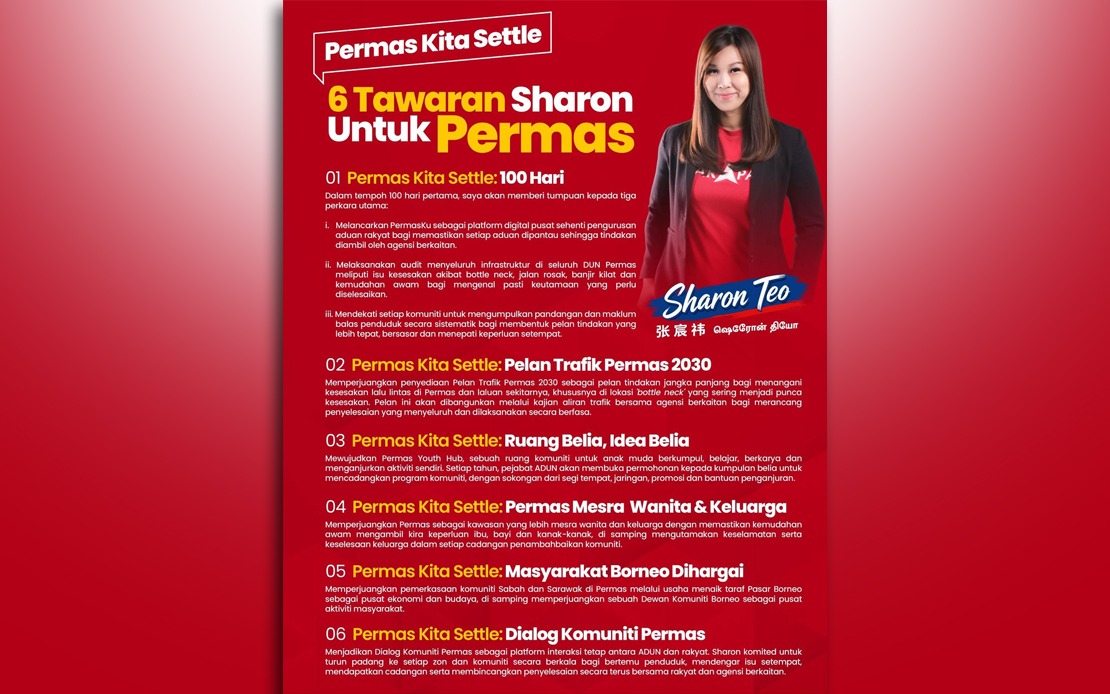
Pakatan Harapan's Sharon Teo Siew Hui has launched her campaign manifesto for the Permas state seat with six concrete pledges designed to address the constituency's most pressing concerns. The "Permas Kita Settle" platform, unveiled during a press conference in Johor Bahru, reflects months of ground-level consultation and aims to distinguish her candidacy ahead of Saturday's state election. The manifesto integrates infrastructure development, traffic management, youth programmes, family support, and community empowerment into a cohesive vision for the 113,963-strong electorate.
The centrepiece of Teo's platform tackles infrastructure deficiencies, which residents have consistently flagged as the primary challenge facing Permas. Rather than proposing generic fixes, her campaign intends to conduct a comprehensive infrastructure audit to establish a baseline for future improvements. This diagnostic approach suggests an acknowledgment that blanket promises often fail without proper needs assessment. The findings will subsequently inform the Permas Traffic Plan 2030, a targeted initiative addressing chronic congestion along the Permas Jaya to Pasir Gudang corridor—a route that daily frustrates commuters and limits economic mobility within the constituency.
Youth engagement represents a strategic priority within Teo's platform, driven by demographic realities. Those aged 18 to 39 constitute 53 per cent of Permas voters, making them decisive in any electoral outcome. Teo's proposed Permas Youth Hub would provide a physical and programmatic space for young residents to develop skills, access mentorship, and participate in civic life. This initiative reflects broader recognition across Malaysian politics that youth voters increasingly demand tangible opportunities rather than rhetorical appeals. Her emphasis on this demographic also signals an attempt to energize traditionally lower-turnout groups, particularly first-time voters who may lack established partisan loyalties.
The manifesto also incorporates family and gender considerations through initiatives aimed at making Permas more women- and family-friendly. While specific programmes remain undefined in her public statements, this plank addresses the growing importance of family-oriented policy among Malaysian voters. Women represent a significant swing demographic in state elections, and their concerns—ranging from childcare accessibility to workplace flexibility—increasingly shape electoral outcomes. By centering this dimension, Teo positions herself within a broader conversation about gender-responsive governance that extends beyond symbolic gestures.
A distinctive element of Teo's manifesto addresses the substantial Sabah and Sarawak communities residing in Johor. These migrant populations often face distinct challenges including language barriers, cultural disconnection, and limited representation in mainstream policy discourse. Her commitment to empower these communities, notably through upgrading Pasar Borneo, demonstrates recognition of Permas's multicultural composition and the political necessity of addressing minority concerns. Such targeted outreach could prove decisive in a four-cornered contest where vote fragmentation remains likely.
Teo's campaign strategy emphasizes accessibility and dialogue rather than top-down messaging. She has prioritized listening tours and community engagement, deliberately engaging voters across ethnic lines and attempting to overcome traditional partisan divisions. This approach reflects lessons from recent Malaysian elections, where voters increasingly reward candidates demonstrating genuine interest in constituent concerns over formulaic campaign rhetoric. Her commitment to assist residents "regardless of ethnicity" also carries implicit criticism of adversarial politics, positioning her as a unifier rather than a divisive figure.
The campaign environment within Permas reveals a surprisingly competitive battleground despite Baharudin Mohamed Taib's 7,926-vote majority in 2022. Teo faces three formidable opponents: the incumbent BN-UMNO representative Baharudin, Dr. Zamil Najwah representing the recently-formed Bersama Malaysia, and T. Vela from Perikatan Nasional. This four-way split creates strategic opportunities for non-incumbent challengers, particularly if opposition votes consolidate around a single candidate. Teo's appeal to fence-sitters and her emphasis on local issues over partisan platforms reflect recognition that many Permas voters remain undecided or persuadable.
Teo brings professional credentials to her candidacy through five years of service as special assistant to the late Datuk Seri Salahdudin Ayub, the Pulai MP. This background provides policy experience and established networks within the Pakatan Harapan apparatus, though it also potentially associates her with unpopular decisions or federal-level controversies. Her decision to foreground her listening approach rather than her bureaucratic experience suggests awareness that constituent service and accessibility matter more than administrative credentials to Permas voters.
The campaign tone she has adopted—emphasizing positive feedback and voter encouragement—contrasts with increasingly negative political advertising across Malaysian elections. This positioning may appeal to voters fatigued by partisan acrimony, though it also risks appearing insufficiently forceful to supporters demanding passionate advocacy. With only days remaining before polling day, Teo must maintain momentum among youth voters and undecided residents while mobilizing core party supporters to overcome the incumbent's structural advantages.
Permas exemplifies broader trends reshaping Malaysian state politics. Historically secure seats now face genuine competition as voter loyalty fragments and local governance quality becomes more decisive. The manifesto approach—focused on infrastructure, youth, and community specifics—reflects this shift toward granular, performance-based politics. Whether Teo's six pledges prove sufficient to unseat an incumbent remains uncertain, but her campaign signals how opposition candidates increasingly compete by addressing concrete constituency concerns rather than broader ideological or national narratives.

