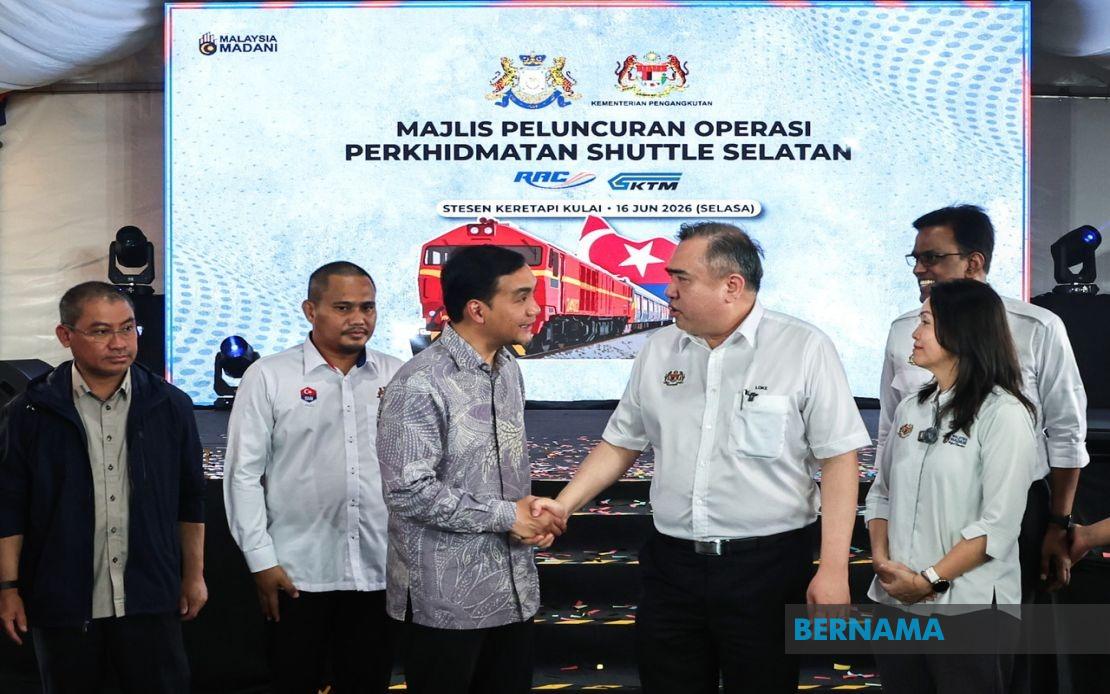
The Shuttle Selatan rail service officially commenced operations on June 16, marking a significant step forward in southern Johor's public transport infrastructure. Transport Minister Anthony Loke inaugurated the service at Kulai KTM station, with the rail link expected to serve a population exceeding two million across the three major urban centres of Kulai, JB Sentral and Pasir Gudang. The launch represents a collaborative effort between the Ministry of Transport, Keretapi Tanah Melayu Berhad (KTMB) and the Railway Assets Corporation (RAC), reflecting the growing emphasis on integrated transport planning across Malaysia's major economic zones.
The initial operational phase will focus on two primary routes designed to address commuting patterns across the region. The first route connects Kulai directly to JB Sentral and back, while the second links Kempas Baru with Pasir Gudang in a circular pattern. Both routes offer substantial time savings compared to alternative transport methods, with the Kulai to JB Sentral journey completed in approximately 40 minutes, while the Kempas Baru to Pasir Gudang stretch requires 40 to 45 minutes. These travel times position the service as a competitive alternative to private vehicle use, particularly for daily commuters traversing these corridors.
Looking beyond the immediate launch phase, government officials have articulated ambitious expansion plans that would significantly extend the service network across southern Johor. Future route extensions are intended to reach from Paloh through to Kulai, encompassing intermediate stations at Kluang, Renggam and Layang-Layang. This strategic approach reflects a recognition that sustainable growth in the region requires connectivity reaching beyond the three primary urban centres, potentially linking smaller towns and rural communities into the broader transport ecosystem. Additionally, three new stations are being planned—Taman Daya, Bandar Baru Sri Alam and Pasir Putih—to enhance accessibility and ensure that a wider demographic gains access to rail-based public transport infrastructure.
To address the persistent challenge of first-and last-mile connectivity that often discourages public transport adoption, the government has implemented a comprehensive supporting infrastructure framework. This includes dedicated feeder bus services that connect residential areas to shuttle stations, coordinated routing through the Bas.My platform to streamline transfers, a dedicated shuttle service operating from Kempas Baru station, and park-and-ride facilities located at AEON Bandar Dato' Onn. These complementary measures acknowledge that rail services alone cannot solve last-mile problems and require an ecosystem of integrated transport options.
Incentivising behavioural change towards public transport adoption has been central to the government's rollout strategy. The Commuter MADANI Shuttle Selatan Card represents a direct approach to encouraging ridership, with 3,000 cards distributed at no cost to Johor residents. The card itself permits unlimited travel for a specified period at face value of RM50, effectively subsidising early adopters. Behind this initiative, the RAC has committed over RM150,000 as financial incentive to stimulate the transition away from private vehicles. This targeted subsidy approach aims to overcome initial hesitation and build ridership momentum during the critical launch phase.
Johor's positioning as one of Malaysia's fastest-growing states underpins the strategic importance of Shuttle Selatan within the state's broader development trajectory. The state's expanding industrial base, logistics capabilities, port operations, educational institutions and trading activities all generate significant commuting demands that conventional transport infrastructure has struggled to accommodate efficiently. Transport Minister Loke explicitly framed the shuttle service as a solution designed to strengthen connectivity between residential communities, commercial city centres and key industrial zones, recognising that these three components form an interdependent ecosystem.
The involvement of Johor's state leadership reinforced the project's significance within provincial governance priorities. Johor Menteri Besar Datuk Onn Hafiz Ghazi and Mohamad Fazli Mohamad Salleh, chairman of the Johor Public Works, Transport, Infrastructure and Communications Committee, both attended the launch ceremony, signalling strong political backing. This senior-level participation suggests that transport connectivity is considered integral to Johor's economic competitiveness and quality of life improvements for residents.
The service's emphasis on speed and comfort differentiates it within Malaysia's existing public transport landscape. By offering journey times competitive with private vehicles whilst providing a more comfortable experience through dedicated rail infrastructure, Shuttle Selatan targets a demographic that might otherwise default to personal car use. This positioning becomes increasingly important as congestion costs and environmental concerns mount in rapidly urbanising regions like southern Johor.
For Malaysian commuters more broadly, the Shuttle Selatan launch demonstrates the government's commitment to expanding rail-based public transport beyond the Klang Valley and Penang. The service represents a test case for applying integrated transport planning principles to regions outside Malaysia's metropolitan core, with potential implications for other high-growth states. Success in Johor could establish a model for replicating similar shuttle services in other economically dynamic regions facing congestion and mobility challenges.
The implementation framework combining government coordination, statutory rail operators and dedicated funding mechanisms reflects a maturing approach to public transport development in Malaysia. Rather than relying on a single operator or funding source, the multi-stakeholder structure allows for distributed responsibility and shared accountability. This collaborative model may inform future transport initiatives across Southeast Asia, where rapid urbanisation and industrial growth create similar connectivity pressures.
Sustainability considerations underpin the economic logic of Shuttle Selatan beyond simple convenience metrics. Shifting commuters from private vehicles to rail transport generates benefits through reduced traffic congestion, lower emissions and decreased demand for parking infrastructure. These externalities, whilst difficult to quantify directly, represent genuine economic gains to the broader Johor community by reducing congestion costs and improving air quality across the three primary service areas.