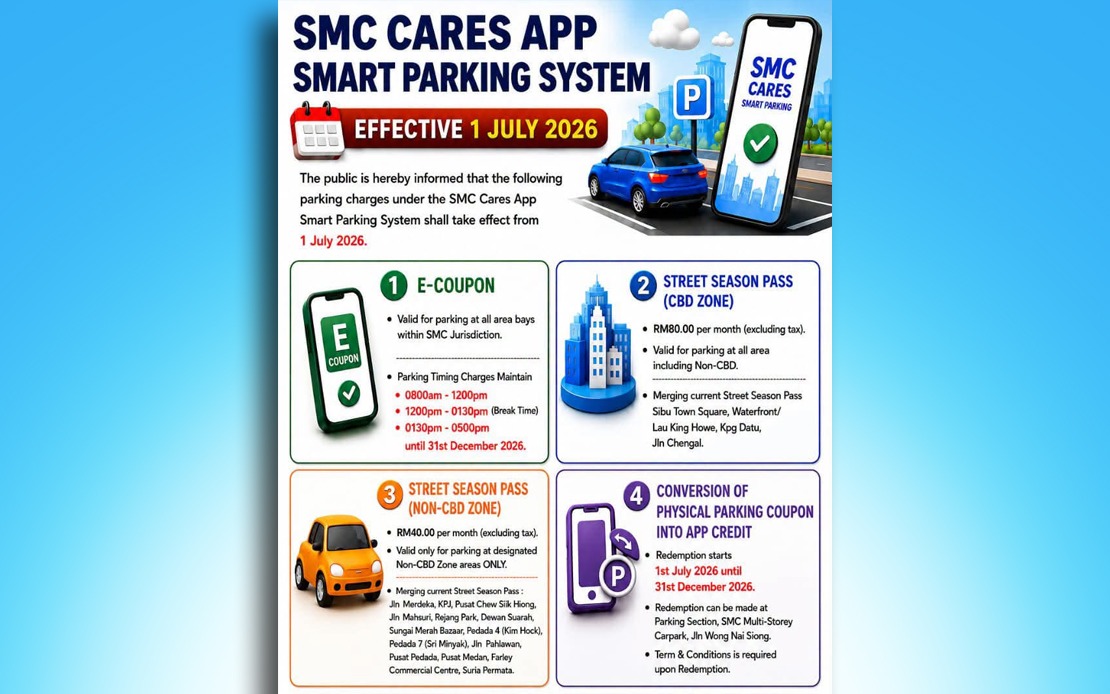
The Sibu Municipal Council has moved to ease tensions surrounding its relatively new digital parking enforcement system by introducing a grace period and additional concessions aimed at making the technology more accessible to ordinary motorists and elderly residents. The announcement signals a pragmatic retreat from the council's initial implementation approach, which triggered significant community pushback after the SMC Cares Smart Parking system went live earlier this month with little tolerance for payment delays.
SMC Chairman Clarence Ting Ing Horh disclosed that the council has instructed its technology partner, Primal Solution Sdn Bhd, to programme a five to ten-minute buffer into the system before Over Parking Notices are automatically generated. This grace window is designed to give drivers reasonable time to complete the physical act of parking, exit their vehicle, and navigate the mobile application—a sequence that proved problematic for many users during the system's rollout. The chairman's acknowledgment that users required this adjustment time represented a tacit admission that the original implementation had not adequately accounted for real-world usage patterns and the practical limitations of relying on smartphone transactions for enforcement.
Equally significant is the council's plan to introduce a dedicated Senior Citizen Parking Pass programme for drivers aged 60 and above, set to launch in August with detailed terms to follow. This recognition of demographic challenges reflects growing awareness that elderly residents often struggle with digital payment systems and mobile applications, a reality particularly acute in Malaysia where technology adoption among seniors remains uneven. The initiative could serve as a model for other Malaysian municipalities wrestling with similar public relations challenges as they digitise formerly manual services.
Ting emphasised that the council welcomed public input and encouraged residents to lodge grievances directly through official channels rather than amplifying complaints through social media, where misinformation can spread rapidly. He acknowledged that motorists believing they had received unjust penalties could appeal to the council for review, with the council maintaining photographic evidence for all issued notices stored within the system itself. This appeals process provides a recourse mechanism, though it places the burden on drivers to contest notices rather than the council proactively investigating problematic enforcement patterns.
The chairman also clarified the division of enforcement responsibilities, explaining that parking wardens contracted by the system provider could only address parking-related violations such as unpaid fees, expired time allocations, and overstaying. Enforcement against genuinely illegal parking—such as obstruction of traffic flow or disabled bay violations—remained the exclusive domain of the SMC's internal enforcement division and police authorities. This distinction matters because social media allegations had conflated all parking-related compounds as potentially improper, a narrative Ting sought to correct by emphasising the contractual boundaries governing the private enforcement partner.
The council has also mandated that its contracted parking wardens adopt a more service-oriented posture, instructing them to assist members of the public unfamiliar with the application mechanics rather than adopting an enforcement-first mindset. Additionally, wardens have been prohibited from wearing face coverings except when medically necessary, a practical step aimed at increasing public trust through improved personal identification and approachability. These behavioural adjustments acknowledge that enforcement technology functions more effectively when accompanied by human support systems rather than purely algorithmic penalty distribution.
To address the technical and usability complaints that dominated initial feedback, SMC established a dedicated support counter at the Sibu Public Library staffed to guide residents through registration and application use. This physical interface for digital system support recognises that many citizens, particularly less tech-savvy users, benefit from in-person instruction rather than relying solely on help functions embedded within applications. The provision of human intermediaries to support digital service adoption reflects best practice in technology implementation within government contexts.
Regarding allegations that Sibu's parking charges represented the highest in Sarawak, Ting contended that comparative analysis demonstrated the city's rates remained competitive against other local authorities across the state. He further clarified the financial mechanics, noting that all revenue collected through smart parking flows directly to SMC's municipal coffers, while Primal Solution receives separate remuneration under a distinct service contract. This transparency addressing revenue allocation counters a common suspicion in such arrangements that private partners unduly profit at the public's expense.
The system has achieved notable adoption metrics, recording over 93,000 registered users since inception, with the council projecting registrations would exceed its original target of 100,000 by year-end. These figures suggest that despite public complaints, the underlying technology has achieved substantial penetration. The distinction between adoption rates and user satisfaction proves instructive: many residents have registered, yet the system's operational difficulties and enforcement approach generated sufficient frustration to produce coordinated social media criticism, forcing this policy recalibration.
The complaints catalogue that prompted these adjustments reveals sophisticated user experience issues extending beyond parking grace periods. Users reported complications during registration, a notably unfriendly interface particularly challenging for seniors, sluggish system performance, unexpected session terminations, payment processing delays, and premature penalty issuance before transactions completed. These technical problems compound the behavioural challenge of adapting to digital parking enforcement, suggesting the original system design and deployment lacked adequate user testing or staged implementation phases.
For Malaysian municipalities contemplating similar smart parking transitions, Sibu's experience offers valuable cautionary insights. The initial public resistance and subsequent policy concessions demonstrate that technological capability alone proves insufficient; implementation strategy, user interface design, stakeholder communication, and graduated enforcement approaches significantly influence acceptance. The grace period and senior citizen provisions represent relatively low-cost adjustments that substantially improved the system's social legitimacy, suggesting that early consultation and iterative refinement yield better outcomes than rigid, unmodified rollouts.
The broader context involves Malaysia's accelerating shift toward digital municipal services and enforcement mechanisms. As local authorities throughout the country consider comparable smart parking, licence plate recognition, and automated penalty systems, the Sibu experience underscores the importance of balancing technological efficiency with public accessibility and fairness perceptions. The council's willingness to modify its approach demonstrates that digital governance need not prove inflexible; responsiveness to legitimate user concerns can enhance both compliance and public trust in municipal administration.

