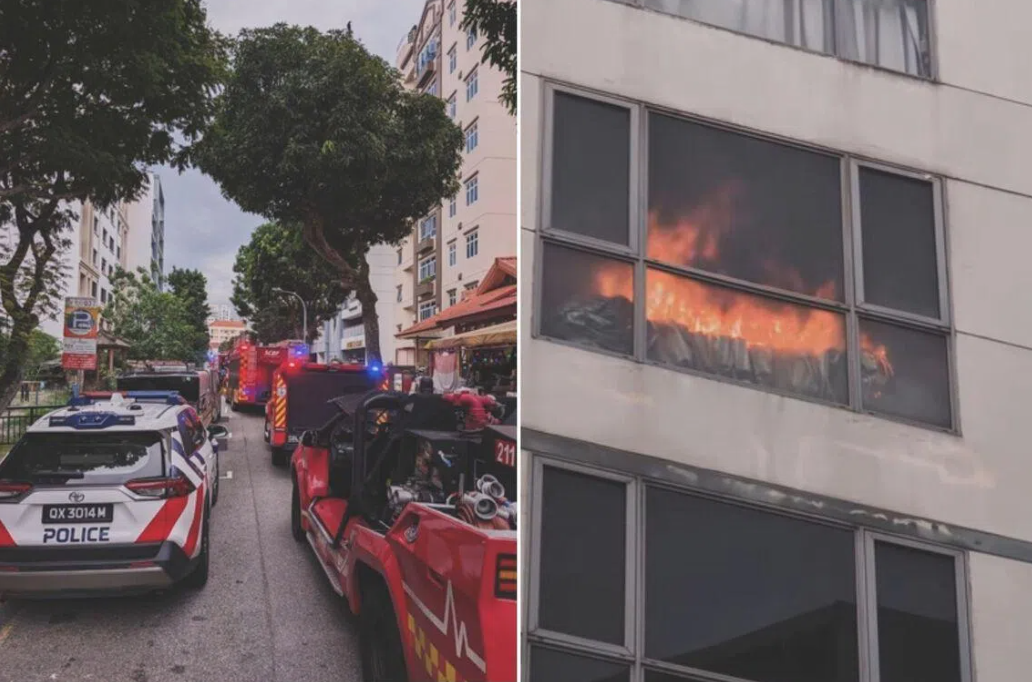
Five residents were forced to leave their homes after a power-assisted bicycle (PAB) battery ignited while charging unattended in a seventh-floor unit at Casa Aerata condominium in Geylang on Sunday afternoon. The Singapore Civil Defence Force (SCDF) responded to the alarm at 9 Lorong 26 Geylang at 5.35pm, where the fire had broken out in the living room of the affected unit. Emergency personnel evacuated neighbouring residents as a precautionary step, though fortunately nobody sustained injuries in the incident.
The rapid response by authorities helped contain the blaze before it could spread further through the residential block. SCDF personnel deployed a hosereel and a compressed air foam backpack to suppress the flames, bringing the fire under control. Initial investigations by the fire brigade determined that the ignition originated from electrical faults within the PAB battery system itself. The intensity of the fire was sufficient to cause thermal damage to windows in the unit, with glass eventually shattering from the extreme heat generated inside.
Cai Yinzhou, the Member of Parliament representing Bishan-Toa Payoh GRC, arrived at the scene after observing smoke and hearing emergency sirens in the vicinity. He took it upon himself to clear the area beneath the burning unit in anticipation of falling debris and glass, demonstrating the seriousness with which the incident was treated by officials on the ground. His swift action helped ensure public safety during the critical moments when the fire was still being contained.
The incident has reignited concerns about the safe use and charging practices for active mobility devices (AMDs) across Singapore and the broader Southeast Asian region. The SCDF has once again reminded the public about critical safety precautions, particularly the danger of using non-original or third-party batteries when charging PABs, personal mobility devices (PMDs), and related equipment. These aftermarket batteries often lack the safety certifications and quality controls present in manufacturer-approved units, making them substantially more prone to thermal runaway and combustion.
Equally important is the charging behaviour that users adopt. The SCDF explicitly warned against charging PAB and PMD batteries for extended periods or overnight while unattended. Such practices leave no opportunity for users to respond immediately if a battery begins to malfunction or overheat. Leaving a battery charging in living areas, particularly in confined residential spaces like apartment units, concentrates the risk in occupied zones where fires can spread rapidly to furniture, curtains, and other combustible materials.
Statistics from early 2025 underscore the growing challenge that battery fires present for Singapore's fire services. The SCDF recorded 304 electrical fires at residential premises during the first months of the year, with 34 of these originating from active mobility devices. While the overall number of AMD-related fires showed a modest decline—dropping from 67 incidents in 2024 to 49 in 2025—this aggregate improvement masks troubling trends within specific categories. Personal mobility device fires, which include e-scooters and similar devices, actually increased from 25 incidents to 31 during the same comparative period, suggesting that certain categories of powered devices pose escalating fire risks.
For Malaysian readers, this incident carries particular relevance given the rapid proliferation of electric-powered mobility solutions across the region. Shared PAB and PMD schemes have expanded into cities such as Kuala Lumpur, Penang, and Johor Bahru, creating growing stocks of batteries that require regular charging in residential and commercial settings. The same safety practices that Singapore authorities now emphasise—restricting the use of non-original batteries, limiting overnight charging, and establishing proper charging protocols—apply equally to Malaysia's emerging personal mobility landscape.
The regulatory frameworks governing active mobility devices in Malaysia remain less comprehensive than those in Singapore, where the Land Transport Authority has implemented specific rules for device registration and safety standards. This gap suggests that preventive awareness campaigns about battery safety must come from other sources, including device manufacturers, rental companies, and consumer advocacy groups. Users across Southeast Asia often purchase devices and batteries from informal channels where safety certifications may be difficult to verify, elevating the statistical risk of thermal incidents.
The potential for battery fires extends beyond individual units to affect building occupants more broadly. In high-density residential environments typical of Southeast Asian cities, a single unattended battery fire in one unit can trigger evacuations across multiple floors, disrupting lives and potentially causing panic. The incident at Casa Aerata demonstrated how quickly emergency protocols must activate and how critical it is for residents to comply with evacuation procedures without delay.
Looking forward, the experience in Singapore suggests that fire safety campaigns specific to active mobility devices need reinforcement across Southeast Asia. Consumers should prioritise purchasing devices from established retailers who can provide authenticity guarantees for batteries and charging equipment. Charging should occur in ventilated spaces during daylight hours when the user remains present and alert. Condominium management committees might consider designating specific charging areas away from living spaces, with proper fire suppression systems installed.
The Casa Aerata incident also highlights the role that community leaders and public officials can play in fire safety advocacy. The rapid response by Cai Yinzhou and the subsequent safety reminders distributed by the SCDF demonstrate how local visibility around such incidents can drive public awareness more effectively than blanket messaging campaigns. Malaysian municipal authorities and housing committees could adopt similar approaches, using actual incidents to emphasise battery safety during peak seasons when mobility device usage increases.
As electric-powered personal transport becomes more entrenched in urban Southeast Asian life, the responsibility for preventing battery fires must be shared among manufacturers, retailers, regulatory bodies, building management, and individual users. Singapore's experience provides a cautionary template for the region, showing that even single incidents can expose systemic vulnerabilities in how societies manage the intersection of charging infrastructure, residential safety standards, and consumer behaviour around emerging technologies.

