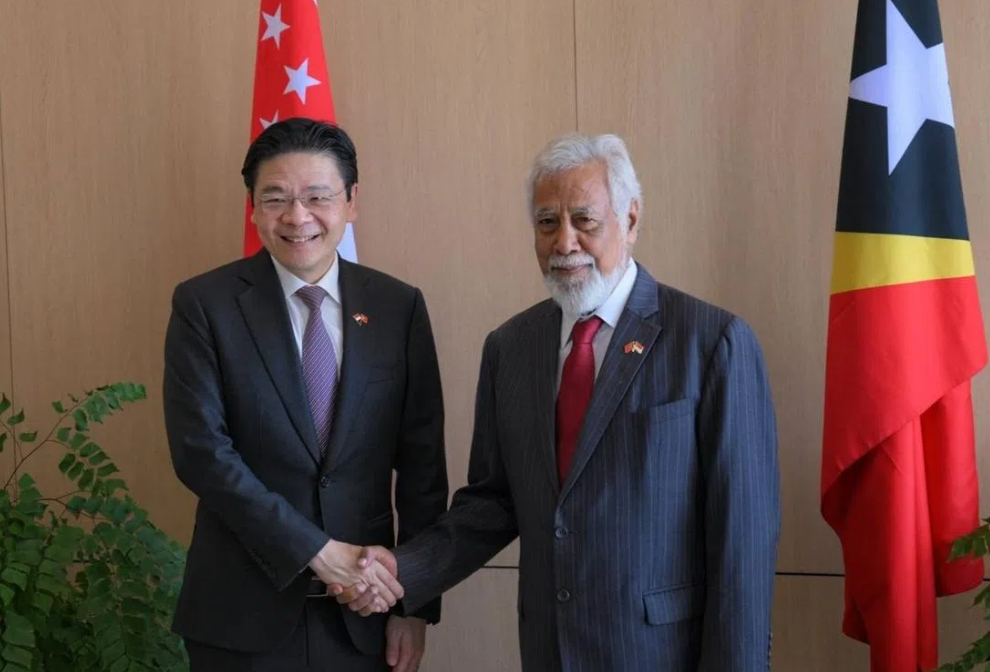
Prime Minister Lawrence Wong's historic visit to Timor-Leste this week signals a deliberate pivot toward deeper engagement with the region's newest member state, marking the first time a Singapore premier has travelled to Dili. The trip culminated in the signing of a comprehensive bilateral framework alongside Timor-Leste Prime Minister Xanana Gusmao, establishing formal mechanisms for sustained cooperation across diplomatic, economic and strategic dimensions. This development carries particular significance for Malaysian policymakers and business interests, as it demonstrates how established Southeast Asian economies are positioning themselves to support and benefit from Timor-Leste's rapid institutional development following its formal accession to Asean in October 2025.
The framework agreement, signed on July 3, creates structured channels for dialogue between the two nations' foreign ministries, enabling regular consultation on bilateral matters alongside broader regional and international issues. This institutional architecture mirrors diplomatic practices common among Asean members and reflects Singapore's confidence in the stability of Timor-Leste's governance institutions. For Malaysia and other regional states, the mechanism offers a template for managing relations with newer members while ensuring coordinated responses to transnational challenges. The regular consultation framework provides both governments with a platform to align positions on issues ranging from maritime security to economic integration, reducing miscommunication and building trust over time.
On the economic front, Singapore is already positioned as one of Timor-Leste's largest foreign investors, with corporate activity spanning wholesale trade, renewable energy and various service sectors. Wong characterised these investments as evidence of growing business confidence in Timor-Leste's development trajectory. This investor enthusiasm reflects recognition that the nation possesses significant natural resource endowments and strategic maritime location alongside an increasingly capable institutional framework. Malaysian firms, particularly those in energy and trading sectors, should monitor Singapore's operational experience in Timor-Leste closely, as it suggests viable business models in areas where Malaysia might establish similar footholds.
A particularly consequential development for the regional labour market involves Singapore's commitment to open selected occupational categories to Timorese workers beginning in 2027. This represents the first expansion of Singapore's non-traditional labour source list to include Timor-Leste, targeting sectors experiencing acute skill or availability challenges such as construction and marine shipbuilding. Manpower Ministry officials noted early interest from Singapore firms seeking Timorese workers, particularly in construction, signalling that demand will likely materialise as the scheme takes effect in the second half of 2027. This arrangement addresses labour shortages while generating employment and remittance income for Timor-Leste, creating a model that could influence other nations' migration policies in the region.
Healthcare cooperation represents another substantive pillar of the expanding partnership. Singapore's National University Hospital has committed to developing a formal agreement with Timor-Leste's Ministry of Health, establishing a five-year collaborative framework focused on health workforce development, training systems modernisation and public health infrastructure strengthening. The cooperation will prioritise areas identified as critical needs by Timorese health authorities, including emergency medicine, prehospital care, paediatrics, ophthalmology, obstetrics and gynaecology, and basic supportive care. Such targeted technical assistance directly addresses healthcare capacity gaps that constrain economic productivity and social development, while positioning Singapore's medical institutions as regional leaders in capacity building.
Educational partnerships equally merit attention, with Wong announcing support for Timor-Leste's teacher training and education professional development institutions. Singapore's involvement in developing school leadership capabilities speaks to recognition that quality education systems require more than curriculum design and material resources. By strengthening the cadre of educational administrators and instructional leaders in Timor-Leste, the collaboration addresses systemic weaknesses that typically emerge in post-conflict nations rebuilding institutions. Malaysian educational authorities and research institutions might consider similar partnerships, particularly given shared language heritage and comparable development experiences in Southeast Asia.
Wong's visit included a formal state decoration, as Timor-Leste President Jose Ramos-Horta conferred the Order of Timor-Leste (Grand Collar) upon the Singapore Prime Minister. This ceremonial recognition acknowledged both Singapore's historical contributions to Timor-Leste's nation-building and Wong's personal commitment to advancing bilateral relations. In his acceptance remarks, Wong emphasised that the award belonged to generations of Singaporeans who conducted training and knowledge transfer in Timor-Leste. This framing highlights how bilateral cooperation operates through sustained institutional engagement rather than individual transactions, building social capital and professional networks that facilitate future collaboration.
A crucial component of Singapore's strategy involves supporting Timor-Leste's integration into Asean structures and preparing the country for its scheduled chairmanship in 2029. Singapore previously launched the Stars (Singapore-Timor-Leste Asean Readiness Support) package in December 2022, which Wong noted has been strengthened since July 2025. The expanded initiative now encompasses additional Asean-related training programmes, tailored workshops on chairmanship responsibilities and opportunities for Timorese officials to attach to Singapore's chairmanship teams when Singapore assumes the rotating role in 2027. This preparatory scaffolding ensures Timor-Leste can exercise its institutional leadership effectively, reducing potential friction from administrative inexperience.
For Malaysia and other Asean partners, the Singapore-Timor-Leste trajectory illustrates an important integration principle: successful expansion requires deliberate capacity building, not merely formal membership. Timor-Leste's assumption of the Asean chair in 2029, only four years after joining, represents an ambitious timeline that necessitates intense preparation. Singapore's willingness to invest substantially in this process reflects confidence that Timor-Leste can meet these responsibilities and delivers reassurance to the broader membership. Malaysian policymakers might consider whether comparable support mechanisms exist for their own institutional responsibilities within Asean frameworks.
The bilateral framework also implicitly recognises the geopolitical dimension of Timor-Leste's strategic location. The nation sits at the intersection of Indian and Pacific Ocean maritime domains, commanding significant chokepoints and fishing grounds. Singapore's deepening engagement reflects interest in a stable, prosperous and institutionally capable neighbour capable of contributing to regional maritime security and economic integration. Wong's characterisation of shared conviction that national size does not determine destiny resonates particularly in the context of smaller Asean members whose influence increasingly derives from institutional participation and strategic positioning rather than territorial or demographic scale.
The timing of this diplomatic surge deserves scrutiny. Timor-Leste's Asean membership, barely nine months old, represents the culmination of a decades-long independence struggle. Singapore's visible support during this vulnerable consolidation period builds relationship foundations that could yield long-term benefits across security, trade and cultural domains. For Malaysia, observing how Singapore leverages soft power through capacity building, labour partnership and institutional support offers lessons applicable to strengthening relations with other regional partners facing similar development challenges.
Looking forward, the bilateral framework establishes mechanisms for sustained cooperation that extend beyond personality-driven diplomacy. Regular foreign ministry consultations, structured health and education partnerships, and labour mobility arrangements create multiple channels for engagement that can weather political transitions. This diversified approach to bilateral relations represents sophisticated statecraft that recognises how modern partnerships require multifaceted institutional foundations. As Timor-Leste consolidates its Asean membership and prepares for continental leadership responsibilities, Singapore's strategic investment positions both nations to benefit from expanded regional integration while contributing to stability across Southeast Asia.

