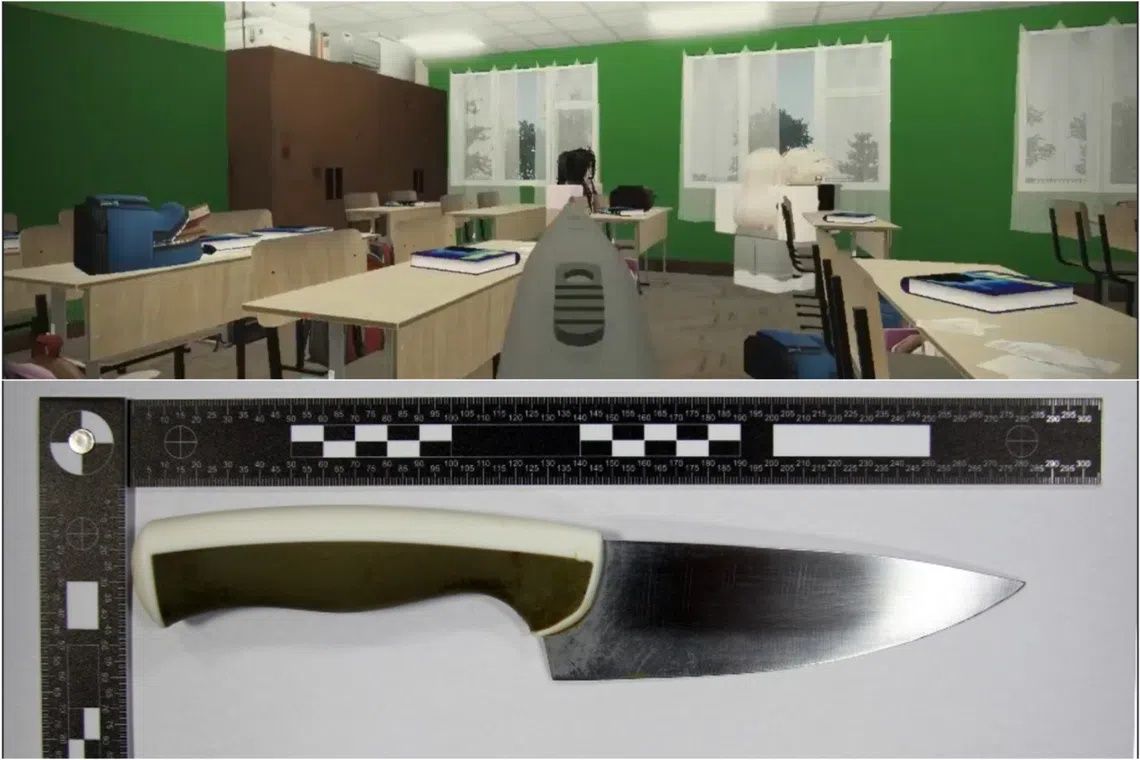
Singapore has moved to detain three teenagers ranging from 14 to 19 years old under its Internal Security Act after they became self-radicalised through violent extremist ideologies and independently plotted separate attacks within the city-state. The detentions underscore deepening concerns among security officials about the vulnerability of young people to online radicalisation and the increasing sophistication of attack planning among juveniles with access to internet resources. The cases are entirely separate from one another, with each youth having developed distinct targeting strategies and weapon preferences.
The most concerning case involves a Secondary 2 student arrested in May who had progressed substantially toward executing plans for a mass stabbing at his secondary school during the June school holidays. The 14-year-old, whose name has been withheld in accordance with Singapore's policy toward juvenile detainees, created an elaborate 21-page manifesto documenting his proposed attack methodology, weapon selections, and an enumerated list of targets that specifically included non-Muslim teachers and students. According to the Internal Security Department, the youth had advanced sufficiently in his planning that authorities described him as having gotten quite close to realising his violent intentions.
The teenager's radicalisation trajectory began when he encountered first-person shooter games on the Roblox gaming platform in 2024 at age 12. Later that year, he discovered footage of the 2016 Pulse nightclub shooting in Orlando, Florida—perpetrated by Omar Mateen—which claimed 49 lives and wounded 58 others. The youth developed an admiration for Mateen, identifying with the shooter's experience of bullying whilst simultaneously being impressed by the casualty count he achieved. This fascination with mass violence converged with personal grievances: the teenager was simultaneously experiencing bullying from schoolmates and academic pressure from teachers. By late 2025, these accumulated grievances crystallised into concrete planning for a mass-casualty attack targeting his school community.
The youth's weapon selection evolved through a process of rational assessment constrained by Singapore's legal environment. His initial preference was firearms, but he abandoned this approach upon recognising the stringent restrictions governing gun ownership in Singapore. He subsequently researched homemade explosives and investigated sourcing bomb-making materials, but ultimately concluded he lacked sufficient financial resources and secure space for construction and testing. His final choice settled on bladed weapons—specifically a kitchen knife and penknife he had identified within his home. He had viewed repeated ISIS stabbing tutorial videos and execution footage online, claiming these resources gave him confidence in his ability to execute such an attack. To maximise casualties whilst minimising teacher intervention, he strategically selected dates when students would be present for co-curricular activities during the school holidays.
The second detained teenager, tertiary student Tan Jun Jun, 19, pursued a markedly different targeting approach centring on military and sexual-minority populations. Arrested in April and issued a detention order in May, Tan developed plans to conduct knife attacks against Singapore Armed Forces personnel stationed at Sembawang Air Base and against LGBTQ students at his tertiary institution. Beyond planned kinetic violence, he attempted to launch distributed denial-of-service cyberattacks against websites operated by Muslim organisations he perceived as ideologically deviant. Such cyberattacks function by overwhelming server capacity with high-volume internet traffic, rendering services temporarily inaccessible. His ideological framework positioned himself as advancing ISIS's interests through simultaneous physical and digital attack vectors.
The third case involves a 15-year-old Secondary 4 student who aspired to construct and deploy pressure-cooker bombs within urban Singapore settings populated by civilians. This teenager viewed Singapore as fundamentally hostile to ISIS interests and desired to further the organisation's cause through explosive terrorism. Whilst he conducted extensive online research into pressure-cooker bomb construction methodologies, the Internal Security Department noted he had not yet crystallised specific timelines, precise locations, or particular targets. Nevertheless, his visualised attack scenario consistently centred on maximising civilian casualties in densely populated urban environments. Notably, his family members and close friends possessed awareness of his extremist ideological commitments but had not reported him to authorities.
Senior Minister and Coordinating Minister for National Security K. Shanmugam addressed journalists on July 27, emphasising the structural asymmetry inherent in counterterrorism operations. He stated that security agencies must succeed completely and consistently in identifying and preventing potential attacks, whereas would-be attackers require only a single successful operation. This formulation highlights the overwhelming advantage accruing to determined plotters and the consequent pressure upon security institutions to maintain perfect predictive and preventive capabilities. Shanmugam, who also serves as Home Affairs Minister, characterised all three cases as individually concerning whilst noting that youth radicalisation represents a particularly grave national security preoccupation.
The Internal Security Department disclosed that more than half of the 23 youths dealt with under the ISA framework across the preceding decade—including these three detainees—had intended to conduct attacks within Singapore. Of particular concern to officials is the observation that radicalised youth populations are trending progressively younger, suggesting that extremist recruitment and indoctrination mechanisms are successfully penetrating younger age cohorts with increasing frequency. All three youths demonstrated strong resolve to enact violence and had each advanced to varying stages of operational planning or direct preparation when apprehended.
Across all three cases, a consistent pattern emerged: the detainees had openly shared their extremist ideologies with family members, friends, schoolmates, or online contacts. One teenager had added family and friends into chat groups where he disseminated pro-ISIS content. Another distributed ISIS videos among friends and schoolmates. This visibility of extremist expression raised urgent questions about community awareness and parental oversight. Shanmugam specifically called upon the public and parents to maintain vigilance and actively safeguard children, implicitly calling for greater willingness among community members to report concerning expressions of extremist ideology to authorities.
The Internal Security Department expressed particular anxiety regarding the youths' identification of easily accessible weapons suitable for attack purposes. All three teenagers had specifically sought out bladed instruments, and the 15-year-old had conducted methodical research into explosive device construction using readily available materials. This convergence of ideological commitment with practical weapons acquisition research demonstrates the qualitative shift in youth radicalisation from passive consumption of extremist content to active preparation for violence. The teenagers had leveraged online platforms not merely for ideological immersion but as practical repositories of tactical information regarding attack execution.
The radicalisation mechanisms identified across these cases illuminate concerning features of the contemporary digital environment. Gaming platforms like Roblox, which ostensibly serve recreational purposes for young users, have become venues where extremist content circulates and where violent scenarios—including recreations of actual mass shooting incidents such as the 1999 Columbine attack—become normalised within gameplay contexts. Social media platforms have facilitated discovery of high-profile terrorist attacks and enabled idealisation of their perpetrators. The combination of readily available extremist propaganda, tactical information, and gaming environments that gamify violence creates a potent ecosystem for radicalisation among vulnerable adolescents.
For Malaysia and the broader Southeast Asian region, these Singapore cases carry significant implications. The radicalisation trajectories documented mirror patterns that security agencies across the region have identified amongst their own youth populations. The accessibility of extremist online content recognises no borders, and the ideologies motivating these Singaporean teenagers—particularly ISIS-aligned theology—command adherents throughout the region. Malaysian security authorities have, like their Singaporean counterparts, documented cases of self-radicalised youth who progressed from online ideological engagement to concrete attack planning. The sophistication evident in the teenagers' weapon selection methodology and attack timing strategies suggests that online extremist communities are effectively transmitting tactical knowledge that enhances operational capability among dispersed recruits.
The detention of these three teenagers underscores the escalating challenge posed by autonomous radicalisation processes occurring beneath the visibility thresholds of traditional intelligence collection. Each teenager became extremist independently rather than through recruitment into established organisations, complicating preventive intervention. The cases also highlight the inadequacy of expecting family members and friends to spontaneously report ideological extremism without institutional frameworks encouraging disclosure. Singapore's response through the Internal Security Act represents one approach to this challenge, though it necessarily raises questions about the balance between security imperatives and civil liberties protections that resonate across democratic societies throughout Southeast Asia.

