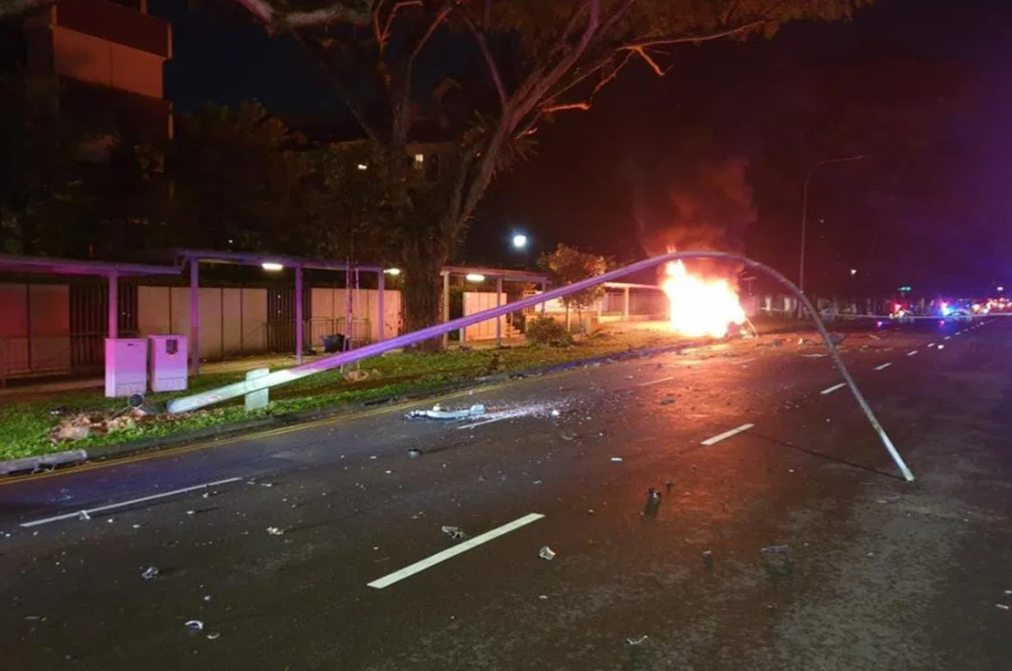
A 29-year-old Singapore man has been formally charged following a chaotic early-morning incident in which he allegedly drove under the influence of alcohol, exceeded safe speeds, and collided with a private bus carrying schoolchildren, leaving two young passengers requiring hospitalisation. Aaron Tan Yao Cong appeared in court on Thursday, June 18, facing five separate charges stemming from the March 6, 2024 incident, which culminated in his vehicle catching fire after striking a lamp post. The case has reignited concerns about repeat drink-driving offenders and the escalating risks posed by impaired drivers on Singapore roads, where school buses represent particularly vulnerable road users.
According to court documents, the chain of events began at 5.50am along Cavenagh Road near Bukit Timah Road, when Tan allegedly ignored a straight-only traffic sign and instead negotiated a left bend directly into oncoming traffic. He came to a temporary stop on the left side of the two-lane Cavenagh Road, occupying space designated for traffic heading towards Buyong Road. This initial breach of traffic regulations marked the beginning of a dangerous trajectory that would unfold over the following minutes.
When police officers approached his vehicle at 6am, Tan accelerated away and fled the scene. A police statement issued on June 17 detailed how officers subsequently tracked him racing along Bukit Timah Road and Upper Bukit Timah Road, where surveillance data and speed recordings indicated he was travelling at an average of 114 kilometres per hour. Throughout this high-speed pursuit, he weaved continuously between other vehicles as he navigated the section between Coronation Road and Anamalai Avenue, creating additional hazards for morning commuters.
The most serious incident occurred at the junction of Sixth Avenue at approximately 6.16am, when Tan allegedly breached a red traffic light signal and collided head-on with a private bus engaged in a lawful U-turn manoeuvre. The impact was sufficient to cause him to lose control of his vehicle, which subsequently struck a lamp post with such force that it erupted into flames. Tan and three passengers in his vehicle managed to escape before the fire spread, while the bus driver and his two young passengers—both aged nine and ten—required emergency medical treatment. The two children represented the most vulnerable casualties in this incident.
Testing conducted after his arrest revealed that Tan's blood alcohol content measured 148 milligrams per 100 millilitres of blood, substantially exceeding Singapore's legal limit of 80 milligrams per 100 millilitres. Adding to the severity of his alleged conduct, Tan initially refused to submit to a breathalyser test when first apprehended by officers, a defiance that itself constitutes a separate criminal offence. This refusal preceded the subsequent blood test that established his intoxication levels and suggested consciousness of wrongdoing.
Tan's history compounds the seriousness of the current charges. Court records indicate he was previously convicted of drink driving and driving without due care and attention in 2019, making him a repeat offender under Singapore's traffic and penal laws. This prior conviction means that the sentencing parameters he now faces are substantially more severe than they would be for a first-time offender. Such a history raises questions about the effectiveness of prior interventions and rehabilitation efforts, and whether punitive measures alone adequately address recidivist drink-driving behaviour.
The charges filed encompass drink driving, dangerous driving causing hurt, leaving a vehicle in a position that would endanger others, failing to cooperate with breathalyser testing, and driving against the flow of traffic. Tan has not yet indicated his plea to any of the five charges, with his case adjourned until July 16. The multiplicity of charges reflects the complex and cascading nature of his alleged offences, each representing a distinct breach of road safety regulations.
If convicted of drink driving as a repeat offender, Tan faces imprisonment of up to two years and a fine reaching $20,000. For dangerous driving causing hurt, he is liable to two years imprisonment, a fine of up to $10,000, or both, with repeat offender penalties doubling the fine to $20,000. Additional charges carry more modest sentences: up to three months imprisonment and $1,000 fine for leaving his vehicle in a dangerous position; up to six months imprisonment and $5,000 fine (or up to a year and $10,000 for repeat offenders) for refusing the breathalyser; and up to three months imprisonment and $1,000 fine for driving against traffic, with six-month imprisonment and $2,000 fine for repeat offenders.
The incident raises broader concerns about school bus safety and the effectiveness of existing regulatory frameworks in preventing dangerous drivers from operating vehicles. In Malaysia and across Southeast Asia, where school transportation often relies on private operators working with limited oversight, such incidents underscore the necessity for rigorous driver screening, vehicle maintenance standards, and enforcement of traffic laws. The involvement of young children—already in a dependent and vulnerable position as passengers—amplifies the public impact and moral gravity of the case.
Singapore's approach to drink-driving enforcement, including random breath testing and strict liability frameworks, has been internationally recognised as relatively effective, yet cases like Tan's demonstrate that even robust legal regimes must contend with individual recidivism. The apparent escalation from his 2019 conviction to the 2024 incident suggests that previous consequences failed to deter his subsequent alcohol-impaired driving. This raises important questions about sentencing philosophy: whether prison terms adequately protect public safety, whether rehabilitation programmes are sufficiently available or effective, and whether licence suspension periods are sufficiently lengthy to prevent repeat offences.
For Malaysian observers, the case provides instructive lessons regarding the persistent dangers posed by drink-drivers, particularly those with prior convictions. Road traffic accidents represent a leading cause of injury and death in Malaysia, and drunk driving contributes significantly to crash severity. The incident also highlights how a single driver's choices can endanger numerous innocent parties, from motorists sharing the road to schoolchildren who depend on adults to provide safe transportation. The fact that Tan's vehicle caught fire, potentially trapping occupants, adds another layer of danger to an already catastrophic sequence of events.