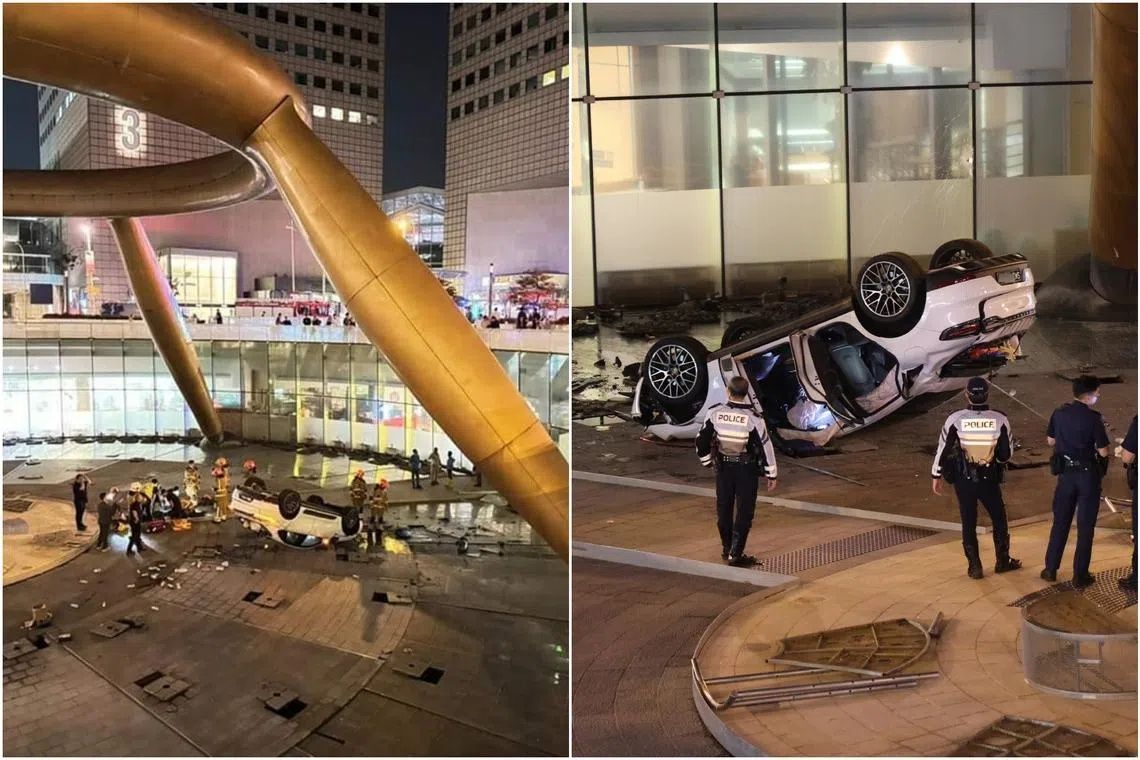
A Singapore court has handed down a custodial sentence to a 58-year-old driver who operated his vehicle after consuming approximately one litre of beer, resulting in a dramatic crash through the iconic Fountain of Wealth at Suntec City last year. The incident, which occurred on July 13, 2024, saw the man's car breach a protective barricade and plunge into the fountain's basement level, narrowly avoiding contact with construction workers present at the time. District Judge Koo Zhi Xuan sentenced him to five weeks' imprisonment on Tuesday, July 14, 2024, alongside a driving prohibition lasting two and a half years from his release date.
According to court proceedings, the driver, identified as Then Shing Chong, had departed his residence around 5pm on July 12, 2024, with the intention of meeting acquaintances for a social gathering at Suntec City. Upon arrival at the shopping complex approximately one hour later, he parked in the basement carpark and proceeded to a bar establishment within the mall. Between 6:15pm and midnight, he consumed the substantial quantity of beer before deciding to operate his vehicle again. Notably, the defendant had informed medical personnel at the Institute of Mental Health that he had ingested either an antihistamine or sleeping medication prior to consuming alcohol, a detail which would prove medically significant given the compounding effects such combinations may produce.
The sequence of events leading to the crash began as Then attempted to exit the carpark. After a gantry barrier raised to permit passage, his vehicle remained stationary for approximately ten seconds before he accelerated onto Temasek Boulevard. The critical moment occurred when, whilst navigating this arterial road, he failed to maintain directional awareness and attention to navigational signage indicating a required left turn into a roundabout. Instead, his vehicle continued straight ahead across three traffic lanes, directly toward the Fountain of Wealth's protective barriers. The force of the impact breached the barricade entirely, and the car descended into the fountain's basement level, inflicting substantial structural damage.
Then's actions created an extraordinarily dangerous situation that could have resulted in fatalities. Three construction workers were actively engaged in maintenance operations within the basement of the fountain at the moment of impact. The Deputy Public Prosecutor, Gladys Lim, emphasised this critical near-miss during sentencing submissions, stating that had the workers remained in the precise location where the vehicle crashed, the consequences would have been "far more devastating and catastrophic." Fortunately, all three individuals managed to vacate the danger zone without sustaining injuries. Recovery of the vehicle required deployment of a lorry crane to extract it from the fountain before subsequent towing.
The material damage resulting from the crash totalled approximately S$64,600, a substantial sum that the defendant has fully reimbursed. However, Then himself sustained injuries during the incident, including a lacerated scalp, necessitating emergency medical attention at Tan Tock Seng Hospital. Significantly, authorities were unable to obtain blood alcohol content or breath alcohol measurements immediately after the accident due to his hospitalisation, creating a gap in the forensic evidence of intoxication at the precise moment of driving. Nevertheless, the defendant entered a guilty plea to the charge of driving in a dangerous manner, acknowledging responsibility for his conduct.
The sentencing decision involved competing arguments regarding appropriate punishment and rehabilitation approaches. The defence team, comprising lawyers Josephus Tan, Cory Wong, and Devlin Mohyong from Invictus Law Corporation, submitted that a mandatory treatment order rather than imprisonment would be suitable. They presented an Institute of Mental Health report indicating that Then suffered from major depressive disorder at the time of the accident and contended there existed a contributory psychiatric link between his mental condition and the dangerous driving offence. Under a mandatory treatment order framework, offenders undergo clinical treatment addressing their underlying mental health conditions instead of serving traditional custodial sentences.
The prosecution vigorously opposed this approach, with Deputy Public Prosecutor Lim arguing that the circumstances of the case demanded a deterrent sentence. She emphasised that drink-driving represents inherently irresponsible behaviour deserving punishment sufficient to discourage others from similar conduct. The court sided with this position, with Judge Koo Zhi Xuan explicitly noting that Then's offence had generated significant property destruction and possessed serious potential to cause injury or death. The judge stressed that general deterrence considerations outweighed the mental health mitigation arguments, particularly given the gravity of operating a motor vehicle whilst impaired by alcohol.
The Suntec City fountain incident exemplifies broader Southeast Asian concerns regarding drink-driving enforcement and public safety at major commercial and entertainment districts. Singapore, like Malaysia and other regional economies, has implemented stringent traffic safety legislation, yet impaired driving continues to threaten public spaces frequented by workers and pedestrians. The presence of construction workers at the fountain's basement underscores how dangerous driving incidents can imperil workers in vulnerable positions, not only vehicle occupants. Many similar incidents across the region involve combinations of alcohol consumption and medication interactions, warranting public awareness campaigns about such health risks.
The sentencing reflects judicial recognition that contemporary urban environments demand heightened personal responsibility when operating motor vehicles in areas hosting infrastructure, workers, and civilians. The two and a half year driving prohibition represents a substantial period of transport limitation for an individual, though such restrictions increasingly reflect international best practice in serious dangerous driving cases. This case also highlights gaps in immediate post-incident evidence collection, as the failure to obtain blood alcohol measurements shortly after the crash meant the prosecution proceeded without this quantifiable intoxication marker. Nevertheless, the guilty plea and comprehensive damage restitution likely influenced the court's sentencing approach, demonstrating how full accountability can partially mitigate consequences in such matters.
For Malaysian readers, the Suntec City incident serves as cautionary reinforcement regarding the consequences of drink-driving behaviour and the judicial approach taken by neighbouring Singapore authorities. The combination of custodial sentence, extended driving prohibition, and mental health considerations reflects contemporary Commonwealth legal frameworks governing impaired driving offences. While Singapore's sentencing appears proportionate to Malaysian standards, the case underscores how a momentary lapse in judgement—exiting a carpark whilst intoxicated—can cascade into catastrophic potential harm and permanent legal consequences. Both nations share similar legislative frameworks addressing dangerous driving, though enforcement intensity and sentencing severity may vary between jurisdictions.

