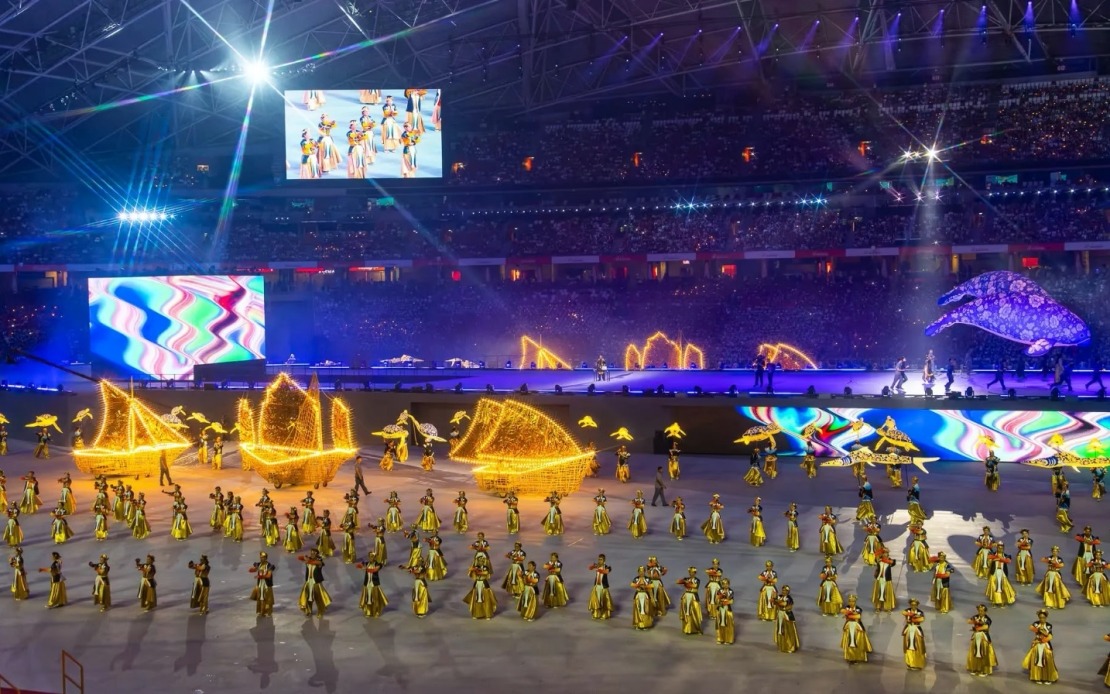
Singapore ushered in its 61st year of independence on Sunday with a significant milestone: the return of the National Day Parade to the National Stadium after more than a decade's absence. The celebration, anchored by the theme "Majulah Singapura, Go Beyond!", drew President Tharman Shanmugaratnam, Prime Minister Lawrence Wong, and Cabinet ministers to preside over the ceremonies that attracted approximately 42,000 members of the public dressed in the nation's red and white colours. The event marked a symbolic return to the city-state's primary sporting venue for one of its most important annual observances, signalling both a restoration of tradition and a forward-looking vision for the nation.
What distinguished this year's celebration was the unprecedented expansion of the parade experience beyond the confines of the National Stadium itself. In a first for the republic's six decades of independence, both the Presidential Gun Salute and State Flag Flypast were repositioned to Kallang Basin, a decision that substantially broadened the audience reach and transformed the traditional ceremonial format. This geographical extension demonstrated how Singapore's planners sought to make the national celebration more inclusive and accessible, allowing citizens across the wider Kallang precinct to participate in the spectacle. The innovation reflects broader thinking about how civic ceremonies can engage larger portions of the population without compromising the formal dignity of state occasions.
The logistical execution of the Kallang Basin component itself revealed considerable military coordination. Four 25-pounder Howitzer guns, each mounted on Mobility 3rd Generation rafts, navigated the waterway to conduct the ceremonial salute, bringing the spectacle closer to thousands of additional onlookers stationed throughout the precinct. This aquatic dimension of the military display transformed what might have been a conventional ground-based ceremony into a more dynamic and visually arresting production. The 21-gun salute itself mobilised 151 personnel drawn from the 23rd Battalion of the Singapore Artillery and the 35th Battalion of Singapore Combat Engineers, underscoring the scale of coordination required to execute even ceremonial elements of the parade.
The formal parade and ceremony segment commenced around 6 pm and ran under the secondary theme "Go Beyond Self", bringing together 32 contingents comprising more than 2,000 active participants. The configuration reflected careful orchestration of military and civilian elements: six Guard of Honour contingents, ten youth organisation units, and sixteen supporting contingents worked in concert with the Singapore Armed Forces Colours Party to structure the processional. The Guard of Honour itself drew personnel across the full spectrum of Singapore's security apparatus, with seventy-two members representing the Singapore Army, Republic of Singapore Navy, Republic of Singapore Air Force, the newer Digital and Intelligence Service, Singapore Police Force, and Singapore Civil Defence Force. This comprehensive representation underscored the role of these institutions in national identity and governance.
Complementing the more formal parade elements was a substantial entertainment programme that sought to tell Singapore's contemporary story through performance. The show segment featured thirty-six artistes and more than 2,600 performers executing a carefully choreographed presentation that centred on the main celebratory theme. The organisers deliberately wove together authentic Singaporean narratives, displays of innovative technology, and an original musical score, creating a performance arc that balanced reflection on national achievements with optimism about future possibilities. This fusion of storytelling, technical sophistication, and musical accompaniment has become a hallmark of modern National Day observances, serving to reinforce collective identity while showcasing the nation's creative capabilities.
Particularly noteworthy was the deliberate inclusion of performers from diverse backgrounds and abilities within the entertainment segment. Seven dancers, specifically selected to represent varied demographic categories, took part in the performances, including an autistic dancer and a dancer with Down syndrome. This programming choice reflected an intentional message about national inclusion: that Singaporean society aspires to recognise and incorporate contributions from all citizens, irrespective of background or physical circumstance. The symbolic weight of such representation in a state celebration cannot be overstated, as it communicates through visual demonstration rather than mere rhetoric a commitment to pluralism and accessibility.
For Malaysian observers, Singapore's National Day celebrations offer instructive comparisons and contrasts. The scale of ceremonial investment, the coordination of military and civilian elements, and the integration of performance and spectacle reflect resource commitments and organisational capacities that reflect Singapore's particular circumstances as a densely populated city-state. The return of the parade to a fixed venue after a decade's hiatus suggests both confidence in public health conditions and a deliberate choice to reinvest in traditional forms of civic gathering. Meanwhile, the expansion into the Kallang Basin demonstrates adaptive thinking about how to enlarge the scope of shared national experience without necessarily requiring exponentially larger gathering spaces.
The thematic emphasis on "going beyond" also warrants attention from a Southeast Asian perspective. In an era of rapid technological change, regional competition, and evolving social expectations, Singapore's choice to frame its national celebration around forward momentum and boundary-pushing suggests official thinking about how the city-state positions itself within both global and regional contexts. The incorporation of digital innovation into the performance segment, alongside more traditional ceremonial elements, reinforces this balance between honoring continuity and embracing transformation—a tension that most Southeast Asian nations navigate in their own ways.
The 42,000-person attendance figure, while substantial, also reflects the practical constraints of the National Stadium's capacity and Singapore's urbanisation patterns. For a nation of approximately 5.9 million people, the parade reaches a fraction of the total population directly, though broadcast and digital dissemination extend the reach considerably. This tiered approach to national celebration—with in-person attendance as the primary tier, supplemented by wider viewership through media—represents a model increasingly common across Southeast Asia as densely populated nations balance inclusive access with manageable logistics.
Looking ahead, the successful execution of this year's parade, including its innovative Kallang Basin extension, may influence how Singapore structures future national celebrations and public ceremonies. The decision to restore the National Stadium as the primary venue after its long absence signals confidence in the venue's symbolic and practical importance. Whether the Kallang Basin component becomes a regular feature or remains a special innovation unique to 2026 will likely depend on factors including public reception, logistical assessments, and budgetary considerations. For now, the celebration successfully accomplished its apparent dual aim: restoring a traditional ceremonial centrepiece while demonstrating responsiveness to contemporary expectations for inclusive, technologically sophisticated public occasions.

