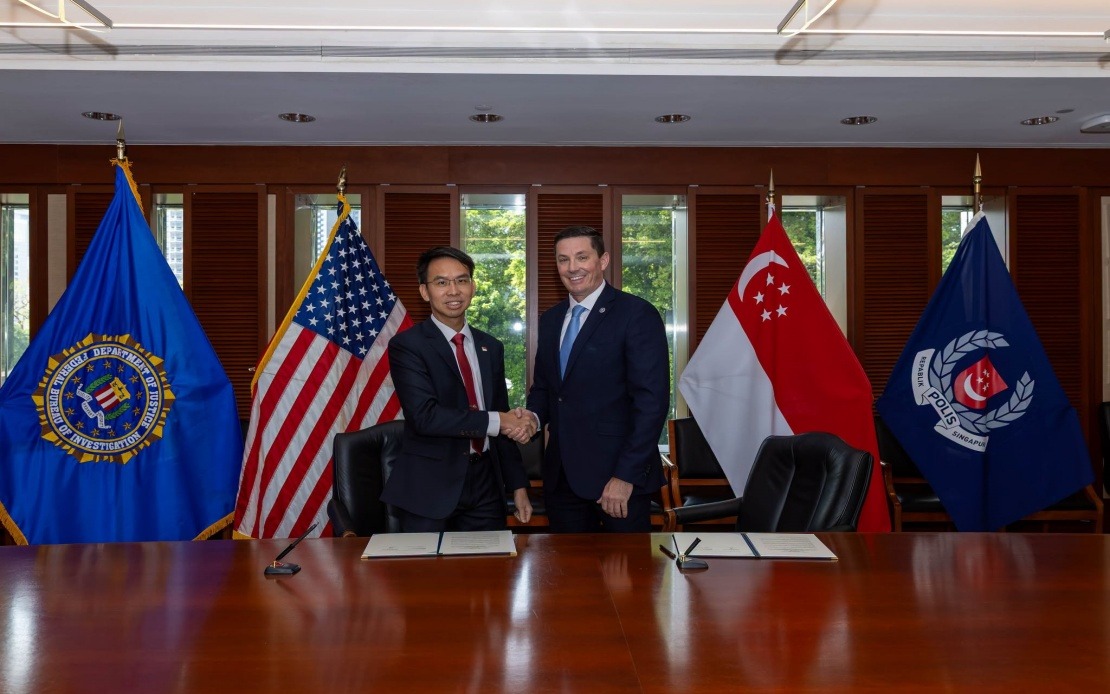
The Singapore Police Force and United States Federal Bureau of Investigation have taken their long-standing collaboration to a new level by formalizing a comprehensive partnership aimed at tackling the rising tide of online scams, cyber-enabled fraud and money-laundering networks. The two agencies signed a memorandum of understanding on Friday to establish a more structured framework for coordinating their efforts against transnational criminal syndicates that increasingly exploit digital channels to defraud victims across borders.
This formal agreement represents a significant commitment from both organisations to prioritise the interdiction and disruption of criminal networks that specifically target their respective citizens. The Singapore Police Force emphasized that the partnership reflects shared values and a mutual determination to address cybercrime threats that have become increasingly sophisticated and difficult for individual nations to combat in isolation. The memorandum establishes mechanisms for joint operations, systematic information exchange, coordinated training initiatives, capacity-building programmes and reciprocal assistance in tackling crimes that transcend geographical boundaries.
The decision to formalize this partnership carries particular relevance for Southeast Asia, where cybercrime and scam networks operate with relative impunity by exploiting the region's diverse regulatory frameworks and limited cross-border enforcement mechanisms. Singapore's role as a financial hub and technology centre makes it an attractive target for organised cybercriminal groups, while the United States faces similar pressures from international fraud rings that target American citizens and financial institutions. By strengthening institutional ties, both agencies recognise that unilateral enforcement efforts increasingly yield diminishing returns against adversaries who operate across multiple jurisdictions.
The agreement's practical value is already evident in recent operations demonstrating tangible results. In July 2026, the SPF's Cyber Command and FBI specialists collaborated on a significant joint operation that specifically targeted transnational cryptocurrency scams affecting victims in both nations. This operation showcases how enhanced cooperation enables the agencies to identify victims and suspects more rapidly and to disrupt criminal infrastructure before additional losses accumulate. The cryptocurrency dimension is particularly important because digital asset scams have become increasingly prevalent across Asia-Pacific, often facilitated by organised networks with origins in mainland China, Southeast Asia and South Korea.
Through coordinated information sharing and sophisticated blockchain intelligence analysis, the two agencies identified 54 individuals as victims or potential victims of these cryptocurrency schemes during the July 2026 operation. The scale of prevented losses demonstrates the economic significance of these efforts—the agencies collectively prevented approximately US$2.7 million in losses in the United States and S$388,000 in Singapore. These figures, while representing a single operation, underscore the massive financial drain that cybercrime imposes on both nations' residents and legitimate financial systems. For Malaysian readers, such transnational scams frequently target citizens through fake investment schemes, romance fraud and cryptocurrency fraud, often with money routed through Singapore and other regional financial hubs.
The blockchain intelligence capability mentioned in the agreement is particularly noteworthy for the region. Cryptocurrency scams typically leave digital footprints that, while obscured, can be traced through sophisticated blockchain analysis if agencies possess the technical expertise and cooperative mechanisms to share findings. Singapore and the United States both have advanced forensic capabilities, and formalizing their cooperation ensures these technical resources are deployed more effectively against organised crime networks. This technical dimension also has implications for law enforcement cooperation throughout Southeast Asia, as successful methodologies developed by SPF and FBI can potentially be adapted and shared with regional partners through existing frameworks like ASEAN.
The formalisation of this partnership also reflects broader recognition that cybercrime has evolved beyond the capacity of any single nation's law enforcement to adequately address. Online scammers operate with minimal geographic constraint, recruiting money mules across multiple countries, establishing command-and-control infrastructure in jurisdictions with weak cybersecurity enforcement, and layering illicit proceeds through complex financial networks spanning dozens of nations. Traditional law enforcement, organised primarily along national lines, struggles to keep pace with criminals who have embraced globalisation as a fundamental operational principle. By institutionalising cooperation through formal agreements, Singapore and the United States establish regular channels of communication, standardised protocols for information sharing, and legitimised frameworks for joint investigations.
The agreement's emphasis on training and capacity-building suggests that the partnership extends beyond immediate investigative cooperation to include longer-term institutional development. This dimension could prove valuable for regional security cooperation, as Singapore often serves as a training hub and knowledge repository for Southeast Asian law enforcement agencies. Techniques and methodologies developed through FBI-SPF collaboration may eventually be disseminated more broadly, strengthening the overall capacity of the region to combat cybercrime. However, such knowledge transfer requires careful calibration to ensure that techniques remain effective and that sharing does not inadvertently compromise ongoing investigations or expose sensitive intelligence sources.
For Malaysia specifically, the strengthening of Singapore-US cybersecurity cooperation has indirect but significant implications. Malaysian residents are frequently targeted by transnational scam networks, and money flows often pass through Singapore's financial system before reaching foreign beneficiaries. Enhanced coordination between Singapore Police Force and FBI creates additional institutional capacity to trace and disrupt these financial flows. Additionally, successful joint operations can serve as models that Bank Negara Malaysia, the Malaysian police force and Malaysian cybersecurity agencies can study and adapt to their own operational contexts. The practical success of the July 2026 operation demonstrates that systematic blockchain intelligence and coordinated investigation can yield results even against sophisticated criminal networks.
The cryptocurrency scam angle is particularly relevant given the proliferation of such schemes throughout Asia-Pacific. Scammers exploit the relative opacity of cryptocurrency transactions and the difficulty ordinary citizens face in distinguishing legitimate investment platforms from fraudulent ones. The FBI and Singapore Police Force have now accumulated institutional expertise in tracing these schemes, and their formal partnership ensures this knowledge is systematically deployed rather than remaining siloed within individual agencies. This matters for Malaysia because the sophistication of scams targeting Malaysian citizens continues to increase, and law enforcement must continuously update its investigative techniques and international cooperation mechanisms to maintain effectiveness.
Moving forward, the memorandum of understanding appears likely to expand in scope beyond the currently emphasised areas of cryptocurrency scams and online fraud. Money-laundering mechanisms that facilitate both cybercrime and traditional organised crime rely heavily on the financial sophistication and banking infrastructure that Singapore provides. The FBI's resources and Malaysia's regional position mean that trilateral or multilateral expansions of this partnership could eventually emerge. For now, however, the Singapore-US agreement establishes a critical foundation upon which more extensive regional cybersecurity cooperation can develop. The success of the July 2026 cryptocurrency operation provides a compelling proof-of-concept that demonstrates the tangible value of institutionalised partnership against transnational crime.

