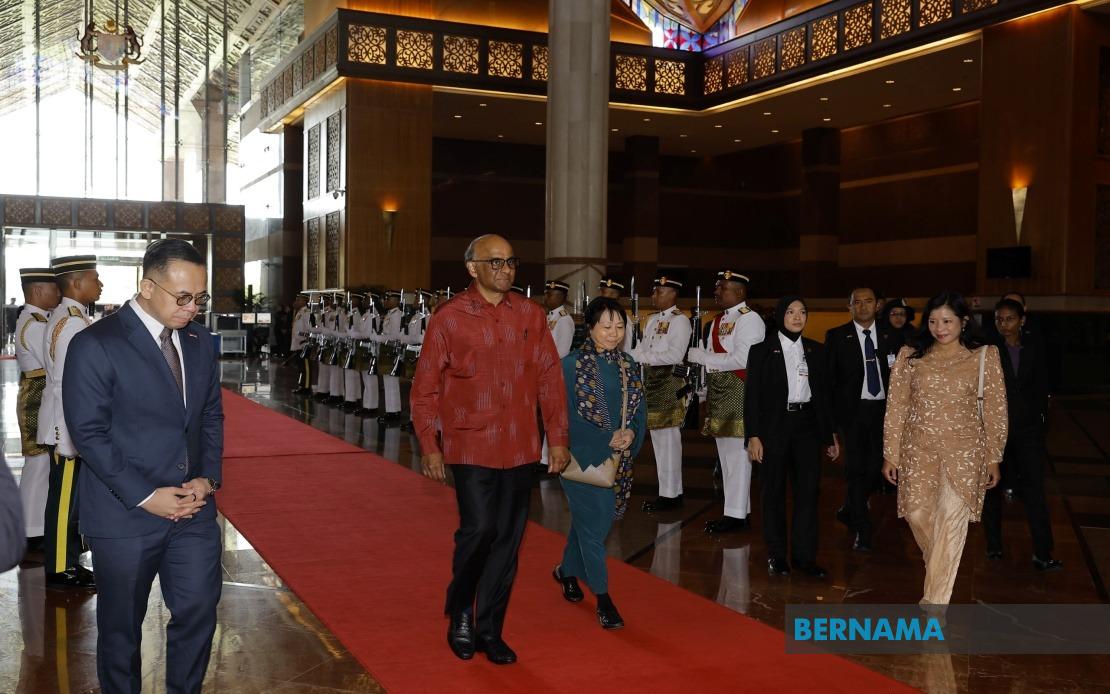
Singapore President Tharman Shanmugaratnam has concluded his maiden state visit to Malaysia as the city-state's head of state, departing Kuala Lumpur International Airport on July 15 at 2.20 pm alongside his spouse Jane Ittogi and accompanying delegation. The visit, which commenced on Sunday at the invitation of His Majesty Sultan Ibrahim, King of Malaysia, marks a significant moment in the diplomatic calendar for both nations, reflecting the deepening engagement between two neighbouring countries whose relationship has long been characterised by pragmatism and mutual interdependence.
Upon his arrival at the Bunga Raya Complex terminal ahead of departure, Tharman was accorded full ceremonial honours befitting a visiting head of state. A static Guard of Honour comprising two officers and 26 personnel from the First Battalion of the Royal Ranger Regiment, under the command of Captain Muhammad Hanafi Ja'afar, presented the formal farewell. The presence of Minister of Entrepreneur and Cooperatives Development Steven Sim at the airport underscored Malaysia's commitment to maintaining the warmth of bilateral relations even in the final moments of the presidential visit.
This state visit held particular significance as Tharman's first official journey to Malaysia since his inauguration as Singapore's ninth President on September 14, 2023. The timing reflects careful diplomatic choreography, as the visit was structured as a reciprocal gesture following Sultan Ibrahim's state visit to Singapore on May 6 and 7, 2024. Such ceremonial exchanges between heads of state serve as important anchors for bilateral relationships, signalling commitment at the highest level and providing opportunities for substantive discussions on matters of mutual concern.
During his stay, Tharman was extended the full complement of state honours befitting a presidential visit. On Monday, he received a formal state welcoming ceremony before proceeding to an audience with Sultan Ibrahim at Istana Negara. This meeting between the two heads of state represents the apex of diplomatic engagement, where issues of strategic importance to both nations can be discussed in a confidential setting. Such private audiences often determine the trajectory of bilateral relations over subsequent months.
The presidential delegation's engagements extended beyond protocol ceremonies to substantive bilateral meetings. Tharman received a courtesy call from Prime Minister Datuk Seri Anwar Ibrahim, a gathering that also included Foreign Minister Datuk Seri Mohamad Hasan, Investment, Trade and Industry Minister Datuk Seri Johari Abdul Ghani, and Minister Sim. The presence of trade and investment portfolios in these discussions suggests focus on economic cooperation, a cornerstone of Malaysia-Singapore relations that encompasses trade, investment flows, and regional economic integration.
The visit also incorporated meetings with state-level leadership, demonstrating the multi-layered nature of contemporary bilateral diplomacy. The Sultan of Selangor, Sultan Sharafuddin Idris Shah, granted an audience to Tharman at Istana Alam Shah, ensuring that engagement extended beyond federal structures to include Malaysia's constituent states. This approach acknowledges the federal nature of Malaysian governance and the importance of subnational actors in shaping regional dynamics.
For Malaysian observers, Tharman's visit carries significance beyond ceremonial niceties. Singapore remains a crucial economic partner and the gateway through which much of Malaysia's regional commerce flows. The city-state's position as a financial hub and its role in regional supply chains make the health of bilateral relations consequential for Malaysian businesses and development objectives. The high-level nature of Tharman's visit signals continuity in this critical partnership despite occasional tensions that periodically surface in Malaysia-Singapore relations.
The visit also arrives at a moment when Southeast Asia faces multiple challenges requiring coordinated responses. Water cooperation, maritime security, investment flows, and labour migration represent areas where bilateral cooperation between Malaysia and Singapore remains essential. Presidential-level visits provide opportunities to reaffirm commitments to existing frameworks and to chart new areas of engagement. The choice of ministerial attendees at key meetings suggests that these substantive discussions likely occurred during the state visit.
For Singapore, Tharman's visit represents an important assertion of the presidency's diplomatic role. The presidency in Singapore's constitutional framework is a largely ceremonial position, yet Tharman has demonstrated active engagement in regional diplomacy. His state visits serve to enhance Singapore's diplomatic footprint and to reinforce the city-state's position as a serious participant in regional affairs. The reciprocal nature of this visit—following Sultan Ibrahim's May journey—reflects the value both governments place on maintaining channels of communication at the highest levels.
The broader context of Malaysia-Singapore relations includes several ongoing considerations. Trade between the two countries remains substantial, though periodic disputes over maritime boundaries, water agreements, and labour standards occasionally create friction. Presidential visits offer opportunities to discuss such issues in constructive settings and to reaffirm commitments to existing bilateral mechanisms. The three-day duration of Tharman's visit allowed for a comprehensive engagement schedule that addressed both ceremonial requirements and substantive bilateral business.
Looking forward, the successful completion of Tharman's state visit sets a positive tone for bilateral engagement. The exchange of presidential visits within a two-month period demonstrates mutual commitment to the relationship. For Malaysia, maintaining strong ties with Singapore remains strategically important given the latter's economic dynamism and regional influence. For Singapore, engagement with Malaysia is crucial given that country's role as a major trading partner and neighbour with whom the city-state shares complex interdependencies.
The visit also carries implications for regional diplomacy more broadly. ASEAN relationships often reflect the health of bilateral partnerships between key member states. Malaysia and Singapore's demonstrated commitment to high-level engagement sends positive signals about the durability of regional partnerships at a time when external pressures and internal challenges test Southeast Asian cohesion. The ceremonial and substantive aspects of Tharman's visit together reinforce the message that both nations view their relationship as a priority worthy of presidential attention and ministerial participation.

