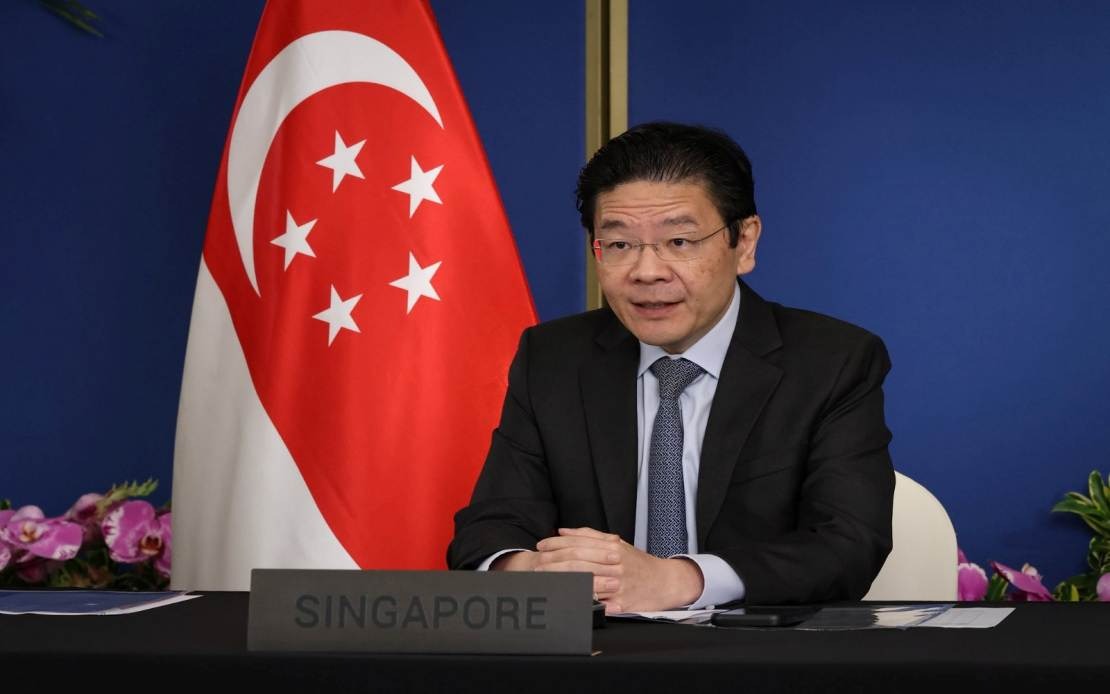
Singapore Prime Minister Lawrence Wong has announced a comprehensive cabinet reshuffle aimed at balancing experienced leadership with the advancement of younger political figures within the government hierarchy. The restructuring, which takes effect primarily on July 27, signals the city-state's ongoing efforts to ensure seamless governance transitions while maintaining institutional continuity during a period of generational change in its political leadership.
The most prominent elevation in this reshuffle is the appointment of K. Shanmugam to the position of Senior Minister, a distinction that positions him alongside Senior Minister Lee Hsien Loong as one of the two most senior figures in Wong's cabinet. Shanmugam retains his existing portfolios as Coordinating Minister for National Security and Minister for Home Affairs, underscoring the government's confidence in his stewardship of the nation's security apparatus. The Prime Minister emphasized that these two Senior Ministers will serve as counsel to younger officeholders, functioning as mentors who can transmit institutional knowledge and strategic wisdom to the next generation of administrators.
A structural reorganization of significant economic consequence involves the transformation of the Ministry of Trade and Industry into the Ministry of Energy, Trade, and Industry, effective October 1. This ministerial restructuring reflects Singapore's strategic pivot toward energy security and industrial modernization in response to regional economic pressures and the global transition toward sustainable energy systems. Deputy Prime Minister Gan Kim Yong will continue overseeing Singapore's trade negotiations and broader economic strategy, while Tan See Leng assumes responsibility for energy and industry matters. This arrangement allows Tan to concentrate fully on his energy portfolio, freeing him from his concurrent duties at the Ministry of Manpower.
For Malaysian observers, Singapore's institutional reorganization carries implications for regional economic coordination and trade relationships. The elevation of energy to ministerial prominence within a renamed portfolio suggests heightened attention to supply chain resilience and the security of energy resources—concerns directly relevant to Malaysia as both a regional trade partner and energy producer. The two-minister structure for METI also indicates Singapore's recognition that contemporary economic stewardship requires specialized expertise across distinct domains rather than consolidated authority.
Two serving ministers have been elevated to full ministerial status without portfolio changes: Jeffrey Siow advances to full Minister of Transport, while David Neo assumes the rank of full Minister for Culture, Community and Youth. These promotions, while maintaining existing responsibilities, represent recognition of capable administrators and provide stability in sectors where Wong's government wishes to ensure continuity. Additionally, Sim Ann has been promoted to Second Minister of Foreign Affairs and Home Affairs, expanding her influence in two critical policy domains and demonstrating the government's practice of assigning high-performing officials to multiple portfolios.
The younger echelon of political leadership has received substantial promotional opportunities within this reshuffle. Jasmin Lau's elevation to Senior Minister of State for Digital Development and Information, combined with her appointment as Acting Minister of Manpower, represents a significant leap in responsibility. Her dual appointment to digital and manpower portfolios aligns with the government's stated priority of positioning Singapore competitively in technological sectors while managing workforce development challenges. Similarly, Goh Pei Ming's promotion to Senior Minister of State for Social and Family Development and Home Affairs reflects growing governmental emphasis on social policy and cohesion—domains increasingly significant across Southeast Asia.
Additional ministerial appointments include Alvin Tan's repositioning as Minister of State in the Ministry of Foreign Affairs, while maintaining his National Development portfolio but relinquishing his Trade and Industry responsibilities. This appointment reshuffling optimizes portfolio assignments while ensuring that expertise in particular areas concentrates among officials with demonstrated capability. Zhulkarnain Abdul Rahim's appointment to Minister of State roles spanning Foreign Affairs and Home Affairs indicates a strategy of grooming administrators for potential senior positions through exposure to multiple policy domains.
New entrants to Singapore's political officeholder ranks include Foo Cexiang, appointed Minister of State for Manpower and Trade and Industry, and Shawn Loh, appointed Minister of State at Education and Health Ministries. These appointments reflect Wong's deliberate strategy of introducing fresh personnel to government while maintaining sufficient experienced guidance. The appointment of Ng Chee Meng, National Trades Union Congress Secretary-General, to Minister in the Prime Minister's Office represents a notable transition from labor leadership to governmental office, potentially signaling evolving governance approaches toward labor relations and workforce matters.
Wong's stated rationale for this comprehensive restructuring emphasizes the necessity of balancing generational perspectives within government. By retaining experienced figures like Shanmugam and Lee Hsien Loong in prominent advisory roles while elevating younger administrators, the Prime Minister articulates a governance philosophy that acknowledges both the value of institutional memory and the requirement for innovative thinking suited to contemporary challenges. This approach addresses persistent tensions within government bureaucracies across the region regarding succession planning and institutional renewal.
For the wider Southeast Asian region, Singapore's cabinet reconfiguration deserves analytical attention as a case study in managed political transition. The explicit emphasis on maintaining continuity while accelerating younger leadership's trajectory offers a contrasting model to political systems experiencing more turbulent succession dynamics. Malaysia, as a comparable Southeast Asian economy with similar challenges regarding generational political renewal, may observe Singapore's structured approach as both exemplary and cautionary—demonstrating how institutional stability can coexist with leadership evolution, yet also illustrating the concentration of power within relatively narrow elite circles.
The October 1 implementation date for the new energy, trade, and industry structure allows the current ministry apparatus time to reorganize administrative functions and clarify reporting relationships before the formal transition. This staged approach to structural reform reflects Singapore's preference for orderly transitions that minimize administrative disruption—a pattern consistent with the city-state's broader governance culture emphasizing predictability and planning over sudden change. Regional businesses and trading partners will likely welcome this phased approach, which permits adjustment to new ministerial relationships and policy coordination mechanisms.
Broadly, Wong's reshuffle demonstrates how Singapore manages the perpetual governmental challenge of succession and institutional renewal. By deliberately positioning the next generation within supportive structures featuring experienced guidance, the Prime Minister attempts to ensure both the continuity necessary for governance stability and the innovation required for responding to evolving regional circumstances. The specific emphasis on energy, digital development, and social policy within this reorganization signals governmental priorities that resonate across Southeast Asia, where these domains increasingly shape national competitiveness and social cohesion.

