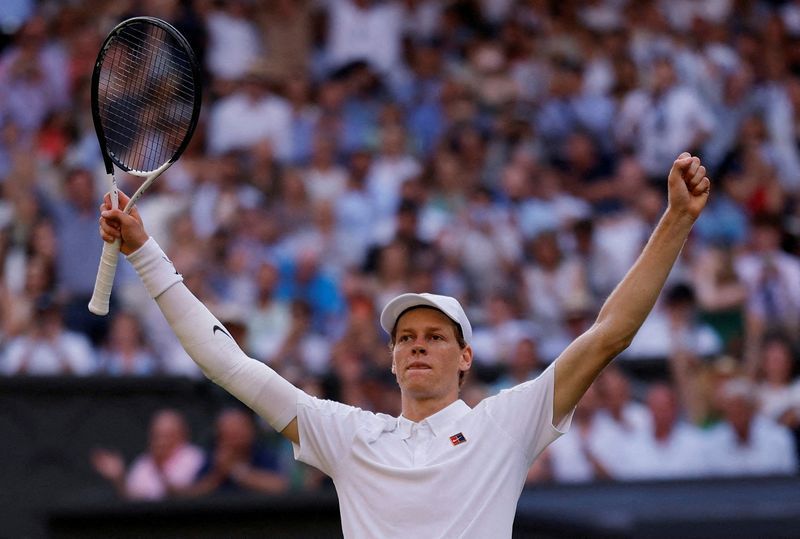
Jannik Sinner arrives at Wimbledon this week as defending champion, yet the Italian's once-unshakeable aura has been punctured by recent reversals that have emboldened a constellation of rivals circling the draw. The world number one must now demonstrate whether he possesses the resilience and adaptability to impose his game on grass whilst simultaneously fending off challengers who have detected vulnerability in the man who appeared unstoppable through the spring season.
Sinner's trajectory before his French Open implosion suggested a player ascending beyond his peers. His run of 30 consecutive victories dating to February appeared to herald a new era of dominance, yet the second-round elimination in Paris exposed the fragility lurking beneath the surface statistics. The physical breakdown that precipitated his surprise exit has raised legitimate questions about the sustainability of his peak performance during the sport's most demanding tournaments, where injury and fatigue can compound exponentially over fortnight-long competitions.
The Italian skipped traditional grass-court preparation tournaments entirely, a calculated gamble that underscores both his confidence in his abilities and the genuine concerns about his current condition. This unconventional approach differs markedly from the typical pre-Wimbledon schedule embraced by competing title contenders, effectively ensuring that Sinner will step onto the All England Club's lawns with minimal recent match exposure on the surface. The strategic calculation prioritises recovery over preparation, a luxury afforded only to those perceived as sufficiently dominant to overcome rust through sheer talent.
Mats Wilander, the seven-times Grand Slam champion now serving as a tennis analyst, attributes Sinner's Paris debacle to accumulated fatigue rather than technical deficiency. According to Wilander, the concentrated schedule preceding Roland Garros—encompassing two months of relentless competition with insufficient recuperation and training opportunities—gradually depleted the Italian's physical reserves until his body simply refused further demands. Wilander suggests that Sinner's current rested state positions him favourably for the grass-court season, though he cautioned that grass surfaces inherently introduce unpredictable variables that even fully fit competitors must navigate with caution.
No figure looms larger in Sinner's defensive ambitions than Novak Djokovic, whose grass-court mastery and legendary return of serve render him a perpetual threat at the All England Club. The Serbian champion is orchestrating a sustained push toward both his eighth Wimbledon crown—which would equalise Roger Federer's record—and an elusive 25th Grand Slam title that has eluded him despite his otherwise unparalleled achievements. At 39 years of age, Djokovic's window for accomplishing these historic milestones is narrowing, infusing his current campaign with heightened urgency and focus.
Djokovic's French Open exit, whilst superficially suggesting diminished current form, has paradoxically strengthened his psychological positioning entering the Wimbledon fortnight. Andy Roddick, the former American world number one turned podcast commentator, observed that Djokovic possesses precisely the type of grass-court aptitude and competitive hunger necessary to exploit Sinner's evident vulnerability. Roddick suggested that Djokovic, rather than languishing over his Paris disappointment, has likely conducted a thorough reassessment of the broader landscape and identified Wimbledon as an exceptionally viable pathway to historical glory during the final chapters of his career.
Alexander Zverev, the newly crowned French Open champion, represents an additional formidable contender whose recent trajectory cannot be dismissed. The German's breakthrough Grand Slam victory on clay signals restored confidence and momentum that could translate productively onto grass, where his prodigious serving capability provides an immediate structural advantage. Boris Becker, himself a six-times major champion and fellow German, has ventured that Zverev now constitutes the tournament favourite given Sinner's evident fragility and the enforced absence of defending champion Carlos Alcaraz through injury.
Alcaraz's injury-enforced withdrawal creates a significant structural imbalance in the tournament landscape. The Spanish player has demonstrated across consecutive years that grass-court tennis uniquely suits his exceptional combination of power, mobility, and instinctive shot-making, consistently triumphing in 2023 and 2024. His absence removes one of the few legitimate challengers capable of matching Sinner's comprehensive skill-set on the fastest playing surface, fundamentally altering the competitive calculus and expanding realistic championship possibilities for a broader coalition of contenders.
The wider draw has experienced corresponding expansion as a consequence of these absences and uncertainties. American contingents including Ben Shelton, Taylor Fritz, and Frances Tiafoe all possess serviceable weapons capable of destabilising higher-seeded opposition, whilst Roland Garros runner-up Flavio Cobolli epitomises the emerging generation poised to capitalise on any disruption within the conventional hierarchy. This diffusion of contender potential signals potential for unexpected advancement rather than the coronation-by-attrition scenario that dominated previous years when the elite possessed minimal meaningful competition.
For Sinner specifically, Wimbledon represents not merely a title defence but a comprehensive rehabilitation exercise. The grass surface's characteristics—its unpredictability, the emphasis on serve-and-volley technique, the compressed points and reduced reaction time—demand a recalibration of tactical approach compared to the clay-court dominance he recently demonstrated. Whether Sinner's physical and psychological reserves have sufficiently recovered to navigate these demands whilst simultaneously parrying sustained challenges from a remarkably motivated cohort of rivals remains the central narrative question as the tournament commences Monday at the All England Club.

