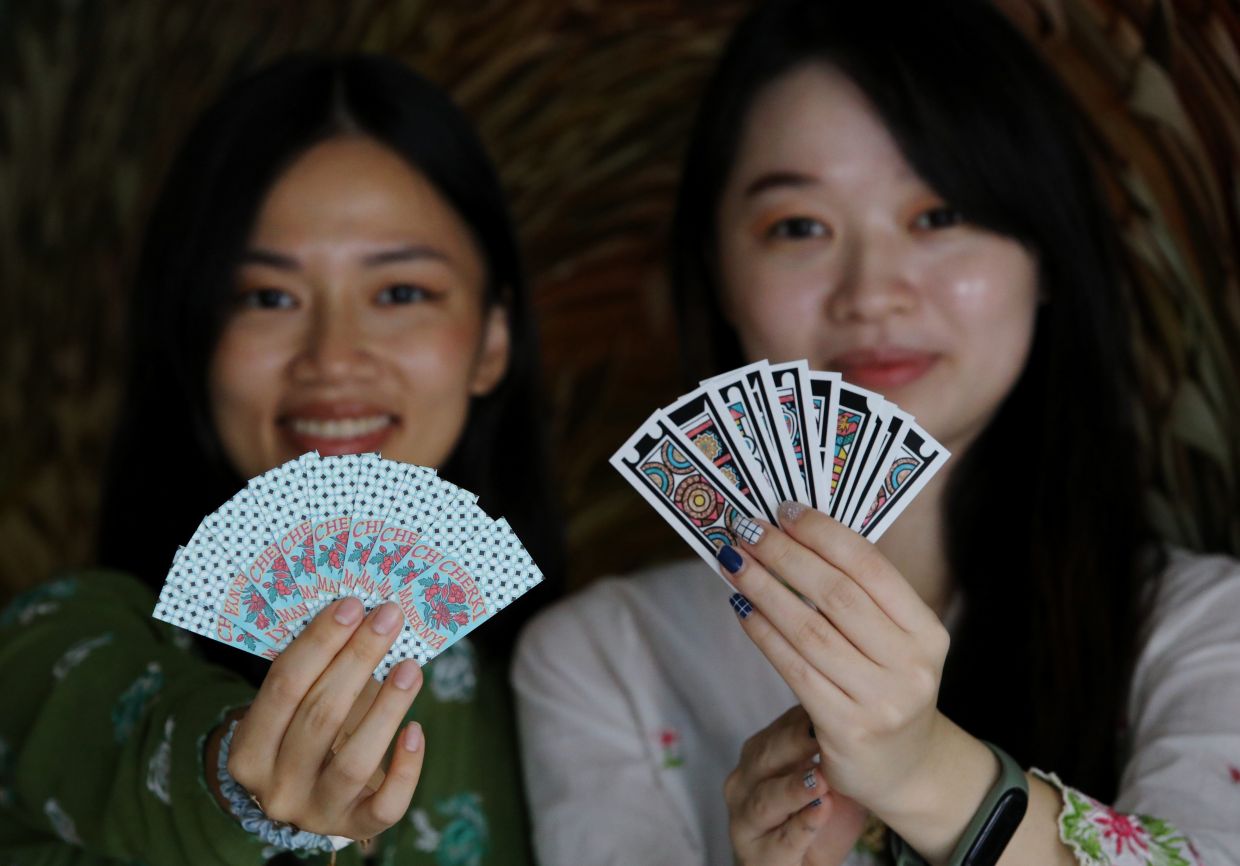
In an effort to preserve a fading element of Peranakan culture, sisters Lee Swee Lin, 32, and Lee Swee May, 31, have reimagined the traditional Cherki card game with vibrant colours and modern aesthetics, transforming what was once a black-and-white game into an visually engaging activity that appeals to contemporary players. The Melaka-born siblings, who run a Kuala Lumpur-based business specialising in Peranakan beaded footwear and decorative pieces, saw reviving Cherki as a natural extension of their commitment to their cultural heritage at a time when younger Peranakans increasingly disconnect from traditional practices.
Peranakan culture has long been celebrated through its distinctive material expressions—intricately beaded slippers, elaborately embroidered baju kebaya, ornamental tiles, and an enviable culinary tradition featuring dishes like ayam buah keluak and Nyonya laksa. Yet many younger members of the community remain unfamiliar with Cherki, a card game that once occupied a significant place in Baba Nyonya households throughout Southeast Asia. The traditional format featured simple monochrome designs spread across two decks of 60 cards, with 30 distinct patterns repeated twice. By introducing colour while preserving traditional motifs and symbols, the Lee sisters have created a bridge between heritage and contemporary sensibilities.
The inspiration for their project came directly from their paternal grandmother, Deo Yeok Kim, whose recent passing prompted reflection on how much cultural knowledge had been transmitted through family relationships rather than formal channels. Growing up largely in their grandmother's Melaka home, the sisters absorbed not just recipes and craft techniques but an understanding of how Peranakan traditions permeated daily life. Swee Lin attributes their entire approach to beading—learned from their mother and grandmother—to principles and influences inherited from their Popo, demonstrating how intergenerational transmission shapes cultural practice in ways that extend far beyond explicit instruction.
The sisters' concern about generational disconnect reflects broader patterns within the Peranakan community. A 2022 academic study examining cultural material transmission between original and newer generations of Baba Nyonya descendants in Malacca found that younger community members increasingly face exposure to global pop culture and digital entertainment, reducing engagement with traditional practices. Lee Yuen Thien, 36-year-old deputy president of Persatuan Peranakan Baba Nyonya Malaysia and manager of the Baba & Nyonya Heritage Museum Melaka, confirms this observation, noting that career pressures, limited family time, and shifting lifestyle priorities have made cultural activities appear less urgent to younger Peranakans. With an estimated 10,000 to 15,000 Peranakans across Malaysia and the association maintaining only 3,000 active members, the challenge of cultural continuity becomes increasingly apparent.
Migration patterns and demographic changes have accelerated this disconnection. As Peranakans have dispersed from ancestral bases in Melaka and Penang—traditionally the heartlands where intergenerational knowledge transfer occurred most reliably—younger members have experienced reduced exposure within family networks. Mixed marriages and evolving social structures have further fragmented the transmission mechanisms through which cultural practices historically persisted. Lee Yuen Thien argues that allowing culture to evolve while simultaneously building awareness among younger generations offers the most promising path forward, suggesting that visibility and relevance drive engagement more effectively than preservation efforts that rely on nostalgia alone.
Cherki itself carries a fascinating transnational history that underscores the Peranakan experience. Similar in gameplay to mahjong, the card game traces its roots to China, with Tang Dynasty records from the ninth century documenting a "leaf game"—the term later adopted into Malay as "daun ceki," which Peranakans subsequently embraced. These cards travelled along trading routes to Europe by the fourteenth century, establishing themselves in Singapore, Malaysia, Indonesia, and Thailand long before their contemporary eclipse. The traditional deck divides into three suits—coins, strings, and myriads—with values ranging from one to nine, supplemented by three special cards traditionally named white flower, red flower, and old thousand.
When Swee May and Swee Lin began developing their Cherki adaptation in 2024, they approached the task with careful attention to balance. Working alongside a small design team, they employed digital tools including Procreate and Adobe Illustrator to introduce colour and modern visual language while maintaining structural integrity. Their version expanded from two decks to four repetitions of each 30-pattern design, retaining the three-suit structure and nine-point values but replacing the traditional special cards with butterfly, dragon, and phoenix—elements reflecting Peranakan aesthetic preferences. Crucially, they developed clearer instructional materials designed to lower barriers for new players, recognising that complexity had likely contributed to the game's decline among those without family mentors.
The redesigned cards function as miniature galleries of Peranakan material culture. Each value card showcases specific symbols: the kantan, a fragrant flower fundamental to Nyonya cooking; the chupu, traditional porcelain serving vessels; the kerongsang, ornamental jewellery used to fasten the kebaya; and the gelang, bracelets worn by Nyonya women. This decision transformed the cards from mere gaming implements into educational objects that convey cultural knowledge through visual engagement. A player handling the redesigned deck encounters Peranakan heritage not as abstract concept but as concrete imagery integrated into gameplay itself.
Swee May articulates the strategic thinking underlying their design philosophy: the objective was making Cherki something people genuinely want to retrieve from their shelves and play with friends in contemporary settings, rather than relegating it to historical curiosity. By combining visual appeal with accessibility and cultural authenticity, they aimed to create an entry point for younger players to connect meaningfully with heritage without experiencing it as obligation or antiquated practice. The modernised aesthetic signals that Peranakan culture remains vital and evolving rather than frozen in time, a crucial distinction for communities seeking to transmit traditions to generations increasingly shaped by global consumer culture and digital entertainment.
The sisters' initiative arrives at a moment when cultural preservation organisations increasingly recognise that passive conservation fails to engage younger demographics. Lee Yuen Thien emphasises that generating awareness of ancestry and heritage can spark interest sufficient to sustain cultural continuity, implying that projects like the Cherki revival serve functions beyond entertainment—they constitute deliberate interventions in processes of cultural transmission. Whether the redesigned card game successfully captures younger Peranakans' attention remains uncertain, but the project itself demonstrates how heritage communities navigate the tension between maintaining authenticity and adapting to contemporary preferences.
For Malaysian readers following Southeast Asian cultural trends, the Lee sisters' approach offers insights into how diaspora and minority communities sustain identity amid globalisation pressures. The Peranakan experience—shaped by historical migration, intermarriage, and cultural synthesis—has always involved adaptation and evolution. The Cherki revival, in this light, continues rather than departs from tradition, honouring ancestral practices precisely by allowing them to transform. As younger Peranakans increasingly occupy spaces far from Melaka's streets and Penang's historical quarters, projects that make heritage visually striking and socially engaging may prove essential to preventing generational rupture. The success or otherwise of this particular venture ultimately matters less than the broader recognition it represents: that preserving culture requires not museum-style stasis but living integration into contemporary practice.

