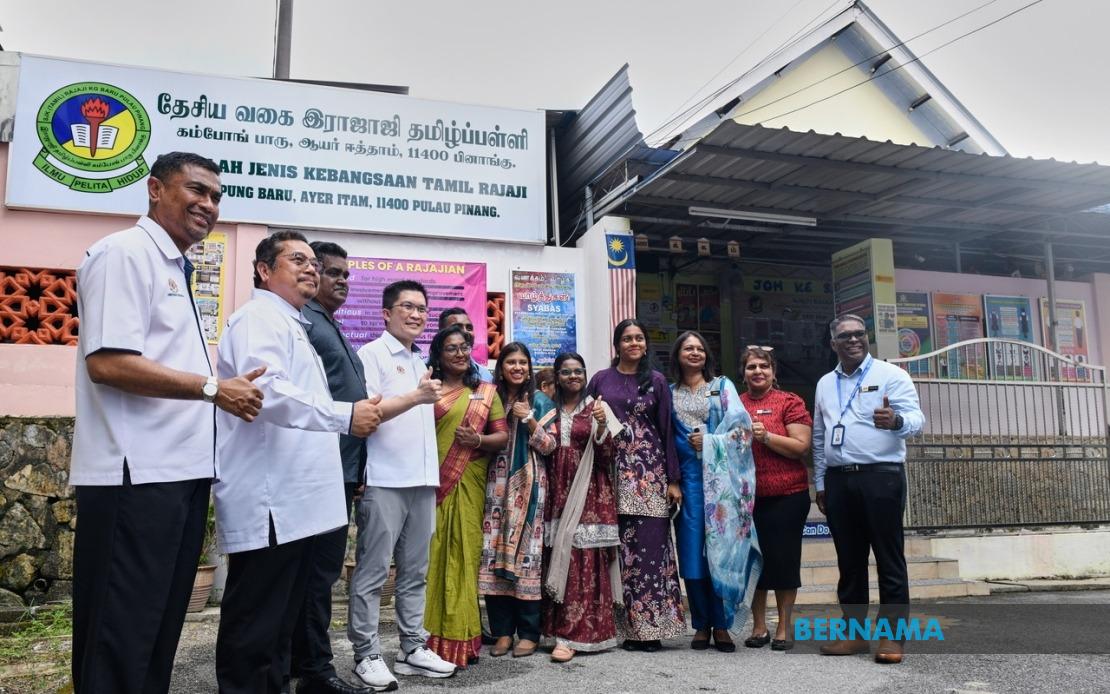
The Education Ministry has greenlit a significant infrastructure upgrade for SJKT Rajaji in George Town, approving an RM8 million project to construct a purpose-built campus at a new location in Farlim, Bandar Baru Ayer Itam. The decision addresses long-standing constraints that have hampered the institution's ability to serve its student community effectively, offering what Deputy Education Minister Wong Kah Woh characterised as a fresh beginning for the 76-year-old establishment.
Operating under increasingly difficult spatial limitations, SJKT Rajaji currently accommodates approximately 100 pupils in what officials acknowledge are inadequate facilities for modern educational delivery. The relocation marks a turning point after decades of operating within these confines, enabling the school to expand its physical infrastructure and provide students with contemporary learning environments. The scale of the investment—RM8 million—underscores government commitment to Tamil-medium education within the state's broader educational ecosystem.
According to Wong, the transition timeline spans 18 months from the commencement of construction, with the school expected to begin welcoming students at the new Farlim campus no later than the 2029 academic session. This measured schedule allows for systematic planning and execution while minimising disruption to the existing student population. The Penang state government had previously identified and approved a 2.3-acre parcel in Farlim—approximately 500 metres from the current location—as the relocation site in 2022, demonstrating sustained political will across multiple administrative levels.
The institutional pathway leading to approval involved the school's board of governors submitting a formal application to the Education Ministry last year. Wong noted that approval followed resolution of coordination issues with local authorities, highlighting the multi-agency collaboration required for such projects. The decision reflects acknowledgment within the ministry that Tamil national-type schools require targeted support to maintain educational quality and accessibility within their communities.
A distinguishing feature of this project involves its financing structure. Rather than relying entirely on government budgetary allocations, the RM8 million construction will be fully funded through a developer's corporate social responsibility initiative. This public-private partnership model demonstrates how commercial entities can contribute meaningfully to educational infrastructure while achieving their own CSR objectives. The arrangement alleviates immediate fiscal pressure on state resources while accelerating project realisation.
Penang's broader commitment to Tamil education infrastructure became evident through remarks by Datuk Seri S. Sundarajoo, who serves as State Housing and Environment Committee chairman and chairs the Penang Tamil Schools Special Committee. Sundarajoo emphasised that the SJKT Rajaji project represents one component within a comprehensive development agenda spanning Penang's 28 Tamil national-type schools. Several institutions are simultaneously advancing their own facility improvements, securing permanent operational sites, and implementing phased expansion projects.
The momentum across this network remains substantial. Sundarajoo indicated that at least three groundbreaking ceremonies for Tamil school projects are scheduled for the current year alone, signalling an acceleration in construction activity. Beyond new facilities, attention extends to revitalising existing institutions, with SJKT Sungai Bakap and SJKT Juru among those undergoing revival efforts. This multifaceted approach acknowledges that Tamil schools require differentiated support tailored to individual institutional circumstances.
For Malaysian Tamil communities, the investment carries symbolic and practical significance. Tamil-medium education maintains cultural and linguistic continuity while serving families seeking vernacular schooling within the national education framework. Infrastructure constraints often undermine the quality of provision in such institutions, creating disparities between vernacular schools and their Malay and English counterparts. The Farlim project directly challenges this inequity through substantial capital investment and improved physical learning spaces.
The regional context further illuminates the initiative's importance. Southeast Asia's Tamil-speaking diaspora communities increasingly advocate for educational equity and institutional development. State governments across Malaysia demonstrate varying commitment to supporting minority language schools, with Penang's approach positioning it as relatively progressive in this domain. The deliberate identification of funding mechanisms and timelines signals governmental responsiveness to community needs.
For stakeholders in Tamil education nationwide, the SJKT Rajaji approval provides a template for institutional advancement. The involvement of private sector partners, state-level coordination, and ministry endorsement creates a replicable model that could inform similar projects elsewhere. As Malaysian states grapple with questions of educational equity and resource allocation, demonstrating successful outcomes from such partnerships potentially encourages broader adoption.
The 18-month construction horizon and 2029 operational commencement represent ambitious yet achievable targets. Meeting these benchmarks requires coordinated effort from multiple agencies, including contractors, local authorities, and the ministry. For current SJKT Rajaji students and families, the timeline means that middle-school cohorts will likely transition to the new facility during their academic progression, experiencing the tangible benefits of expanded infrastructure during their formative years.
Looking forward, the successful delivery of this project will demonstrate whether public-private collaboration can effectively address infrastructure gaps in vernacular education sectors. Should the SJKT Rajaji initiative reach completion on schedule and within budget, it may catalyse additional partnerships supporting other Tamil schools facing similar constraints. The initiative thus transcends its immediate institutional context, potentially shaping educational development patterns across Malaysia's Tamil school network for years to come.