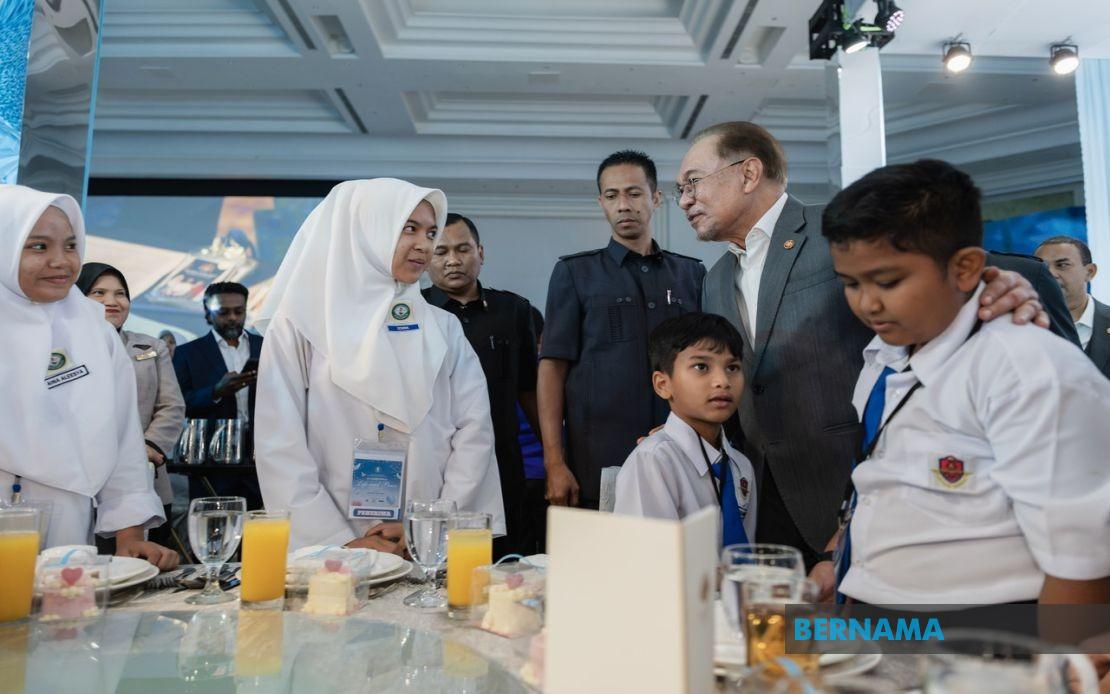
Prime Minister Datuk Seri Anwar Ibrahim has delivered a pointed message to young Malaysians about the limits of intellectual prowess when divorced from ethical living, warning that scholastic success without moral grounding ultimately benefits neither the individual nor society. Speaking to 700 pupils from 47 schools gathered in Kuala Lumpur and Putrajaya for a "Celebration of Life and Peace" event on July 15, Anwar articulated a vision of education that extends far beyond examination results and university placement—one that places character development and interpersonal respect at the centre of what it means to become an educated person.
The Prime Minister's remarks came as part of a broader appeal to parents, educators, and students themselves to recognise their collective responsibility in shaping the next generation. He posed a fundamental question to his young audience: what is the purpose of attending school if not to acquire both knowledge and wisdom, and to develop into individuals of substance and integrity? This framing challenges a narrowly academic understanding of educational success that has long dominated discourse in Malaysian schools, where competitive examination performance and entry into prestigious institutions often overshadow considerations of character or social responsibility.
Anwar specifically targeted bullying as a behaviour that undermines the entire educational project, characterising it as a gateway to a destructive adult life. His concern reflects mounting evidence from Malaysian schools and international research that bullying creates lasting psychological harm for both perpetrators and victims, often becoming a precursor to more serious antisocial conduct in adulthood. By naming bullying explicitly and linking it to personal failure, the Prime Minister attempted to reframe peer harassment not as a trivial schoolyard occurrence but as a serious impediment to healthy development and future success.
The appeal to students included practical exhortations—to work diligently at their studies, to show respect to teachers, and to honour their parents through both word and action. These directives reflect traditional Malaysian values of filial piety and respect for authority, principles that remain deeply embedded in the national educational philosophy and family structures. Yet Anwar's emphasis on love and prayer toward parents, rather than mere obedience, suggests a softer, more emotionally grounded interpretation of these traditional duties than the more rigid versions sometimes encountered in formal settings.
The event itself, organised by ERM Foundation to commemorate the birthdays of participating children and the founder Xin'er, embodied the values Anwar articulated. Each attending pupil received RM500 in financial assistance, a gesture that acknowledged the economic pressures many Malaysian families face while sending a symbolic message about the state's investment in youth development. Beyond the material provision, the celebration offered entertainment, food, and performances—elements designed to convey that childhood should encompass joy and community recognition, not merely academic striving.
Xin'er's remarks during the event expanded the discussion to encompass broader issues of childhood vulnerability and inequality. By noting that many children lack the opportunity to celebrate birthdays surrounded by community support or face health challenges that constrain their enjoyment of such occasions, she highlighted the disparities that shape childhood experiences across Malaysian society. This observation adds texture to Anwar's moral instruction—the recognition that not all young Malaysians begin from the same starting point, and that those fortunate enough to enjoy stable families and good health bear a responsibility to those whose circumstances are more constrained.
The attendance of Anwar's wife, Datuk Seri Dr Wan Azizah Wan Ismail, alongside political secretary Datuk Azman Abidin, lent institutional weight to the occasion and signalled the government's prioritisation of youth welfare. Such visible support from the country's highest leadership for an event centred on character building rather than policy announcement or political messaging represents a notable investment in softer forms of social influence—efforts to shape values rather than merely redistribute resources or implement programmes.
For Malaysian educators and parents grappling with contemporary challenges in schooling, Anwar's intervention offers both reassurance and challenge. The reassurance lies in official validation that their concerns about student conduct, empathy, and social responsibility matter at the highest levels of government. The challenge emerges in translating rhetorical commitment to character education into concrete institutional changes—revising curricula, training teachers in conflict resolution and social-emotional learning, and creating school environments where kindness is actively cultivated rather than merely praised in speeches.
The implicit tension in Anwar's message—between demanding high achievement and insisting on moral development—reflects a broader global concern about educational systems that inadvertently create pressure cookers where young people become academically accomplished but psychologically fractured or interpersonally destructive. Malaysia, like many high-performing East Asian education systems, has historically prioritised examination results, sometimes at considerable cost to student mental health and wellbeing. The Prime Minister's emphasis on balance suggests a recognition that this approach requires recalibration.
Bullying in Malaysian schools remains a documented concern, with periodic media reports of serious incidents involving physical violence, cyberbullying, and harassment along ethnic or socioeconomic lines. Addressing this phenomenon requires sustained effort across multiple fronts—awareness campaigns, peer-support systems, clear disciplinary policies, and perhaps most importantly, a cultural shift in which young people themselves internalise the understanding that harming others represents a betrayal of educational purpose rather than a minor transgression.
The choice to frame these messages directly to children rather than solely to adult audiences carries particular significance. By addressing the assembled pupils personally and even posing his ethical questions as commitments he asked them to make to him, Anwar attempted to create a sense of personal covenant—an appeal to their emergent sense of responsibility and capacity for moral reasoning. This approach treats young people as moral agents capable of understanding consequences and making better choices, rather than as passive recipients of instruction.
Looking forward, the sustainability of such messaging depends on reinforcement across home, school, and community settings. A single event, however well-intentioned and beautifully executed, cannot fundamentally reshape how Malaysian society values or cultivates character in young people. Yet moments like this, particularly when articulated by national leadership and amplified through media coverage, contribute to a broader conversation about what education is ultimately for—a conversation that seems overdue in a nation increasingly concerned about its young people's mental health, social cohesion, and long-term wellbeing alongside their academic and economic competitiveness.

