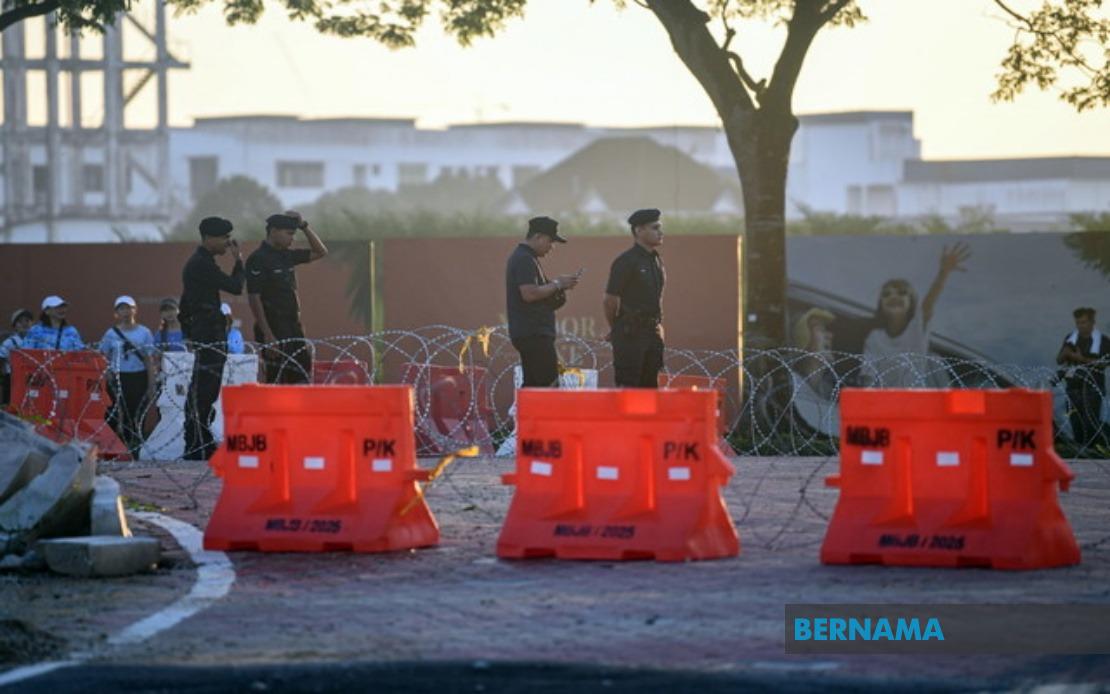
The 16th Johor State Election gathered momentum on June 27 as nomination centres across the state welcomed candidates and their supporters under favourable atmospheric conditions. The Election Commission established 56 polling and candidate registration centres across Johor to facilitate the first major phase of an election cycle that will culminate in voting on July 11. Weather forecasts proved broadly cooperative, with the Malaysian Meteorological Department predicting dry conditions through the morning hours, though afternoon thunderstorms were expected in scattered locations across the state.
Election officials commenced the formal nomination process at 9am, with a one-hour window designated for receiving nomination papers and conducting final verification procedures. At multiple centres, the proceedings unfolded with minimal disruption, reflecting weeks of coordination between the Election Commission and local authorities. Security arrangements had been positioned strategically to manage crowds and maintain orderly conduct, with uniformed and plainclothes personnel visible at each location. The precautions proved warranted, as enthusiasm from party workers materialised well before official opening times, with supporters gathering as early as 7.30am to demonstrate backing for their preferred candidates.
Johor's electoral landscape encompasses considerably more participants than routine domestic polls. The state legislative assembly commands 56 seats, making it a substantial political prize within Malaysia's federal system. The dissolution of the previous assembly on June 1 triggered the formal election timeline, with the Election Commission scheduling early voting for July 7 to accommodate military and police personnel. Ordinary polling will proceed five days later, on July 11, allowing sufficient interval for all preparatory arrangements and campaign activities to conclude. This spacing reflects established electoral practice intended to ensure voter accessibility whilst maintaining security and organisational efficiency.
The voter base mobilised for this election extends significantly beyond typical peninsular state contests. The Election Commission registered 2,727,926 eligible voters across multiple categories, segmented into distinct participation streams. Ordinary civilian voters constitute the overwhelming majority at 2,703,175 individuals, whilst military personnel and their spouses numbered 12,041 and police personnel with eligible household members totalled 12,710. This tri-partite division necessitates differentiated logistical arrangements, particularly the advance polling mechanism designed for security force personnel whose operational commitments may prevent standard voting day participation.
For Malaysian observers tracking regional political dynamics, Johor represents strategically significant terrain. The state's electoral outcomes influence broader peninsular political configurations and often signal shifts in voter sentiment that ripple through subsequent national deliberations. The scale of the voter roll, approaching 2.73 million individuals, ensures that campaign strategies and ground organisation reach intensity levels comparable to major urban centres. Parties contesting all 56 seats must coordinate extensive volunteer networks, media strategies, and candidate positioning across constituencies ranging from urban Johor Bahru to rural districts in the state's interior.
Nomination proceedings themselves serve as preliminary indicators of candidate quality, party internal hierarchies, and last-minute strategic positioning. The orderly atmosphere observed across centres suggests that both Election Commission preparations and party discipline functioned as intended. Whilst supporter enthusiasm generated notable crowd presence, the absence of reported incidents indicates that security arrangements successfully balanced accessibility with maintaining procedural integrity. Such observations matter considerably in Malaysian electoral contexts, where nomination days historically occasionally witness confrontational moments reflecting underlying political tensions.
The weather cooperation observed throughout June 27 carried practical implications for both election officials and participating candidates. Clear morning conditions allowed unobstructed movement of nomination submissions and documentation processing, whilst predicted afternoon thunderstorms did not materialise severely enough to disrupt proceedings. The Malaysian Meteorological Department's forecast accuracy—or fortunate accuracy—meant that contingency plans requiring deployment of covered registration areas remained unnecessary. Such operational smoothness, though sometimes overlooked by observers, contributes substantially to public confidence in election administration processes.
Looking forward to the subsequent phases, the compressed timeline between nomination and polling introduces particular pressures on campaign operations. Candidates have precisely two weeks to mobilise support, communicate policy positions, and consolidate voter backing before ballots are cast. Early voting on July 7 will commence voting four days before the main polling day, potentially affecting campaign intensity and momentum timing. The two-stage voting arrangement reflects contemporary Malaysian electoral practice adapted to accommodate professional and security force participation, though it also distributes voting activity across a wider window that campaigns must navigate strategically.
The composition of the 2.73 million voter population carries demographic and political significance. Johor has experienced internal migration flows, with younger populations in urban areas and established residential communities in smaller towns each demonstrating distinct electoral inclinations. Candidates and parties must address regionally specific concerns ranging from infrastructure and employment in developed areas to agricultural and rural service provision in peripheral locations. The inclusion of military and police voters, whilst numerically modest, carries symbolic weight reflecting established Malaysian practice of honouring security force participation in democratic processes.
Stakeholders observing these developments include federal ruling coalitions, state opposition blocs, and independent candidates pursuing representation for particular constituencies or identity-based movements. Johor's position as an economically dynamic state with substantial manufacturing, logistics, and service sectors means that economic policy positions and employment-related campaign messaging carry tangible resonance. The state also maintains historical significance within Malaysian political narratives, adding layers of meaning to electoral outcomes beyond immediate parliamentary mathematics.
As candidates formally entered the electoral process through nomination submissions, the institutional machinery activated across 56 locations demonstrated the scale and coordination required for managing democracy in Malaysia's second-largest state. The procedural regularity observed during June 27 proceedings established baseline expectations for subsequent campaign phases and voting day administration. Regardless of forecast afternoon weather patterns and individual candidate fortunes, the nomination process concluded substantially as intended, positioning the competition for Johor's 56 assembly seats to advance toward July's decisive balloting.

