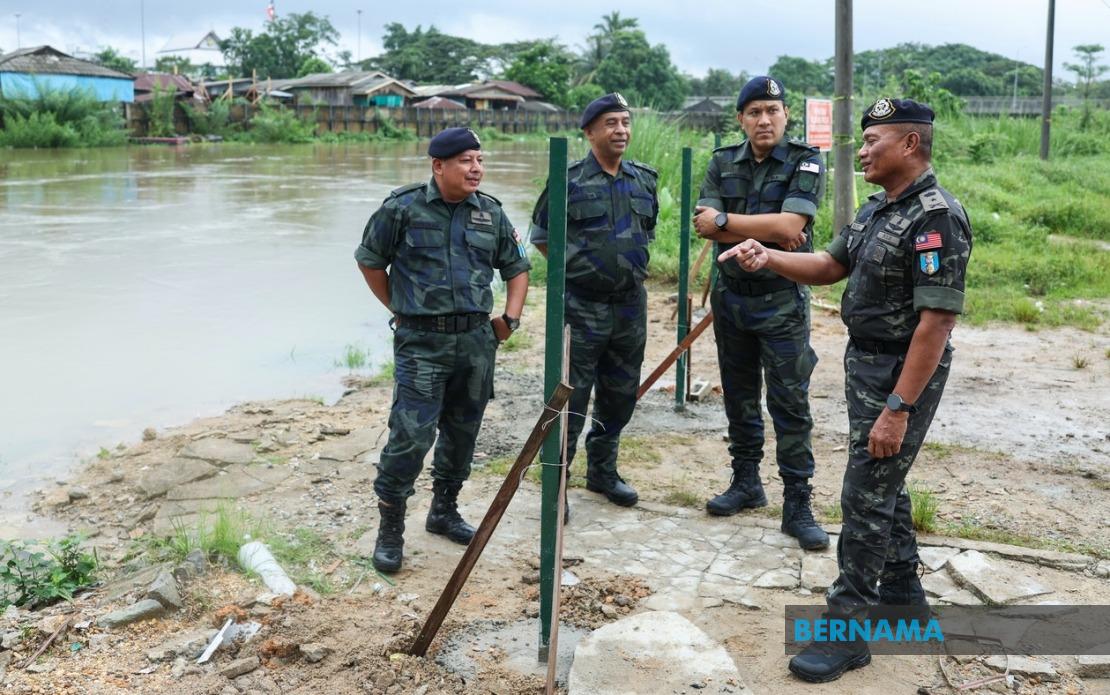
Malaysia's border security agencies are grappling with an evolving smuggling strategy that fragments migrant movements into smaller units to circumvent detection systems. The General Operations Force's 8th Battalion uncovered this tactical shift during Operasi Taring Wawasan Kelantan in Pasir Mas, Kelantan yesterday, resulting in the arrest of 13 Myanmar nationals who had entered the country through illegal channels.
According to Southeast Brigade GOF commander SAC Ahmad Radzi Hussain, the syndicate's revised approach involves transporting undocumented migrants in dispersed waves rather than consolidated groups, substantially complicating interception efforts. This methodological change reflects an adaptation by trafficking networks to security force patterns and technological capabilities. The operation itself began at approximately 3.30 am when GOF personnel detected a suspicious Proton Exora in Kampung Banggol Kemian. When the driver spotted the security presence, he abandoned the vehicle and fled into nearby forest, ultimately evading capture.
Inside the abandoned car, authorities discovered four Myanmar men sitting in the rear seats, all unable to produce legitimate travel documentation. Within roughly an hour, follow-up searches of the surrounding forest terrain led to the apprehension of nine additional Myanmar nationals believed to have recently crossed into Malaysian territory via unauthorized routes. The 13 detainees, whose ages ranged from 20 to 37 years old, included five women. Their accounts to investigators revealed the trafficking methodology: two unnamed individuals had shuttled them across the Golok River from Thailand, deliberately spacing out deliveries across different forest locations to minimise the conspicuousness of any single transit movement.
This incremental dispersal strategy represents a significant concern for Southeast Asian border management. Rather than moving entire groups as single units—a practice that generates larger detection footprints—smugglers now orchestrate what amounts to a relay system. Migrants are deposited sequentially at different waypoints within forested areas, reducing the temporal and spatial concentration of any single crossing event. For overwhelmed security forces with finite surveillance capacity, distinguishing between isolated individuals and coordinated migration flows becomes substantially more difficult.
The arrested migrants indicated their ultimate destination was the Kuala Lumpur metropolitan region, where employment opportunities in informal sectors remain accessible to undocumented workers. This pattern aligns with broader Southeast Asian labour migration dynamics, whereby workers from economically disadvantaged Myanmar communities seek positions in construction, manufacturing, and domestic services across Thailand, Malaysia, and other receiving economies. The economic incentives driving these movements persist regardless of enforcement intensity, creating sustained pressure on border infrastructure.
Beyond the individual arrests, authorities seized the Proton Exora utilised for transportation, valued at approximately RM30,000. This vehicle recovery represents tangible asset disruption but speaks to the relatively modest financial exposure trafficking networks face when individual operations are compromised. The economics of migrant smuggling suggest that losing a RM30,000 vehicle constitutes an acceptable operating cost when successful movements generate substantially higher revenues across multiple migrants.
The Golok River crossing point, which divides Malaysia from Thailand, has long functioned as a porous transit zone for undocumented migration. Despite physical barriers and regular enforcement activities, the river's geography and the remote nature of surrounding terrain create inherent vulnerabilities. Smuggling networks possess intimate knowledge of seasonal water conditions, optimal crossing windows, and patrol patterns, allowing them to time movements strategically. This operational intelligence, accumulated across years of activity, provides trafficking organisers with tactical advantages that persist even as enforcement agencies rotate personnel and modify patrol tactics.
Investigations into the arrested individuals proceeded under Section 6(1)(c) of the Immigration Act 1959/63, the statutory framework governing illegal entry offences. The CID of Pasir Mas district police headquarters assumed investigative responsibility, examining chains of custody, transportation logistics, and potential connections to larger smuggling networks. Such investigations rarely prosecute only the migrants themselves; authorities typically pursue higher-level organisers and local facilitators who coordinate movements and arrange onward transport.
For Malaysia's policy framework, this operational evolution underscores persistent challenges in managing irregular migration through conventional enforcement approaches. When smuggling networks successfully adapt to detection methods by fragmenting movements, larger enforcement capacity becomes necessary to maintain the same statistical intercept rates. The small-group tactic essentially requires security forces to identify not consolidated trafficking events but rather dispersed individual movements—a substantially more resource-intensive surveillance requirement.
Regional cooperation mechanisms, particularly between Malaysian and Thai authorities, represent a critical but often complicated response vector. Cross-border intelligence sharing, joint patrols, and coordinated operations targeting smuggling networks at origin or transit points offer greater potential impact than purely domestic enforcement. However, variation in enforcement capacity, differing legal frameworks, and competing national priorities frequently constrain such collaboration. Thailand itself faces significant migrant pressures from Myanmar, creating circumstances where Thai border management focuses primarily on preventing onward movement rather than comprehensive source control.
The broader context involves Myanmar's ongoing instability, which generates sustained displacement and economic desperation. Since the February 2021 military coup, hundreds of thousands of Myanmar citizens have sought refuge or income opportunities across neighbouring countries. This supply-side pressure ensures continuous demand for smuggling services regardless of enforcement intensity. Until Myanmar's political and economic circumstances stabilise—a prospect appearing remote in the near term—migration pressures will persist, and smuggling networks will continue innovating their operational methodologies.
For Malaysia specifically, the incident illustrates how border security agencies must simultaneously contend with evolving smuggler tactics, limited enforcement resources, and the structural economic factors driving migration. Incremental improvements in detection capacity, whether through enhanced surveillance technology, expanded personnel deployment, or improved regional coordination, address symptomatic challenges rather than underlying causal dynamics. Longer-term policy approaches addressing labour market integration of migrant workers, formalisation of migration channels, and development assistance to source countries may prove more consequential than enforcement escalation alone.

