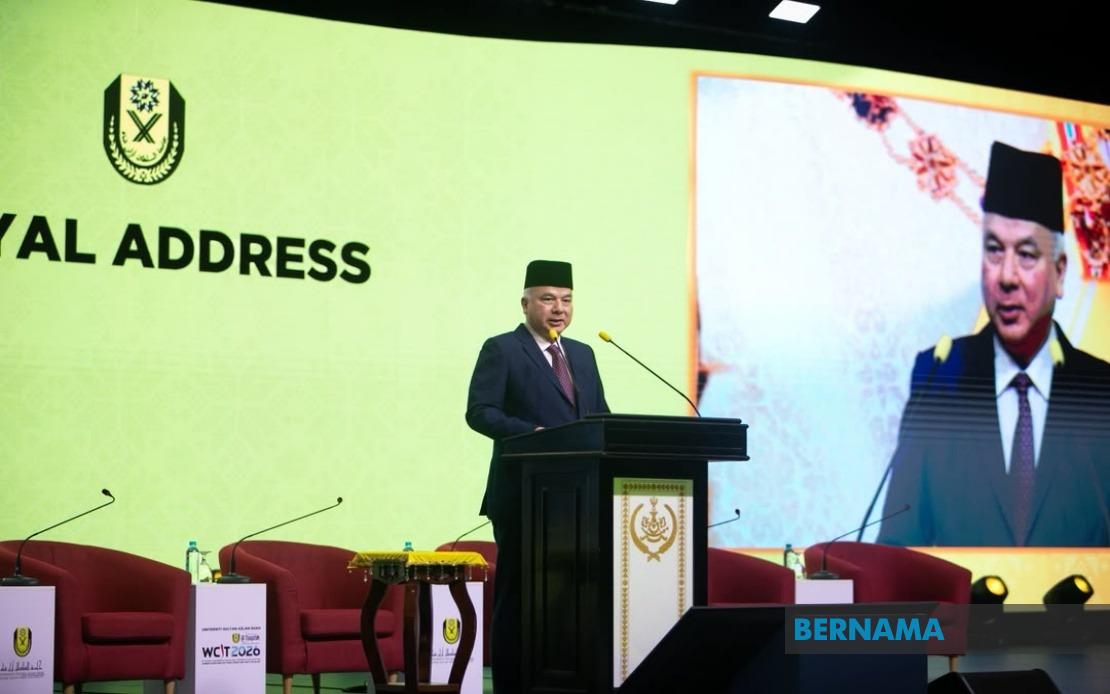
The Sultan of Perak, Sultan Nazrin Shah, has made a compelling case that lasting national security stems not from military fortifications or cyber defences, but from the bonds that tie a society together. Speaking at the 8th World Conference on Islamic Thought and Civilisation in Ipoh, His Royal Highness articulated a vision of security that extends well beyond the conventional framework of border protection and countering extremism, instead rooting it in the fundamental question of whether citizens feel they truly belong to their nation.
While conventional security measures remain necessary, Sultan Nazrin cautioned that they are insufficient without a foundation of social cohesion. He pointed to a paradox that confronts many developing nations: a country may successfully repel external threats and maintain strict order, yet still collapse from within if its people feel disconnected from its institutions and each other. This observation carries particular weight for Malaysia, a multicultural democracy that has managed relative stability despite deep religious, ethnic, and economic divisions. The Sultan's framing suggests that the greatest risk to national security may not come from abroad but from the gradual erosion of trust between communities.
A significant concern raised by Sultan Nazrin was the deliberate manipulation of religious conviction to serve narrow political objectives. He warned that faith is increasingly weaponised to drive wedges between citizens rather than unite them, a phenomenon that threatens the inclusive vision Islamic thought is meant to embody. This warning resonates across Southeast Asia, where religious identity has become a tool in electoral politics and social mobilisation. The statement appears directed at domestic political actors who exploit sectarian sentiment, a practice that has intensified in recent years despite pledges by successive Malaysian governments to uphold religious harmony.
Central to Sultan Nazrin's argument is the concept of shared national belonging. He stressed that true integrity cannot be constructed through force or suppression of dissenting voices, but only by ensuring that all communities—regardless of ethnicity or religious affiliation—see their interests reflected in the nation's laws, economic opportunities, educational institutions, and political leadership. This principle challenges Malaysia's current approach in several areas. Educational systems that remain largely segregated, economic disparities between regions and communities, and leadership structures that underrepresent certain groups all undermine the sense of equal stakes in national success that Sultan Nazrin identifies as fundamental.
The distinction the Sultan drew between unity imposed through coercion and unity built on genuine belonging offers a useful analytical framework for understanding social fragility. Brittle unity—achieved through surveillance, restrictions on speech, or enforcement of conformity—can shatter suddenly when circumstances change or enforcement weakens. By contrast, resilient unity emerges when citizens voluntarily identify with national goals because they see themselves in national institutions and feel their voices matter. This framework suggests that Malaysia's occasional lapses in civil liberties, while perhaps effective in the short term, may ultimately undermine the deeper security the nation requires.
On the question of education, Sultan Nazrin outlined a comprehensive vision that goes beyond traditional school expansion to encompass a fundamental reimagining of how societies prepare young people for an increasingly complex world. He advocated for robust investment in both science and mathematics alongside the humanities and arts, recognising that a complete education must develop both technical and creative capacities. This balanced approach contrasts with the tendency in many Asian nations to emphasise STEM fields at the expense of critical thinking and moral philosophy, often producing technically skilled but intellectually narrow graduates.
The Sultan's commentary on vocational and technical education carries particular significance for Southeast Asia, where skilled trades remain essential to economic development yet carry lower social prestige than university degrees. By insisting that vocational pathways deserve equal dignity and investment as academic routes, he challenges the credential inflation that has consumed many Malaysian families, leading them to pursue university education even for careers that would be better served by technical training. This reframing could help address skills shortages in construction, manufacturing, and services while reducing the burden on higher education systems.
Addressing the challenge of artificial intelligence, Sultan Nazrin articulated a response that distinguishes between information retrieval—where machines excel—and the distinctly human capacities of critical analysis, ethical reasoning, creativity, and adaptability. His observation that rote memorisation and standardised testing served an industrial economy but are poorly suited to an AI era has profound implications for Malaysian education policy. Current examination-driven systems, which reward retention over reasoning, prepare students for a world that no longer exists. The Sultan's emphasis on cultivating the uniquely human capacities that machines cannot replicate suggests a needed pivot in educational philosophy.
Partially implicit in Sultan Nazrin's remarks is a framework for understanding Islamic education that bridges traditional and contemporary concerns. He notes that properly conceived Islamic education has always sought to develop both revealed knowledge and rational inquiry, making it well-suited to cultivating the critical thinking and ethical reasoning demanded by modernity. This contrasts with narrow interpretations of Islamic education that emphasise rote learning of religious texts or contemporary approaches that treat Islam as separate from scientific and philosophical inquiry. The Sultan's position suggests that Islamic educational institutions, if properly developed, could lead rather than lag in preparing students for the modern world.
The presence of Deputy Prime Minister Datuk Seri Fadillah Yusof and Perak Menteri Besar Datuk Seri Saarani Mohamad at the conference underscores the government's acknowledgment of these issues, at least at the rhetorical level. However, the gap between such statements and actual policy implementation remains substantial. Malaysia's education system continues to emphasise examination performance, its vocational pathways remain underfunded relative to academic routes, and its governance structures continue to reflect historical imbalances. The true test of Sultan Nazrin's vision will be whether political leaders translate these principles into concrete reforms that meaningfully expand opportunities and ensure genuine inclusion.
For Malaysia and broader Southeast Asia, Sultan Nazrin's message offers a reorientation of security thinking away from spending on defence and surveillance toward investment in the conditions that create genuine social belonging. This approach acknowledges that security is ultimately psychological and social rather than merely military. It suggests that nations which neglect the sense of stake and belonging among their citizens are building on sand, regardless of the sophistication of their security apparatus. As Malaysia navigates deepening political divisions and competing visions of national identity, the Sultan's emphasis on shared belonging may represent a necessary corrective to zero-sum approaches that treat national questions as battles to be won rather than challenges to be solved collectively.

