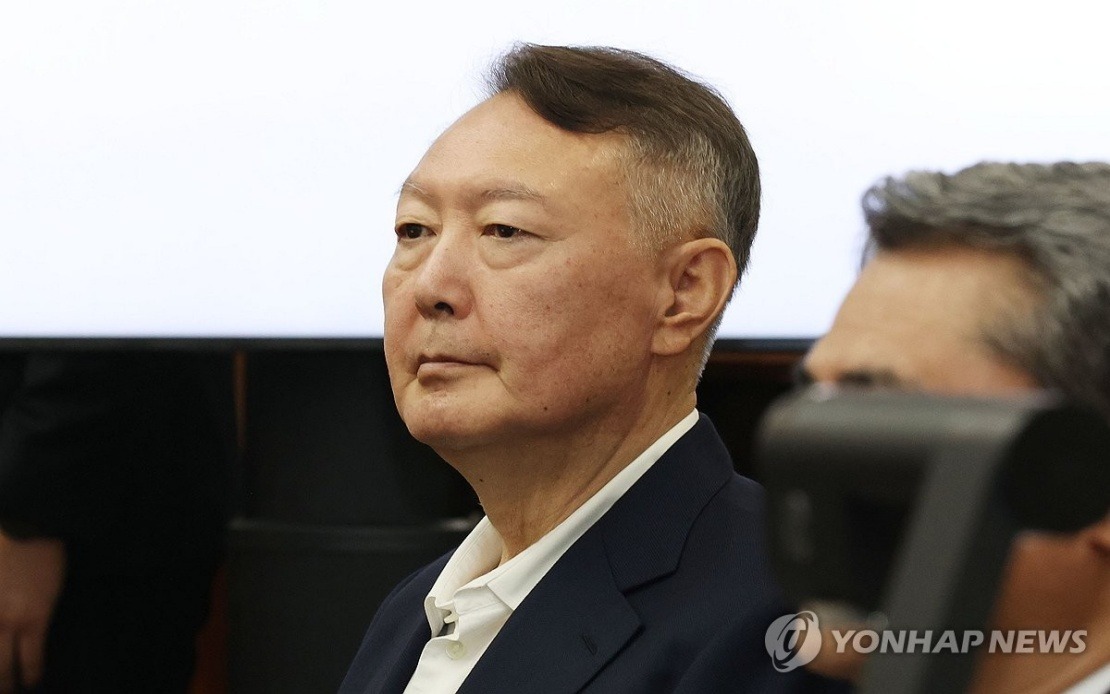
A Seoul district court has handed down a two-year prison sentence to former South Korean President Yoon Suk Yeol after finding him guilty of violating the country's Political Funds Act through the acceptance of illegal campaign support. The Seoul Central District Court's conviction marks a significant legal blow to the embattled former leader, who continues to face multiple trials stemming from his failed attempt to impose martial law in December 2024. The ruling underscores the judiciary's willingness to pursue high-level political corruption cases, a development that carries implications for South Korea's democratic institutions and governance standards that regional observers closely monitor.
At the heart of the case lies an arrangement involving self-proclaimed power broker Myung Tae-kyun, who allegedly provided Yoon with opinion polling services free of charge between April 2021 and March 2022. The court determined that Yoon received 14 of these polls without compensation, amounting to roughly 270 million won in undisclosed support. Rather than purchasing these services through legitimate commercial channels, as standard practice would require, the former president obtained them under an informal arrangement that prosecutors successfully characterized as an illegal political contribution. This method of financing campaign activities circumvents transparency requirements embedded in South Korea's electoral laws, allowing politicians to secure valuable research data without public disclosure.
The prosecution team, led by special counsel Min Joong-ki, had alleged that Yoon engaged in collusion with his wife, former first lady Kim Keon Hee, to orchestrate the arrangement with Myung. Prosecutors contended that Yoon made explicit promises to support former representative Kim Young-sun's nomination as a conservative People Power Party candidate in parliamentary by-elections scheduled for June 2022. In exchange for this political endorsement, Myung supplied the opinion polls at no cost, effectively converting polling data into an unlisted campaign contribution. The court's acceptance of this quid pro quo arrangement demonstrates how Korean jurisprudence addresses cases where political favors are exchanged through indirect means rather than direct monetary transfers.
The sentencing reflected a middle ground between prosecution demands and potential leniency. Prosecutors had sought a four-year prison term for Yoon and three years for Myung, but the court imposed only two years on the former president and eighteen months on the power broker. This discrepancy between prosecution requests and judicial sentences often reflects judicial skepticism regarding specific elements of the case or consideration of mitigating factors. The court also ordered Yoon to forfeit 13.96 million won, partially compensating for the value of services received through improper channels. Such financial penalties, while symbolic, demonstrate the judiciary's intent to impose concrete consequences beyond incarceration.
The conviction of Yoon contrasts strikingly with the acquittal of his wife in a related proceeding before the Seoul High Court. That appellate panel ruled in April that Kim Keon Hee could not be considered to have profited from the free opinion polls, reasoning that Myung had distributed similar services to other individuals as well. The court essentially concluded that the provision of polling data to multiple recipients undermined the characterization of it as a targeted political contribution. This divergence between the fates of husband and wife reveals inconsistencies in how the judiciary evaluates similar conduct, a discrepancy that Min's prosecution team has challenged through appeal. Such legal splits create uncertainty about the boundaries of acceptable political financing and raise questions about whether comparable actions deserve uniform treatment under law.
For Malaysian and Southeast Asian observers, the Yoon case illustrates the mechanisms through which developed democracies attempt to police political corruption and enforce campaign finance regulations. South Korea maintains relatively robust institutional frameworks for investigating and prosecuting high-ranking officials, including independent prosecutors' offices and appellate courts willing to reverse convictions when evidence proves insufficient. The persistence of the special counsel team in pursuing multiple trials against a sitting president—later superseded by a successor—demonstrates institutional resilience even when political circumstances change. By contrast, many regional governments struggle to maintain equivalent investigative capacity or judicial independence when cases implicate former leaders or politically sensitive figures.
The timing of these convictions assumes heightened significance given Yoon's broader legal predicament. In February, a separate court sentenced him to life imprisonment for orchestrating the failed martial law declaration, the most serious charge he faces. That conviction rested on accusations of leading an insurrection through his short-lived attempt to suspend constitutional governance, a crime that carries maximum penalties under South Korean law. The accumulation of multiple sentences across different trials—one for campaign finance violations and another for attempted emergency rule—suggests systematic judicial pursuit rather than isolated prosecutions. Whether these sentences will ultimately stand depends on appellate review processes that may take years to conclude.
The political dimensions of the Yoon prosecutions warrant careful consideration. Critics contend that aggressive pursuit of a former president by prosecution teams and courts representing the current administration raises questions about weaponization of the justice system for partisan advantage. Supporters counter that rule of law requires equal application of legal standards regardless of political status, and that shielding former leaders from accountability corrodes democratic institutions. This tension between accountability and the risk of politicized justice animates debates across East Asia, where transitions of power sometimes trigger prosecutions of predecessors. Southeast Asian governments frequently cite concerns about selective justice when evaluating whether to strengthen independent prosecutorial offices, creating a dilemma between institutional strength and potential partisan abuse.
The opinion polling component of the charges reveals how modern political campaigns generate vulnerabilities to corruption that traditional frameworks may inadequately address. Opinion research has become essential to competitive campaigns, commanding significant budgets and strategic importance. When politicians obtain such services through informal channels rather than transparent purchases, they gain undisclosed advantages while reducing accountability for campaign spending. The Yoon case suggests that Korean law enforcement recognizes this emerging risk and seeks to prevent it through aggressive prosecution. Regional democracies increasingly grapple with similar questions about the treatment of in-kind contributions, particularly when they involve valuable services like research, advertising production, or data analysis provided informally by supporters.
Looking forward, the Yoon prosecutions will likely influence how South Korean political actors approach fundraising and campaign support strategies. The demonstrated willingness of courts to convict high-ranking figures based on circumstantial evidence of quid pro quo arrangements may encourage greater formality and transparency in political finance. Conversely, ambitious politicians might develop more sophisticated methods of securing support while maintaining plausible deniability about coordinated arrangements. The special counsel team's pursuit of additional cases against Yoon and associates suggests that Korean authorities view the broader 2024 martial law affair as symptomatic of deeper governance failures requiring systematic correction through multiple trials and convictions. Whether these efforts ultimately strengthen democratic accountability or generate backlash that undermines institutional credibility remains an open question with implications extending throughout the region.

