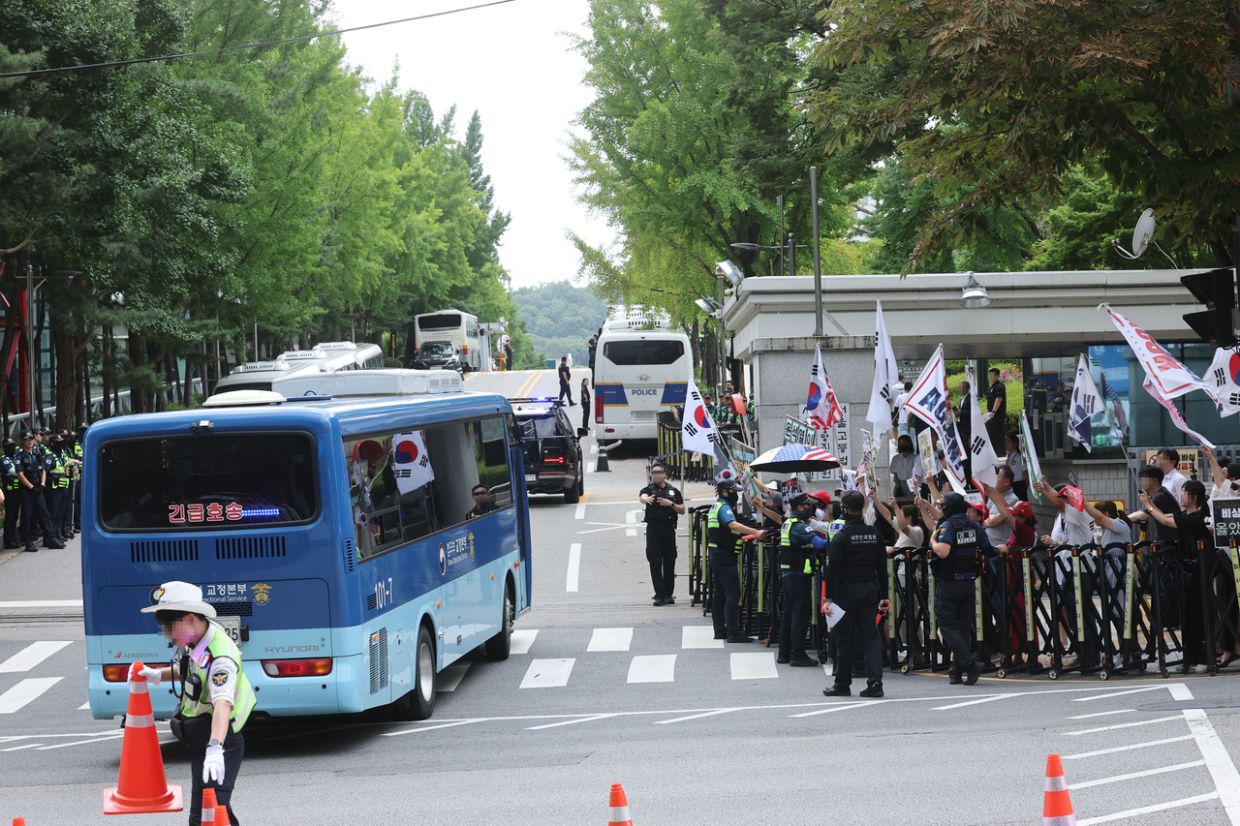
Former South Korean President Yoon Suk Yeol received a two-year prison sentence on Monday following his conviction for illegally accepting free political polling services during his presidential campaign. The Seoul Central District Court determined that Yoon had violated the Political Funds Act by receiving 14 surveys worth approximately 27.92 million won ($18,600) from political broker Myung Tae-kyun without proper disclosure or compensation. This ruling represents a watershed moment in South Korea's ongoing efforts to enforce campaign finance regulations and hold senior political figures accountable for electoral misconduct.
The court's investigation traced the arrangement back to the period between June 2021 and March 2022, when Yoon was actively campaigning for the presidency. Prosecutors had initially alleged that Yoon, together with his wife former first lady Kim Keon Hee, conspired to receive as many as 58 free surveys valued at over 270 million won from Myung during this timeframe. However, the court found sufficient evidence to convict Yoon in connection with only 14 of these polls, adopting a more conservative assessment of the actual financial benefit he derived from the arrangement. This discrepancy between the prosecution's broader allegations and the court's narrower conviction underscores the evidentiary challenges inherent in proving campaign finance violations.
Presiding Judge Lee Jin-gwan articulated a principled defense of the court's decision, emphasizing that opinion polls serve as crucial instruments in democratic electoral contests. The judge noted that when surveys and their results are provided outside the regulatory framework governing political contributions, they create substantial risks to the integrity of the democratic process. By circumventing campaign finance disclosure requirements, the receipt of free polling services allows candidates to gain unfair informational advantages while obscuring the true sources and value of resources deployed in their campaigns. This reasoning reflects international concerns about maintaining transparency in electoral financing and preventing wealthy individuals or organizations from gaining disproportionate influence over political outcomes.
The mechanism of the alleged quid pro quo arrangement also figured prominently in the court's analysis. The court found that Kim Keon Hee had effectively delegated control over the timing, content, methodology, and dissemination of the polling data to Myung, and that Yoon had been aware of this arrangement and tacitly accepted it. More significantly, the court determined that Yoon had promised Myung that former lawmaker Kim Young-sun would receive the ruling People Power Party's nomination for elected office in return for the provision of the free polling services. Though prosecutors had emphasized the quid pro quo element, the court stressed that establishing a direct exchange of favours was not technically necessary to prove a violation of the Political Funds Act, focusing instead on the improper receipt of valuable services.
In executing his influence over the nomination process, Yoon allegedly worked through Chang Je-won, who served as chief of staff to the president-elect, to ensure that Kim Young-sun would secure the party's endorsement. This arrangement suggests a systematic effort to coordinate campaign resources, polling intelligence, and political patronage in order to advance both Yoon's own electoral prospects and the political fortunes of his ally within the ruling party structure. Such coordination raises broader questions about the relationship between campaign financing and the distribution of party nominations and other political benefits in South Korea's system.
In a parallel development that highlights the complexity of the case, political broker Myung Tae-kyun received an 18-month prison sentence and was taken into custody immediately following the Monday ruling. Myung's conviction and imprisonment represent the judicial system's determination that his role in facilitating the improper provision of polling services constituted a serious breach of campaign finance law. The relative disparity between Myung's 18-month sentence and Yoon's two-year sentence reflects judicial assessment of their respective roles and culpability in the scheme.
The court's ruling in Yoon's case stands in marked contrast to the treatment of parallel allegations involving Kim Keon Hee in a separate legal proceeding. The former first lady was acquitted at both the trial and appellate court levels on related charges stemming from the same polling services provided by Myung. Judge Lee specifically noted that the circumstances surrounding the polling services in Kim's case and those in Yoon's case could not be considered legally identical, though both matters involved the same provider and roughly the same timeframe. In Kim's case, the lower courts found that prosecutors had failed to establish that she had received a measurable financial benefit equivalent to the market value of the surveys or that the polling services were provided specifically in exchange for Kim Young-sun's party nomination.
This divergence in outcomes between Yoon and Kim raises important questions about how South Korean courts differentiate between similar factual circumstances and the evidentiary standards applied in campaign finance cases. The Supreme Court is scheduled to deliver a final ruling in Kim's case on Thursday, which may either affirm the acquittals or remand the matter for further proceedings. That decision could provide additional clarity on the legal standards governing the receipt of undisclosed campaign services and the circumstances under which political figures can be held financially accountable for such receipts.
For Malaysian and Southeast Asian observers, the Yoon case offers instructive lessons about the institutional mechanisms available for enforcing campaign finance regulations against high-ranking officials. South Korea's independent judiciary and specialised oversight bodies have demonstrated capacity to investigate and prosecute sitting or former leaders, a function that remains inconsistently developed across the region. The willingness of courts to impose custodial sentences on former heads of state for electoral misconduct reflects a particular commitment to the principle that no political figure should enjoy immunity from accountability for breaches of campaign finance law. However, the case also illustrates the practical difficulties inherent in proving the value and intent of in-kind contributions, particularly when services like polling are provided informally or through intermediaries.

