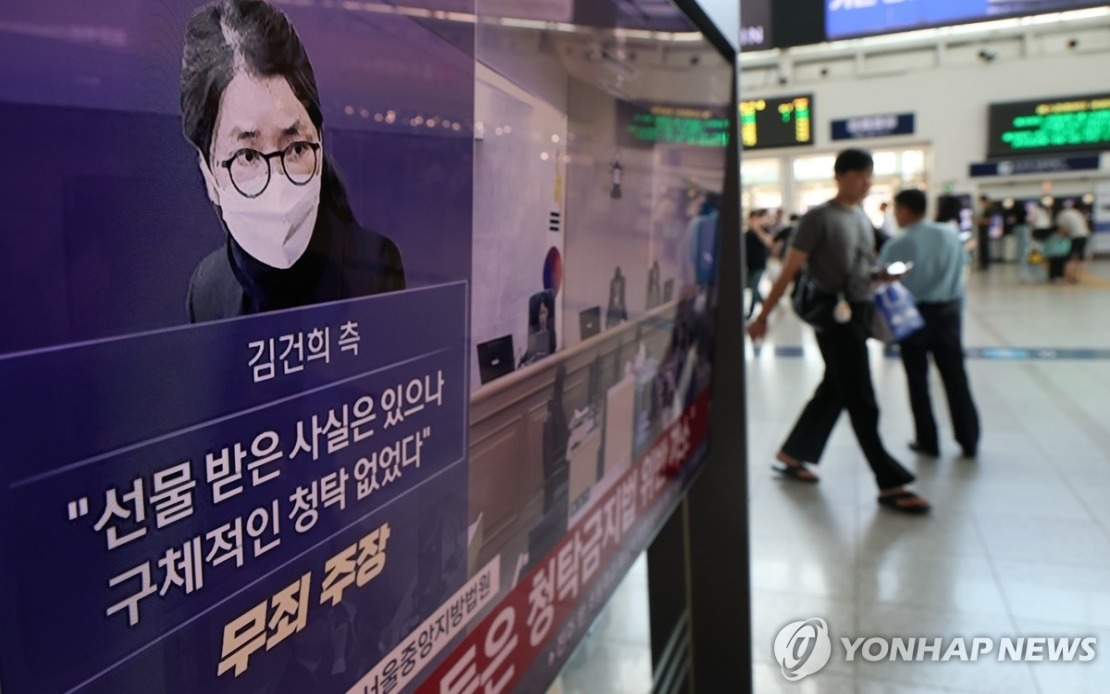
A Seoul court has handed down a seven-year prison sentence to Kim Keon Hee, the former first lady of South Korea and wife of ousted president Yoon Suk Yeol, after finding her guilty of accepting costly gifts in exchange for securing government appointments and corporate favours. The ruling on Friday represents one of the most significant corruption convictions involving a former presidential spouse in recent South Korean political history, underscoring the extent of institutional safeguards meant to prevent abuse of high office by family members of elected leaders.
The Seoul Central District Court determined that Kim received gifts totalling approximately 300 million won across a series of transactions, though the most prominent allegation involved a Van Cleef & Arpels necklace and additional jewellery valued at over 100 million won. According to court findings, she accepted this luxury jewellery from a construction company chairman in exchange for using her influence to secure a government position for his son-in-law, exemplifying how proximity to power can be leveraged for personal gain through intermediaries seeking official favours.
Presiding judge Cho Sun-pyo delivered scathing remarks during the televised hearing, stating that Kim had fundamentally betrayed the dignity of her role by treating the position of first lady as a vehicle for private enrichment rather than public service. The judge's assessment went beyond the immediate criminal conduct to address the broader erosion of public trust that occurs when those in elevated positions exploit their access to power for material advantage. This framing is particularly significant in the Korean context, where institutional legitimacy and public confidence in government structures have repeatedly been tested by high-profile corruption scandals involving former political families.
The evidence presented during the trial documented a pattern of gift-giving spanning from March 2022 through September 2022, largely coinciding with her husband's presidency between May 2022 and his removal from office in April 2025. Among the items detailed in the indictment was a Dior bag valued at 5.4 million won received from a pastor, a golden turtle ornament from Lee Bae-yong, a former head of the National Education Commission, and a Vacheron Constantin watch from another businessman. Additionally, Kim was accused of receiving a painting by renowned artist Lee Ufan from a former prosecutor in February 2023 in return for her assistance in securing him a party nomination.
The court found particularly damning Kim's attempts to minimize her culpability once investigations commenced. When officials began examining her conduct, she either returned certain items or claimed to have purchased them herself—actions the judge interpreted as clear acknowledgement of wrongdoing and an effort to obscure the transactional nature of these exchanges. Such defensive manoeuvres, rather than demonstrating innocence, were construed by the bench as consciousness of guilt and awareness that her actions violated legal and ethical standards.
Special counsel Min Joong-ki's investigation team, which had sought a marginally harsher sentence of seven and one-half years, expressed satisfaction with the outcome. However, Kim's legal representatives have signalled their intention to challenge the conviction through the appeals process, suggesting the case may continue to consume judicial resources as it moves through higher court levels. The extended legal proceedings typical of high-profile corruption cases in South Korea often prolong public discourse around governance failures and institutional accountability.
Co-defendants in the case received more lenient treatment. The construction company chairman who provided the primary bribe received a one-year prison sentence suspended for two years, effectively allowing him to avoid immediate incarceration. The businessman who gifted the watch faced a ten-month suspended sentence, while the pastor was handed a fine of 8 million won. These disparities reflect judicial recognition of the primary culpability of Kim as the official wielding influence, though critics may argue they raise questions about whether corporate actors received insufficient accountability for their participation in corrupt transactions.
This conviction compounds Kim's legal troubles. She had already been sentenced by an appeals court to four years imprisonment in a separate corruption matter, and multiple sentences may be served concurrently or consecutively depending on judicial determinations. Furthermore, she faces additional trial proceedings related to allegations that members of the Unification Church were coerced into joining the People Power Party ahead of the 2022 presidential election in an apparent effort to influence her husband's successful bid for the party's presidential nomination. These cascading legal challenges paint a portrait of systemic governance dysfunction during the Yoon administration.
The case resonates beyond South Korea's borders, offering instructive parallels for Southeast Asian democracies grappling with similar corruption challenges. Malaysia, Indonesia, the Philippines, and Thailand have each confronted comparable scandals involving family members of political leaders exploiting official proximity for financial gain. The South Korean precedent of prosecuting and convicting a former first lady demonstrates that even in established democracies, anti-corruption infrastructure can function effectively when political will aligns with institutional independence, though the outcome depends heavily on factors including media scrutiny, opposition party pressure, and the timing of investigations relative to shifts in political power.
The conviction also illuminates broader vulnerabilities in how governmental systems manage conflicts of interest and the informal networks through which power circulates. The gift-giving pattern documented in Kim's case—high-value luxury items from businesspeople seeking appointments and regulatory favours—reflects a particular manifestation of corruption wherein physical exchanges of expensive goods serve as documentation of quid pro quo arrangements. Understanding these transaction patterns remains essential for compliance officers, investigators, and policymakers seeking to tighten regulatory frameworks and reduce opportunities for such conduct.
Moving forward, the implications extend to questions about the Yoon administration's governance record and public confidence in South Korean institutions. Opponents will cite the case as evidence of systemic corruption, while supporters may contend that the eventual prosecution demonstrates the functioning of accountability mechanisms. The broader trajectory of the case through appeals and any potential presidential clemency decisions will likely remain a flashpoint in South Korean politics as the country navigates leadership transitions and efforts to restore institutional credibility damaged by recurring scandals.

