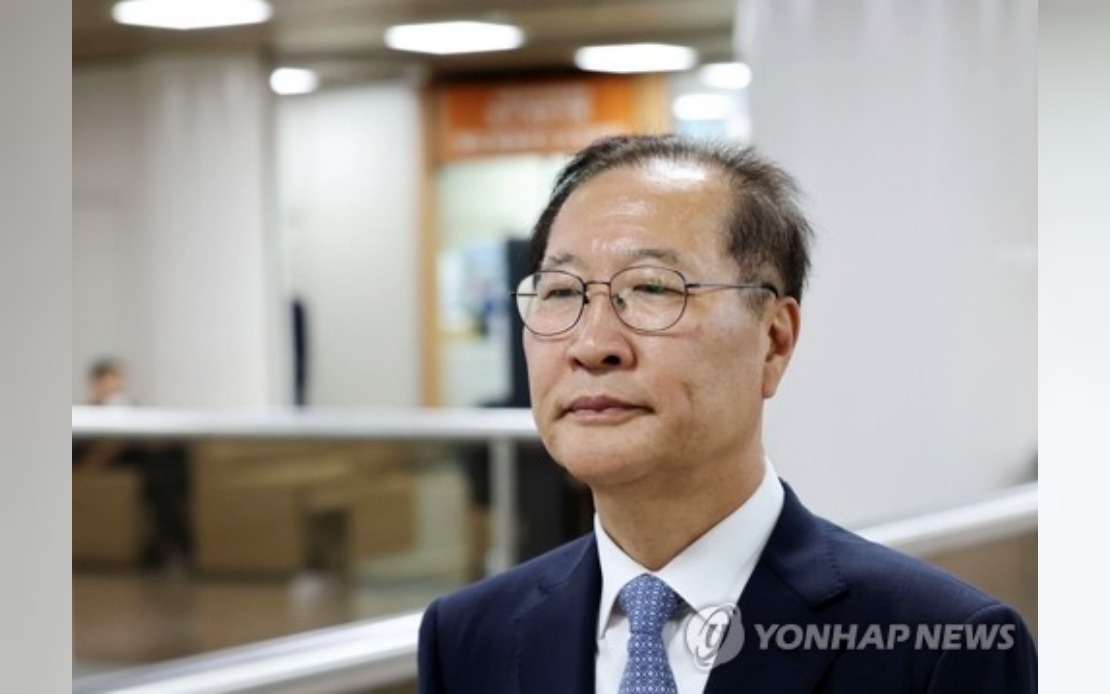
South Korea's ex-Justice Minister Park Sung-jae was convicted and sentenced to 25 years in prison on Monday by the Seoul Central District Court, marking another significant outcome in the nation's ongoing reckoning with the dramatic martial law crisis that gripped the country late last year. The court determined that Park played a central role in supporting an insurrection through his actions following former President Yoon Suk Yeol's controversial martial law declaration on December 3, 2024, a move that sent shockwaves through the South Korean political establishment and triggered a constitutional crisis.
The severity of the sentence, which exceeds the 20-year term initially requested by special counsel Cho Eun-suk's investigation team, underscores the gravity with which the court viewed Park's culpability in the affair. Significantly, the judge ordered Park remanded in custody immediately, expressing concerns that he might otherwise tamper with evidence or attempt to obstruct the ongoing judicial proceedings. This decision reflects the seriousness of the charges and the court's assessment of the risk posed by allowing him temporary freedom.
According to the special counsel's indictment, Park faced two principal accusations: first, that he played a central role in the insurrection itself, and second, that he abused his ministerial authority by convening a gathering of senior officials within his ministry following Yoon's martial law declaration. The court found Park guilty on both counts, validating the prosecution's core argument regarding his deliberate participation in the constitutional crisis rather than his duty to prevent it.
The court's reasoning centered on Park's actions in the hours following Yoon's announcement. Park allegedly called the ministry meeting to oversee the deployment of prosecutors to bodies supporting the martial law regime, to assess whether correctional facilities had sufficient capacity to hold the numerous politicians and prominent figures expected to face arrest under martial law provisions, and to direct officials overseeing travel restrictions to report for duty. These actions painted a picture of methodical preparation to execute the martial law agenda through the justice system.
In its ruling, the court delivered a pointed rebuke of Park's conduct, stating that he had fundamentally abandoned his constitutional obligation to preserve democratic order when he assessed the insurrection as likely to succeed and opted instead to actively participate in it. This language suggests the judges viewed Park's decision not merely as passive acquiescence but as a conscious choice to prioritize the apparent inevitability of the coup over his sworn duty to defend the constitution.
Park's case fits into a larger pattern of accountability now unfolding within South Korea's political and security apparatus. Former Prime Minister Han Duck-soo and former Defence Minister Kim Yong-hyun have already been convicted of similar charges related to their roles in the martial law scheme. Meanwhile, President Yoon himself received a life sentence in February for leading the insurrection through his initiation of martial law, though he has filed an appeal contesting that verdict. These cascading convictions demonstrate that the judicial system is systematically examining the conduct of those across the government hierarchy who facilitated or supported Yoon's extraordinary power grab.
The court exercised notable restraint in one dimension of the case by dismissing additional charges Park faced under anti-corruption statutes. These charges stemmed from allegations that he had issued inappropriate directives to subordinates at the behest of Yoon's wife, Kim Keon Hee, in May 2024. Kim had allegedly requested that Park investigate specific aspects of a prosecution inquiry into corruption allegations leveled against her. The court ruled that these charges fell outside the scope of the special counsel's investigative authority, a decision that suggests the judicial system is drawing distinct boundaries around what constitutes the martial law crisis proper and what might constitute separate instances of abuse of power.
Park's legal team immediately signaled its intention to challenge the conviction, characterizing the ruling as intellectually indefensible and grounded neither in factual reality nor in sound legal reasoning. This defiant posture suggests the case will likely proceed to appellate courts, where Park's lawyers will attempt to undermine the trial court's findings and overturn or substantially reduce his sentence. The appeal process may take months or longer, prolonging the drama surrounding this emblematic case.
The special counsel's office, by contrast, indicated it would not pursue an appeal, a position that reflects confidence in the judgment and suggests that prosecutors view the court's articulation of a justice minister's duty—to resist illegal declarations of martial law and defend constitutional order—as having been properly established in the verdict. This restraint also indicates that the special counsel sees the conviction itself as serving the essential purpose of the prosecution: establishing a legal precedent regarding ministerial responsibility in constitutional crises.
For regional observers, the Park case illuminates ongoing tensions within South Korea's political system regarding executive power, the rule of law, and the independence of institutions. The episode also resonates across Southeast Asia, where several countries have experienced military interventions or constitutional emergencies, reminding policymakers of the importance of institutional checks and the potential consequences when senior officials prioritize loyalty to powerful figures over fidelity to constitutional principles. The sentencing of a former justice minister for his role in abetting an attempted seizure of power sends a forceful message about accountability that extends beyond Seoul's borders.

