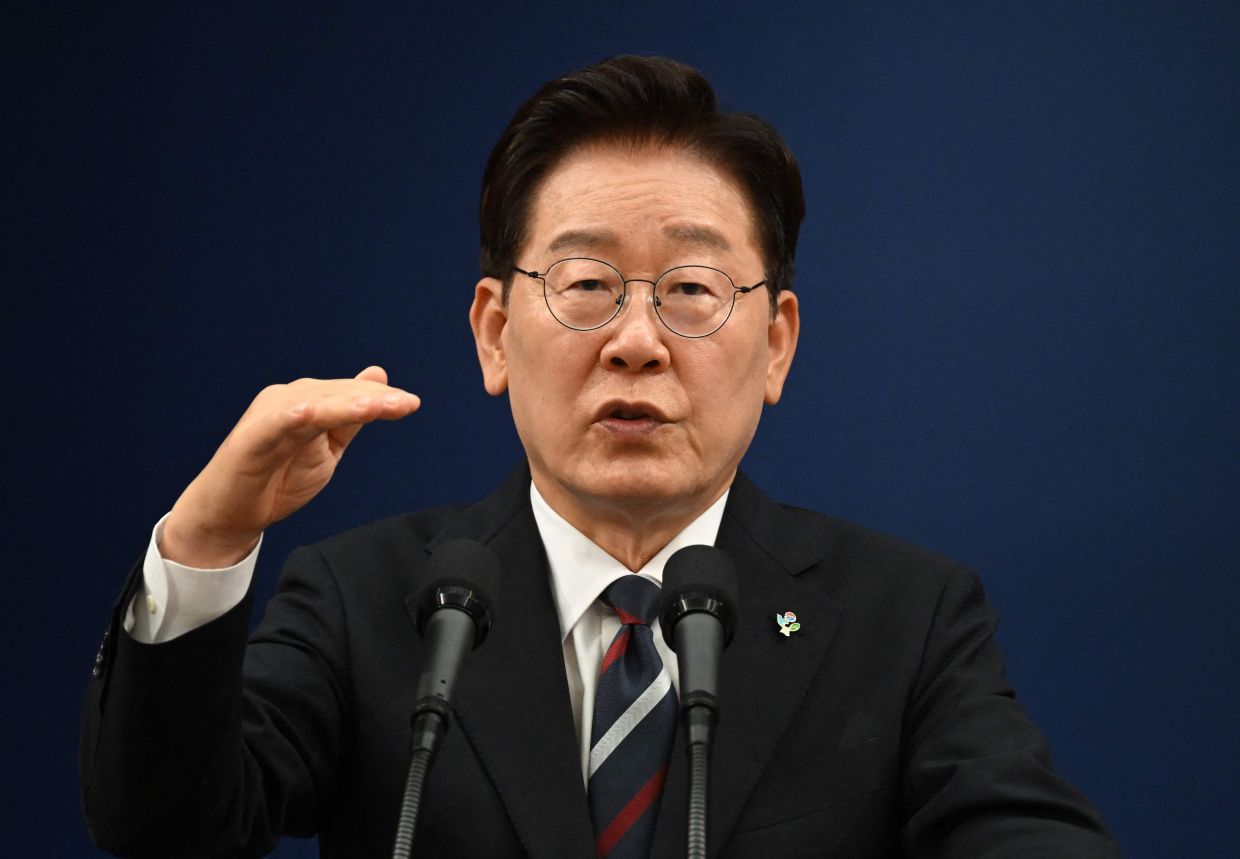
South Korean President Lee Jae Myung faces a critical political moment as his approval rating has dropped into negative territory for the first time since his inauguration on June 4, 2025. Data released by pollster Realmeter on June 22 revealed that just 46.7 per cent of respondents approved of his performance, marking a dramatic reversal from his initial honeymoon period and establishing a worrying precedent early in his administration. The decline represents the fifth consecutive week of deterioration, signalling deepening public dissatisfaction that extends beyond typical post-election adjustments.
The crossing of negative sentiment above positive marks a watershed moment in Lee's presidency. Disapproval now stands at 49.7 per cent, surpassing approval by a margin that, while narrow enough to fall within the survey's margin of error, nevertheless indicates a fundamental shift in public mood. This milestone carries particular significance when measured against Lee's immediate predecessors. Former President Yoon Suk Yeol experienced a similar crossover just six weeks into his term, while Park Geun-hye took roughly 16 months and Moon Jae-in 19 months to reach the same threshold. Lee's faster descent into negative territory suggests either heightened public expectations at the outset or unusually volatile political circumstances.
The trajectory of Lee's support reveals a steeper and more consistent decline than his opening weeks suggested. His approval rating began at 60.5 per cent in mid-May before sliding through successive weeks, dropping to 51.5 per cent by mid-June. The five percentage point weekly decreases demonstrate a pattern of accelerating disillusionment rather than random fluctuation, indicating substantive shifts in voter sentiment rather than polling noise. This week-on-week consistency suggests underlying structural problems rather than isolated controversies.
Realmeter identified two primary culprits for the president's declining fortunes: the ballot shortage crisis during June's local elections and roiling internal divisions within the ruling Democratic Party of Korea. The election management fiasco proved particularly damaging, as it raised questions about administrative competence at a moment when Lee was still establishing his governing credentials. Simultaneously, intensifying factional conflicts within the Democratic Party over the August 17 leadership convention have created an impression of party chaos that inevitably reflects on the president's broader political authority. Both issues converge to undermine confidence in state institutions and political leadership during what should have been a stabilising period.
Geographically, Lee's support has eroded most severely in regions traditionally considered his strongholds, suggesting that even his core political base has begun withdrawing confidence. Conservative strongholds in Daegu and North Gyeongsang Province experienced the sharpest declines, dropping 9.9 percentage points to 34.6 per cent. The Greater Seoul region, which includes Seoul, Incheon, and Gyeonggi Province—areas crucial for any president's political sustainability—showed approval falling to 39.8 per cent in Seoul and 44.8 per cent in the surrounding areas. These regional trends indicate that territorial advantages cannot insulate Lee from the broader political headwinds.
Ideological breakdowns reveal important fractures within Lee's coalition. Support among moderate voters, traditionally a swing constituency, declined to 47.5 per cent, suggesting he is losing the centrist voters essential for presidential majorities. Liberal support, while remaining substantially higher at 80.4 per cent, still declined by 3.2 percentage points, indicating that even his natural constituency is experiencing doubts. Most troubling, conservative support—which should form his core base—has collapsed to just 19.8 per cent, indicating severe alienation among voters who should provide the strongest backing for a conservative president.
The pollster attributed part of this erosion to mounting concerns over asset market disparities, a particularly acute concern in South Korea where real estate and stock market performance directly affects household wealth perceptions. These economic concerns resonate especially strongly among middle-class voters in Greater Seoul, the nation's most politically volatile region. The irony that the Kospi index broke through the 9,000-point barrier—normally positive economic news—failed to offset these broader concerns illustrates how election administration failures and party divisions have poisoned the broader political environment and overwhelmed typical economic messaging.
The presidential office's response attempted to project humility while reframing the poll results as reflecting broader assessments of economic and governmental performance. Cheong Wa Dae acknowledged the numbers seriously and promised greater attention to public concerns, a measured response that avoided defensiveness but also provided no substantive policy pivot. This cautious stance reflects the administration's limited immediate options—the election administration crisis cannot be quickly reversed, and party leadership tensions derive from Democratic Party faction dynamics beyond direct presidential control.
Parallel polling on party support reveals the broader political realignment occurring beneath the presidential approval ratings. The conservative People Power Party maintains a narrow 42.3 per cent support to the Democratic Party's 40.1 per cent, but this margin has narrowed substantially, and the party faces its own internal hemorrhaging. Youth support for conservatives has collapsed, with voters in their 20s and 30s showing particularly dramatic defection, declining 10.5 and 5.1 percentage points respectively. This demographic pattern threatens future conservative electoral prospects, as younger cohorts rarely reverse party loyalty preferences.
The Democratic Party's modest rebound to 40.1 per cent support appears driven by strategic crisis management rather than policy appeal. Realmeter attributed the gain to bipartisan agreement on a National Assembly investigation into election failures and an emphasis on party unity following factional tensions. This suggests Democratic gains reflect opposition competence at parliamentary accountability rather than substantive policy differentiation, and may prove temporary if underlying party divisions resurface or if the investigation process becomes seen as mere political theatre.
For regional observers, Lee's rapid approval deterioration carries important implications. South Korean political instability can ripple across Northeast Asia, particularly affecting security cooperation, trade relationships, and broader regional dynamics. A president weakened domestically in his first months may face constraints in pursuing assertive foreign policies or maintaining consistent diplomatic postures. Conversely, these domestic pressures may incentivise government attention to nationalist or security-focused narratives to rebuild support—a dynamic with potential consequences for regional relations.
The data from Realmeter's nationwide survey of 2,517 voters conducted from June 15 to 19 captures a South Korean electorate expressing simultaneous dissatisfaction with both presidential performance and broader state administration capacity. That approximately 3.6 per cent remained undecided despite these dramatic declines suggests few voters remain genuinely uncommitted; most have formed negative judgments. Lee's political challenge now involves not merely arresting the decline but demonstrating renewed competence and decisiveness on issues that clearly matter to South Korean voters: electoral integrity, economic equity, and stable governance. How he responds in coming weeks will determine whether this moment represents a temporary adjustment within a five-year presidency or the beginning of fundamental legitimacy erosion.
The trajectory established in these opening months will likely define the entire Lee administration. Presidential approval ratings typically recover somewhat after initial stumbles, but sustained downward momentum in a president's first months rarely reverses completely, even after corrective actions. Lee's challenge is executing sufficiently compelling policy responses to electoral and party management failures while maintaining coalition cohesion across ideological and geographic lines that have already begun fracturing. The next several weeks, culminating in the Democratic Party's August leadership convention, will determine whether Lee can stabilise his position or whether these opening months represent the beginning of a longer-term erosion of presidential authority.

