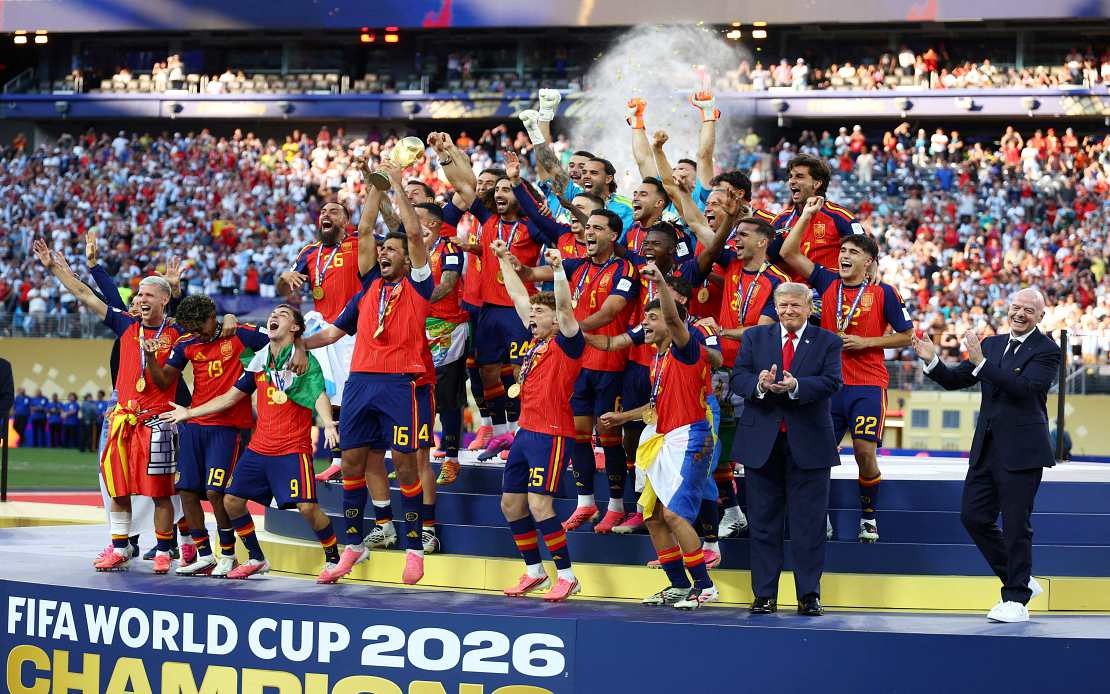
Spain's triumphant World Cup campaign concludes with a homecoming celebration that promises to be one of the largest gatherings in the Spanish capital in recent memory. The national team, captained by Rodri, is scheduled to arrive at Madrid airport at 12.50 pm on Monday, marking the beginning of festivities designed to honour the squad's extraordinary achievement in the United States. Organisers anticipate unprecedented crowds as the nation seizes the opportunity to celebrate its second men's World Cup title in style.
The itinerary reflects the magnitude of Spain's accomplishment and the country's determination to involve as broad a cross-section of society as possible in the festivities. Following their arrival, the players and coaching staff will proceed directly to the Royal Palace, where King Felipe VI will host an official reception during the afternoon. This formal acknowledgement of the team's achievement underscores the significance of winning football's most prestigious tournament, elevating the victory beyond sport into a matter of national pride and cultural importance.
The centrepiece of Monday's celebrations will be an open-top bus parade through Madrid's streets, where organisers expect hundreds of thousands of spectators to line the route. Such processions have become iconic moments in modern Spanish history, offering ordinary citizens the chance to express their joy directly to the heroes of the moment. The parade represents not merely a sporting celebration but a collective expression of national identity and unity, particularly significant given Spain's complex regional dynamics.
The festivities will culminate in Cibales Square, traditionally the focal point for major civic gatherings in Madrid. A substantial production has been planned, with the main show commencing at 6 pm and the team expected to arrive at 9 pm. The timing suggests planners anticipate the square will be filled well before the official programme begins, indicating confidence in public enthusiasm for the event. This final gathering provides an opportunity for direct interaction between players and supporters in an intimate yet grand setting.
Defender Marc Cucurella captured the players' sentiment regarding their return, expressing genuine appreciation for the welcome awaiting them. His comments underscore a desire shared by the squad to ensure the celebration extends beyond the immediate circle of players and coaching staff to encompass supporters who contributed to the team's success through their unwavering backing. The defender's acknowledgement that many supporters could not attend the final in the United States reflects the practical limitations facing international followers, making the Madrid reception especially significant for those unable to witness the triumph in person.
Spain's World Cup victory came through Ferran Torres' extra-time goal against Argentina in a match that captivated global audiences. The winning moment demonstrated the technical excellence and mental resilience that characterised Spain's tournament campaign. Torres' decisive contribution in the final exemplifies how modern Spanish football, built on technical sophistication and possession-based principles, can still deliver dramatic, match-winning moments when pressure is greatest.
The presence of the Spanish royal family at the match in New Jersey, alongside Prime Minister Pedro Sánchez, reflected the political and institutional significance attached to the team's performance. Sánchez's subsequent post on social media, declaring "We Are World Champions" while praising the national team, demonstrates how sporting success becomes integrated into broader narratives of national achievement and governmental legitimacy. For Asian observers, particularly those from Malaysia and the broader Southeast Asian region, Spain's celebration methodology offers insights into how established democracies integrate sporting success into civic engagement and national identity formation.
From a Southeast Asian perspective, Spain's World Cup victory and the consequent celebrations carry particular resonance. The tournament, held in the United States, attracted global attention but highlighted the traditional dominance of European and South American football. Spain's success represents a continuation of European football's hegemony at the highest level, a pattern that influences how football development is conceptualised across Asia. The Spanish model of technical, possession-based football has influenced coaching methodologies throughout the region, making the national team's continued success internationally relevant.
The scale of preparations for Madrid's celebrations also demonstrates the infrastructure and organisational capacity of a mature European democracy managing mass public gatherings. For Malaysian and Southeast Asian readers, the contrast between Spain's ability to mobilise civic spaces for celebration and similar capacities in developing democracies offers implicit lessons about institutional maturity and public resource management. The coordination between royal, governmental, and municipal authorities required to execute such events seamlessly reflects institutional frameworks that have developed over centuries.
Monday's homecoming represents more than ceremonial recognition of sporting achievement. It provides Spanish society with a moment of collective joy and national affirmation at a time when European politics faces considerable fragmentation and uncertainty. The football team's success offers a unifying narrative that transcends regional, political, and ideological divisions that characterise contemporary Spanish politics. This function of sport in reinforcing social cohesion remains universally relevant, particularly for multicultural societies navigating complex internal dynamics.
The world watches as Spain completes its World Cup cycle, transforming individual moments of athletic excellence into extended national celebration. From the perspective of international news consumers in Southeast Asia, Spain's approach to honouring sporting success provides a model of civic engagement and institutional coordination. The events unfolding in Madrid on Monday will be documented and analysed globally, contributing to broader conversations about the cultural significance of football in modern society and the capacity of sporting achievement to mobilise populations across traditional dividing lines.

