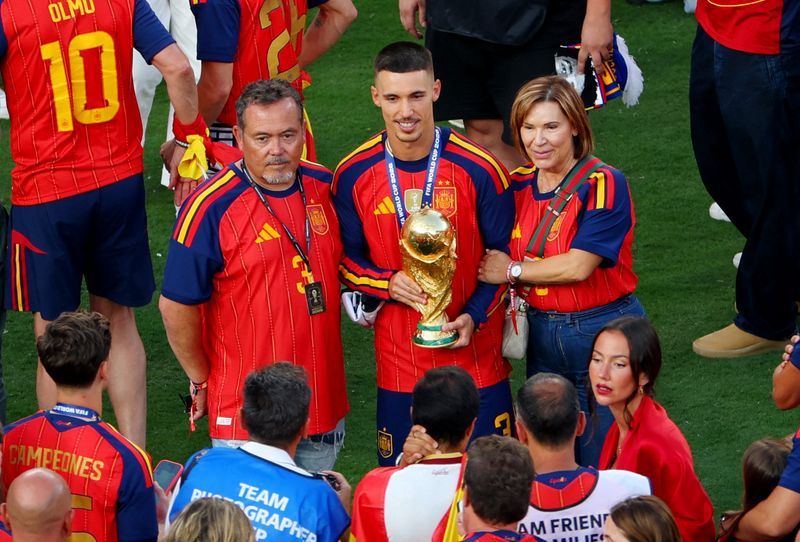
Spain achieved World Cup supremacy on Sunday in East Rutherford, New Jersey, with a narrow 1-0 victory over Argentina that perfectly encapsulated the philosophy underpinning their entire campaign. The triumph represented far more than a single match outcome; it validated an entire approach to football built on patience, precision passing, and an almost reverential treatment of the ball as a shared asset rather than a tool for individual glory. From the opening whistle to the final moments of extra time, Spain's footballing identity remained unmistakably consistent—technical, methodical, and unrelenting in their refusal to deviate from principles that have defined their rise to dominance.
The victory demonstrated how Spain has evolved beyond simplistic narratives of tiki-taka football. While their characteristic possession-based approach remained central—they controlled the ball for more than 65 percent of the match—their performance against Argentina showcased tactical maturity and adaptability. Rather than abandoning their identity when Argentina adopted a more defensive posture, Spain simply intensified their dominance, accumulating twelve shots on target and completing significantly more passes than their opponents. This was not revolutionary football; it was the reassertion of a proven template executed with metronomic precision even as frustration might have crept in during a tightly contested final stretch.
Perhaps most tellingly, the decisive goal arrived through the contributions of substitutes Nico Williams and Ferran Torres, marking the third instance in the knockout rounds where a replacement player had provided the crucial strike for Spain. This pattern reveals something fundamental about how Luis de la Fuente has constructed his squad. Unlike teams built around irreplaceable superstars whose absence creates visible voids, Spain functions as an interconnected organism where tactical understanding and technical proficiency remain constant regardless of which eleven take the field. The bench was not merely a collection of backup players; it represented the continuity of a system so deeply embedded that newcomers could seamlessly execute their designated roles.
Spain's statistical dominance over Argentina reflected an almost surgical superiority. They completed nearly twice as many passes as their opponents and generated offensive opportunities with remarkable consistency, yet their failure to convert several chances revealed a persistent vulnerability that has shadowed their campaign. The absence of a traditional, clinically efficient centre-forward—a classical number nine capable of clinical finishing in confined spaces—remains the one discernible weakness in an otherwise comprehensively assembled squad. This limitation forced Spain to create and score through more diffuse attacking patterns, relying on contributions from multiple players rather than clinical conversion opportunities.
Yet this apparent deficiency tells an important story about modern Spanish football. Their fourteen goals across eight matches came from eight different players, a distribution that mirrors their European Championship triumph in 2024, when ten different scorers combined for a tournament-record sixteen goals. This pattern indicates a team designed not around individual strikers but around collective attacking movement where multiple players share responsibility for penetrating opposition defences. For some teams, the absence of an elite finisher represents catastrophic vulnerability; for Spain, it simply reflects a fundamentally different attacking philosophy.
Spain's clean sweep of multiple individual tournament accolades further underscored their comprehensive excellence. Pau Cubarsi received recognition as the tournament's best young player, Unai Simon was named outstanding goalkeeper, and Rodri claimed the prestigious award for most valuable player. Only the Golden Boot escaped Spanish hands, awarded instead to France's Kylian Mbappe—a result that seemed almost fitting given Spain's deliberate rejection of football centred on individual achievement. Their collective approach had already delivered the ultimate prize; individual honours felt secondary to the championship itself.
The victory extended Spain's unbeaten run to thirty-eight consecutive matches, surpassing Italy's previous record and consolidating three years of international football dominance. This represents not merely a successful tournament run but the culmination of sustained excellence under a manager who embodied the virtue of patience. Luis de la Fuente spent considerable years developing Spanish talent through youth structures before ascending to the senior role, periods when Spanish media dismissed him with reductive nicknames. His journey from academy coach to World Cup-winning manager represents a vindication of long-term player development philosophy over the pursuit of quick fixes and managerial fashions.
Beyond football tactics and statistics, Spain's championship holds profound significance as a reflection of the nation itself. The squad represents a deliberate geographical and cultural tapestry, with players hailing from distinct regions with their own historical identities. Defenders like Mikel Oyarzabal and goalkeeper Unai Simon represent the Basque Country's footballing tradition, while midfielders such as Rodri anchor Madrid's contribution. Other regions equally feature prominently: Borja Iglesias from Galicia, Ferran Torres from Valencia, Fabian Ruiz and Gavi from Andalucia, Pedri from the Canary Islands, and notable Catalan representatives including Cubarsi, Cucurella, and Lamine Yamal. The latter two players, along with Nico Williams, represent contemporary Spain shaped by immigration and demographic change, embodying a nation transcending its traditional boundaries.
For Malaysian and Southeast Asian observers, Spain's triumph offers valuable lessons about sustainable international football development. The emphasis on youth integration, tactical consistency across coaching transitions, and building teams around principles rather than personalities demonstrates an approach increasingly rare in global football. As nations across the region invest substantially in football development, Spain's model—patient accumulation of technical talent channelled through coherent tactical frameworks—presents an instructive alternative to the pursuit of individual stars or frequent managerial upheaval.
The deeper cultural significance of Spain's victory extends beyond football statistics into the realm of national identity. On the pitch, Spanish regional differences—historically a source of considerable political tension—temporarily dissolved into unified purpose. Catalan, Basque, Galician, and Castilian players functioned as integral components of a single, harmonious whole. Football achieved, at least momentarily, what political institutions frequently struggle to accomplish: creating genuine unity across Spain's diverse constituencies. The championship triumph demonstrated that shared cultural endeavour and collective excellence can temporarily transcend the divisions that mark Spanish political life, offering a vision of national cohesion built on mutual respect and common purpose rather than political negotiation.

