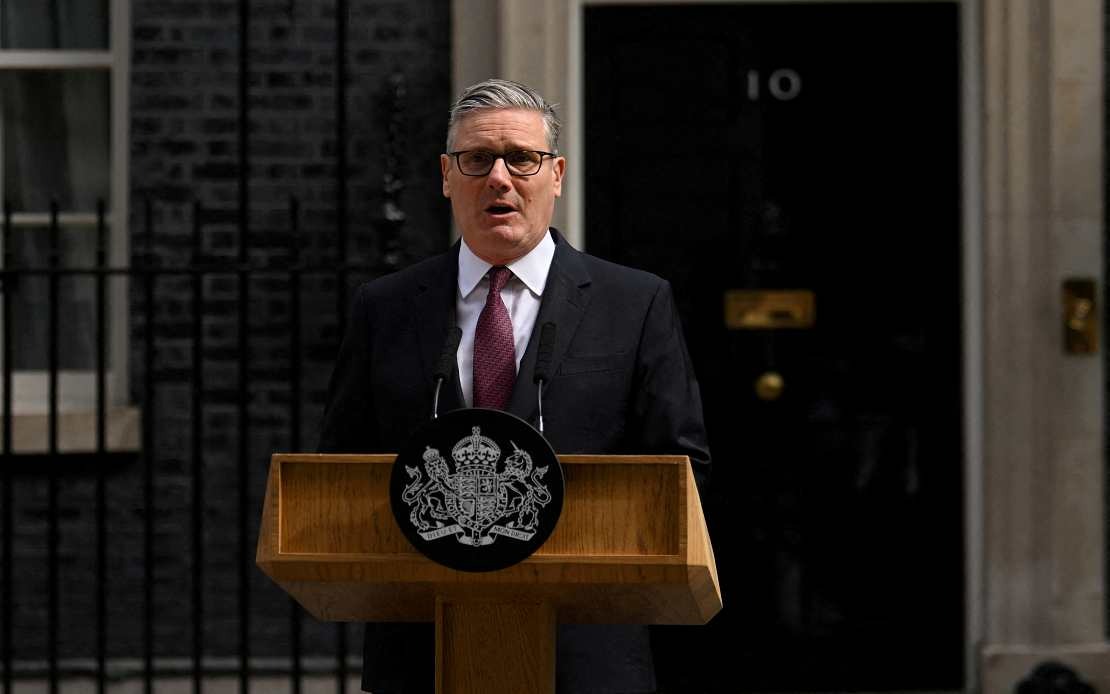
Keir Starmer brought his tenure as British Prime Minister to a close on Monday with a farewell address at Downing Street, characterising his departure as the natural conclusion of his mission while projecting optimism about the country's future trajectory. Standing alongside his wife Victoria Starmer and surrounded by colleagues and supporters, the departing premier struck a reflective tone as he prepared to travel to Buckingham Palace to formally tender his resignation to King Charles.
In his final remarks before relinquishing office, Starmer emphasised the transformation he believed his government had achieved during its relatively brief tenure. He asserted that the United Kingdom had become demonstrably "stronger and fairer" than when his Labour administration assumed power roughly two years earlier, painting a narrative of tangible progress across the span of his premiership. The language of accomplishment underpinned his departure, suggesting a leader stepping aside at a moment of his own choosing rather than one forced from office by electoral defeat.
Starmer's political trajectory had represented a remarkable reversal of fortunes for the Labour Party. Beginning in 2019 with what he characterised as a "historic defeat," the party had languished in opposition under previous leadership. Over the intervening years, Starmer had systematically rebuilt Labour's electoral appeal, repositioning the party as a viable alternative government and restoring its credibility among voters fatigued by Conservative governance. This reconstruction culminated in a decisive general election victory in 2024, delivering Labour a commanding mandate that appeared to validate his strategic approach.
The transition to Andy Burnham represents a significant moment in British political life, though the circumstances surrounding this succession warrant scrutiny. Burnham, who has established himself as a prominent Labour figure and mayor of Greater Manchester, inherits both the opportunities and considerable challenges facing any incoming prime minister. The timing of Starmer's departure after achieving electoral victory yet before completing a full term raises questions about the pressures and dynamics within the Labour government that may have prompted this decision.
For Malaysian and Southeast Asian observers, the British leadership transition offers instructive lessons about political succession in established democracies. The orderly, constitutional nature of the power transfer—conducted through established parliamentary and monarchical procedures—contrasts sharply with political transitions in some other global contexts. The reliance on institutional mechanisms rather than personalised power consolidation reflects the maturity of Westminster parliamentary traditions, even as contemporary British politics grapples with polarisation and institutional challenges.
Burnham's ascendancy to the premiership signals a shift in Labour's leadership profile. As a figure with substantial experience in regional governance and local politics, he brings a different background from Starmer's prosecutorial and legal career. This generational and experiential transition within Labour may reshape the party's policy priorities and political messaging as it enters the next phase of its governance mandate. The implications for economic policy, social provision, and Britain's international engagement remain subjects of immediate political interest.
The broader context of this transition includes the Labour government's management of various domestic challenges during its initial two years. From economic policy to healthcare system pressures, public services reform, and evolving social expectations, the incoming administration inherits a complex agenda. Burnham's tenure as Manchester mayor has involved engagement with devolution questions and regional economic development, experience that may inform his approach to governing at the national level.
Internationally, the leadership change occurs as Britain navigates its post-Brexit relationship with Europe, manages security challenges, and assesses its strategic positioning amid shifting geopolitical dynamics. Burnham's foreign policy orientation and approach to Britain's place in the world remain subjects of considerable attention. Southeast Asian nations with trade and diplomatic interests in the United Kingdom will monitor how the incoming administration prioritises relationships in the region and whether it maintains, expands, or reorients existing bilateral and multilateral engagements.
The constitutional aspects of this transition merit particular attention. The formal process involving the resignation submitted to the reigning monarch and the subsequent selection of a new prime minister underscores the legal and procedural frameworks underpinning British governance. While Labour retains its overall parliamentary majority, the mechanics of designating Burnham as Starmer's successor and confirming him as the party's choice demonstrate how institutional continuity functions during leadership changes within sitting governments.
Starmer's closing characterisation of his role as complete, articulated through his statement about passing the baton, projects an image of planned succession rather than crisis-driven transition. Whether this reflects genuine satisfaction with policy achievements or represents a strategic calculation about the optimal moment for departure reflects the complex motivations underlying high-level political decisions. His assertion of accomplishment may serve to frame his legacy and shape historical assessment of his premiership's significance.
The implications of this transition extend beyond Westminster to affect British policy orientation toward the Commonwealth, European relations, and emerging global challenges. Burnham inherits substantial executive authority and a parliamentary position of strength, yet faces the inherent pressures of leading a government in its subsequent phase after initial implementation of core agenda items. His success in consolidating Labour's position and advancing his government's mandate will significantly influence British political trajectory over the coming years.

