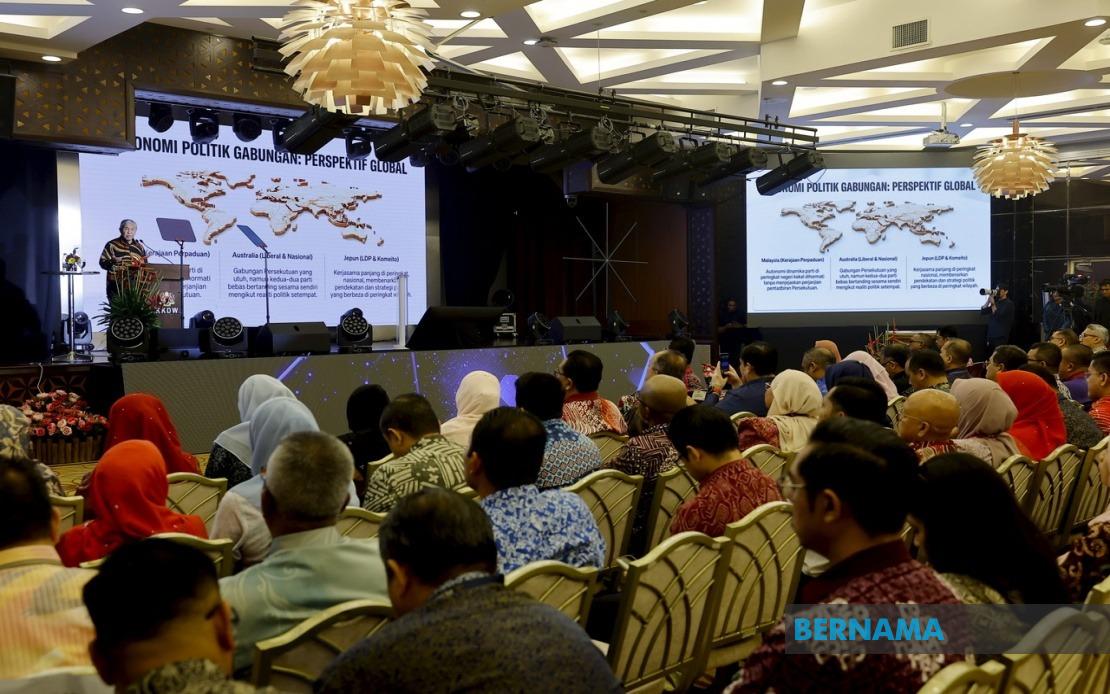
Deputy Prime Minister Datuk Seri Dr Ahmad Zahid Hamidi has moved to reassure the country that the Unity Government coalition will remain intact and functional regardless of electoral outcomes at the state level. Speaking at a monthly assembly held by the Rural and Regional Development Ministry in Putrajaya on August 6, Ahmad Zahid sought to separate the political competition that naturally occurs during state elections from the stability mechanisms underpinning the federal administration. His comments came as the nation digested the implications of recent state-level political contests, particularly in Johor and Negeri Sembilan, where coalition dynamics have shown signs of strain.
As chairman of Barisan Nasional and the second-ranking figure in the federal government, Ahmad Zahid's statement carries weight in clarifying how Malaysia's present political architecture is designed to function. The deputy premier emphasised that the understanding between coalition partners—which collectively form the MADANI Government—remains ironclad as long as Parliament has not been dissolved. This foundational agreement, he suggested, transcends the vicissitudes of state-level political manoeuvring and creates sufficient institutional ballast to keep the federal ship on course. The message was calibrated to address growing concerns among Malaysians about whether internal coalition tensions could metastasise into broader governance failures.
Ahmad Zahid articulated a conceptual framework for understanding how the current arrangement differs from previous coalition models. Rather than demanding that member parties surrender their distinct political identities or abandon pursuit of their core ideological positions, the Unity Government permits what he termed "political autonomy within a coalition government." This formulation acknowledges a fundamental reality of Malaysian coalition politics: forcing parties to completely submerge their separate interests typically generates resentment and instability. By contrast, allowing each coalition member a degree of latitude to pursue its own electoral strategy and political positioning, provided core agreements remain honoured, creates a more resilient structure. This approach represents a maturation in how Malaysia's plural political system manages its inherent tensions.
The practical implications of this doctrine are significant for understanding how the government will navigate the remainder of the current parliamentary term. Electoral contests at the state level will inevitably produce winners and losers among the coalition partners, potentially shifting the balance of power in particular states. These outcomes may affect resource allocation, ministerial appointments at state level, and the distribution of patronage networks. However, Ahmad Zahid's exposition suggests the federal government has been explicitly designed to operate independently of these fluctuations. As long as the formal parliamentary numbers supporting the government remain intact, the machinery of federal administration will persist, budgets will continue to be executed, and policy implementation will proceed according to schedule.
For Malaysian voters and observers, this framing raises important questions about the nature of democratic accountability and coalition governance. The deputy premier's assurance that "every responsibility entrusted to us by the people will be fulfilled as usual" carries an implicit promise that the government will not be distracted by internal party machinations from delivering on its mandate. The MADANI Government's planned policies, programmes, and projects represent commitments to the electorate, and Ahmad Zahid positioned these as separate from and insulated against partisan squabbles. This separation of concerns—distinguishing between party-level competition and government-level administration—may appear theoretically sound but has historically proven challenging to maintain in practice.
The timing of Ahmad Zahid's remarks reflects an effort to manage expectations in advance of what may be further electoral contests. Recent results in Johor and Negeri Sembilan demonstrated that coalition partnerships can shift and evolve at the state level without triggering federal upheaval. Nevertheless, each electoral episode carries some risk of weakening one or more coalition partners, potentially affecting their leverage within federal councils and cabinet deliberations. By articulating a clear doctrine that state-level outcomes do not automatically translate into federal consequences, the deputy premier attempted to establish a bright line between two distinct arenas of political competition.
This doctrine of coalition resilience also reflects lessons learned from Malaysia's recent political history. The instability that preceded the formation of the Unity Government—characterised by defections, breakaways, and shifting alliances—demonstrated the dangers of allowing state-level upheaval to destabilise the federal centre. The current arrangement, despite its imperfections, has provided continuity that many Malaysians viewed as preferable to the chaos of the preceding years. Ahmad Zahid's emphasis on honouring the founding agreement of the government thus appeals to stakeholders across the political spectrum who value predictability and institutional stability.
However, the sustainability of this arrangement depends on maintaining trust among coalition partners. The framework Ahmad Zahid described assumes that each party will voluntarily restrain itself from pursuing state-level victories in ways that fundamentally undermine federal arrangements. This self-restraint cannot be legally enforced; it must emerge from a shared conviction that the benefits of federal stability outweigh the satisfactions of unconstrained partisan competition. Recent political history suggests this conviction exists, but it remains perpetually vulnerable to erosion if economic conditions deteriorate, if particular coalition members experience sustained electoral losses, or if fundamental policy disagreements surface.
The Malaysian public's reception of Ahmad Zahid's remarks will likely depend on whether the federal government's actual performance validates his promises. If the government continues to deliver on the MADANI framework, manages the economy competently, and sustains public services, the theory of decoupled state and federal competitions will gain credibility. Conversely, if federal administration visibly falters amid state-level rivalries, his assurances will ring hollow. The deputy premier has essentially staked his credibility and that of the government on the proposition that institutional design can successfully separate electoral competition from administrative function.

