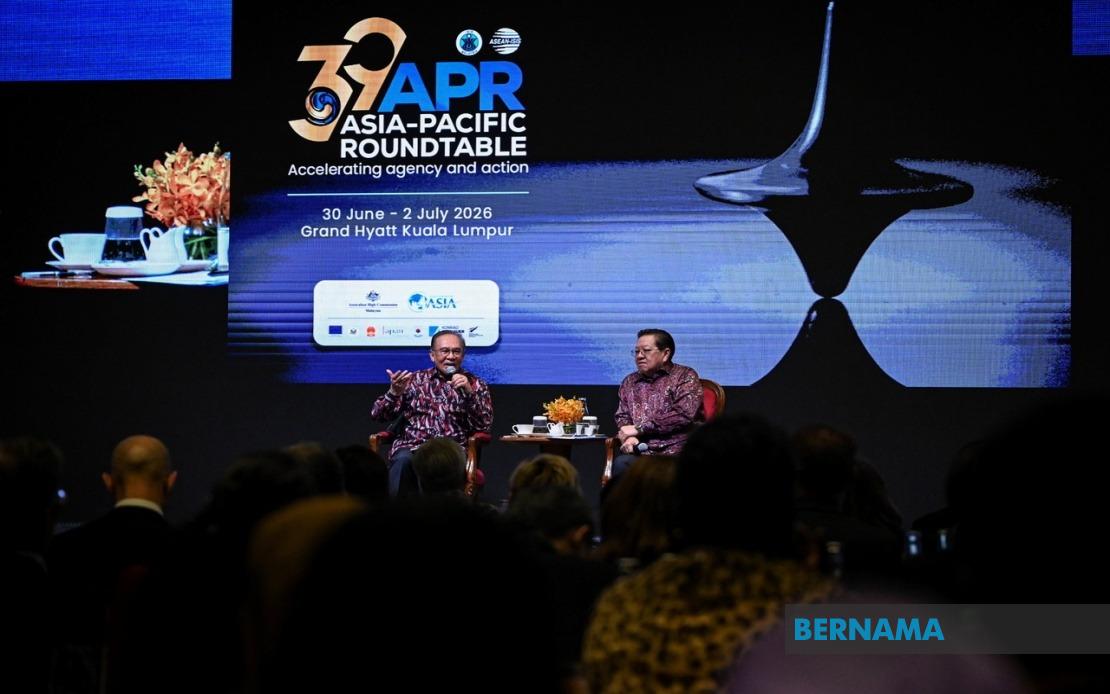
Prime Minister Datuk Seri Anwar Ibrahim has stressed that Malaysia's paramount obligation is to strengthen its governance infrastructure and pursue comprehensive domestic reform, rejecting the notion that the country can effectively engage in international affairs without first putting its own house in order. Speaking at the 39th Asia-Pacific Roundtable in Kuala Lumpur, Anwar articulated a vision where meaningful global contributions emerge organically from successful internal transformation rather than being pursued as parallel endeavours.
The Prime Minister outlined a governing agenda centred on four interconnected pillars: institutional reform, anti-corruption efforts, addressing socioeconomic disparities, and guaranteeing all citizens equitable access to education and healthcare. This framework reflects an implicit recognition that governance failures and inequality undermine a nation's credibility and effectiveness when engaging with international partners. Anwar's emphasis on these domestic priorities signals a deliberate recalibration of Malaysia's national focus after years of political turbulence and institutional challenges that have tested public confidence in government institutions.
Anwar acknowledged that Malaysia would continue articulating principled positions on international matters of concern to the nation, yet he made clear that such engagement remains secondary to demonstrating concrete progress at home. This approach carries particular significance for a Muslim-majority democracy navigating complex geopolitical currents while managing diverse domestic constituencies. By asserting Malaysia's commitment to democratic governance, moderation, and inclusivity, Anwar positions the country as a model alternative to narratives portraying Islamic-majority nations as inherently authoritarian or incompatible with democratic institutions.
The Prime Minister's remarks directly challenge reductive framings of contemporary global tensions as an inevitable clash between civilisations or religious communities. Instead, he drew on the analytical framework of Palestinian-American scholar Edward Said to characterise international conflicts as fundamentally rooted in ignorance, misunderstanding, and prejudice rather than insurmountable ideological gulfs. This distinction carries profound implications for how Malaysia approaches its role in regional diplomacy and multilateral forums, suggesting a commitment to dialogue, education, and mutual comprehension as tools for conflict resolution and cooperation.
Central to Anwar's vision is the government's MADANI framework, which the Prime Minister described as deliberately balancing technological progress with the cultivation of human values and social cohesion. Rather than treating technological advancement and humanistic concerns as competing priorities, the framework seeks to integrate both, recognising that development divorced from ethical moorings and social inclusion generates instability. For Malaysia, where rapid modernisation coexists with persistent inequality and intercommunal tensions, this balanced approach addresses legitimate concerns that growth alone does not translate into shared prosperity or social harmony.
Anwar drew on the Quranic concept of "li ta'arafu"—often translated as an invitation for peoples to know and understand one another—to articulate an aspiration extending beyond mere tolerance of difference. The principle, as presented by the Prime Minister, calls for active engagement with and appreciation of others' perspectives, cultures, and values rather than passive acceptance of diversity. This distinction matters considerably in the Malaysian context, where coexistence among multiple racial and religious communities requires not just legal protections but genuine interpersonal understanding and mutual respect.
The Prime Minister's framing positions Malaysia as a testing ground for whether a diverse, Muslim-majority nation can sustainably uphold democratic values, meritocratic institutions, and inclusive governance. Success on this domestic front would carry outsized symbolic weight in global conversations about democracy, religious pluralism, and development, potentially offering alternative models to narratives suggesting fundamental incompatibility between Islamic governance traditions and contemporary democratic practices. Conversely, governance failures or deepening inequality would undermine Malaysia's international standing and influence.
For citizens and observers in Southeast Asia, Anwar's remarks underscore an important reorientation of Malaysia's strategic priorities. Rather than positioning the nation as a heavyweight regional player or ambitious global actor, the current administration is signalling that resource allocation and political capital must first address longstanding domestic deficits. This includes rebuilding institutional trust damaged by corruption scandals, managing fiscal pressures, and ensuring that economic growth translates into tangible improvements in citizen welfare. The implicit acknowledgment is that Malaysia cannot simultaneously pursue ambitious international leadership while institutional foundations remain fragile.
The emphasis on eradicating corruption carries particular weight given Malaysia's recent history. Governance is not an abstract concept but intimately connected to public confidence, investment climate, and social stability. By prioritising anti-corruption efforts alongside institutional reform, Anwar signals awareness that durable governance depends on demonstrable accountability, transparent decision-making, and equitable application of rules. These elements form prerequisites for both citizen engagement and international credibility.
Anwar's articulation of Malaysia's responsibilities also reflects pragmatism about the nation's actual capacity and influence. Southeast Asia contains multiple significant actors with competing interests, and Malaysia's ability to shape regional outcomes depends partly on internal stability and economic vitality. By acknowledging that governing well at home is the foundation for any meaningful external engagement, the Prime Minister places Malaysia within a realistic assessment of its position and potential. This approach contrasts with grandiose positioning that overstates influence while underlying problems fester.
The commitment to ensuring education and healthcare access reflects recognition that these sectors directly determine national competitiveness, social mobility, and citizen satisfaction. In an increasingly knowledge-based global economy, educational quality shapes Malaysia's ability to develop human capital capable of driving innovation and productivity. Healthcare access influences both public health resilience and household financial stability, particularly for lower-income families whose economic participation underpins broader growth. These investments thus represent not charity but strategic necessity.
Moving forward, the practical challenge for the government involves translating these stated priorities into concrete policies, institutional reforms, and measurable outcomes. Citizens will evaluate the administration's seriousness through budget allocations, legislative action, and visible progress against corruption. International observers will watch whether Malaysia's domestic focus translates into stable governance and renewed institutional strength. The coming years will test whether the philosophical commitment to governance reform and inclusive development can overcome bureaucratic inertia, vested interests, and the complexity of balancing multiple constituencies' competing demands in a diverse society facing both domestic and external pressures.

