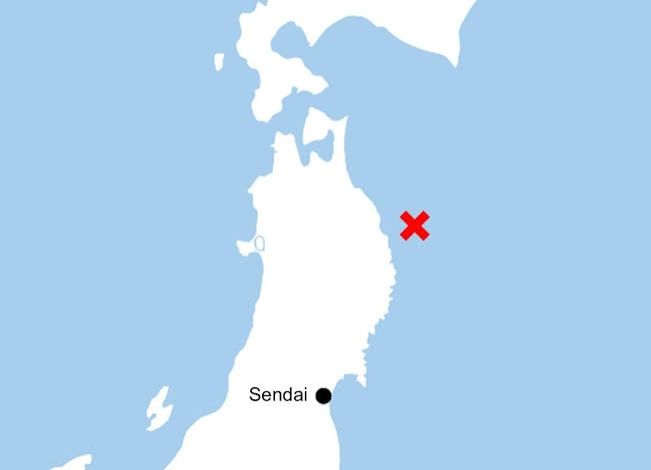
A 7.2-magnitude earthquake rocked northern Japan on Thursday morning, sending tremors across hundreds of kilometres but leaving minimal damage and no casualties in its wake. The seismic event, which struck at 7:30 am local time in waters off Iwate prefecture on Honshu's main island, rattled residents as far away as Tokyo yet spared the country from the catastrophic consequences that such tremors can inflict. The Japan Meteorological Agency initially classified the quake at magnitude 6.9 before revising upwards to 7.2, with the epicentre situated 44 kilometres beneath the ocean floor, a depth that likely contributed to the relatively contained impact on surface infrastructure.
The quake's effects manifested primarily as inconveniences rather than devastation. Kitchen cupboards swung open and disgorged their contents across homes and shops, security cameras wobbled violently, and merchandise tumbled from shelves in retail establishments. Television footage captured the mundane chaos of everyday objects scattered across floors—saucepans heaped haphazardly, goods displaced from display cases—a familiar scene in earthquake-prone regions where residents have grown accustomed to securing their belongings. Mutsumi Shimohata, a 61-year-old food processing employee in nearby Hashikami town in Aomori prefecture, reported that her household sustained nothing more serious than a fallen picture frame, though she found the tremor's duration unsettling and was immediately alerted by a smartphone warning system.
The broader infrastructure experienced modest disruption. Some shinkansen bullet train services were temporarily suspended, disrupting the intricate network of rail connections that bind Japan's economy together. In Hashikami, a primary school closed temporarily as a precautionary measure, while the town's administrative buildings suffered enough damage to require attention—one office's automatic doors ceased functioning and ceiling sections collapsed. Emergency services received at least four calls from Hashikami and nearby Hachinohe, including reports of individuals trapped in a lift and a tanker truck that overturned, though none of these incidents escalated into serious casualties. The quick response from authorities and the resilience built into Japanese infrastructure prevented what could have been a far more serious situation.
Seismic intensity measurements revealed that residents in Aomori prefecture experienced shaking registering at the upper sixth level on Japan's seven-point Shindo intensity scale. At this level, individuals typically cannot maintain their footing without external support and risk being thrown to the ground, unsecured furniture topples with ease, and windows frequently shatter. Despite these hazardous conditions, the combination of strict building codes, earthquake-resistant design standards implemented nationwide, and the population's embedded awareness of seismic safety protocols meant that injury rates remained non-existent. Government spokesman Minoru Kihara acknowledged that while no human casualties had been reported, authorities would continue monitoring damage assessments as more information emerged.
The nuclear sector, always a critical concern following any significant seismic event in Japan, reported no abnormalities at regional power stations. The Nuclear Regulation Authority's swift confirmation that facilities remained secure provided immediate reassurance to a population with long institutional memory of the Fukushima Daiichi disaster. This proactive communication about nuclear safety reflects how comprehensively Japan's regulatory framework has tightened in response to the devastating 2011 experience, when a magnitude 9.0 undersea quake spawned a tsunami that killed approximately 18,500 people and triggered the world's worst nuclear incident since Chornobyl.
Prime Minister Sanae Takaichi responded swiftly by directing government ministries and agencies to coordinate with local authorities on damage assessment and response efforts. Through a social media announcement, Takaichi urged residents in areas that experienced intense shaking to remain vigilant for possible aftershocks of comparable magnitude, acknowledging Japan's seismic reality and the uncertainty that follows major tremors. Her measured response reflected both the seriousness of the event and the confidence that robust preparation and early warning systems had prevented catastrophe.
This earthquake arrives within a pattern of elevated seismic activity that has characterised Japan in recent months. An April tremor measuring 7.7 magnitude struck the country's north, injuring at least ten people and triggering tremors felt across Tokyo that swayed skyscrapers. That earlier event prompted authorities to issue a special advisory highlighting heightened risk of even more powerful earthquakes reaching magnitude 8.0 or beyond, raising public anxiety and prompting discussion about disaster preparedness. Although authorities lifted that advisory after one week, the succession of significant events has underscored Japan's vulnerability to sudden, powerful geological forces.
Japan's geographic positioning accounts for its extraordinary seismic exposure. The archipelago sits atop the intersection of four major tectonic plates along the western boundary of the Pacific Ring of Fire, the horseshoe-shaped zone where approximately 90 percent of global earthquakes occur. With a population of around 125 million people concentrated on islands spanning a seismically active zone, Japan experiences the phenomenon of hundreds of earthquakes annually, accounting for roughly 18 percent of worldwide seismic activity. This concentration of geological hazard and human population creates unique challenges that have driven Japanese innovation in earthquake engineering, early warning systems, and disaster response protocols.
The June event underscores how Japan's preparedness framework has evolved since the transformative 2011 disaster. While that catastrophe claimed tens of thousands of lives and reshaped national policy regarding nuclear power, infrastructure resilience, and emergency management, the country's response to recent tremors demonstrates substantial institutional learning. Building codes now mandate earthquake-resistant construction throughout the nation, early warning systems alert residents within seconds of tremor initiation, public education campaigns ensure widespread understanding of safety procedures, and regular drills maintain collective readiness. The absence of casualties from a magnitude 7.2 quake reflects not luck but the deliberate construction of societal resilience.
For Southeast Asian observers, Japan's experience offers sobering context about earthquake risk management in a region where multiple nations occupy tectonically active zones. Indonesia, the Philippines, and other countries in the area share similar geological hazards but often lack equivalent resources for building code enforcement, early warning infrastructure, and public education. Japan's success in minimising casualties despite its exceptional exposure to seismic activity demonstrates how comprehensive preparation, investment in warning systems, strict building standards, and cultural adaptation to earthquake risk can substantially reduce vulnerability. The June earthquake, though dramatic, serves as a reminder that geological hazards need not be catastrophic when societies invest systematically in resilience and preparedness.

