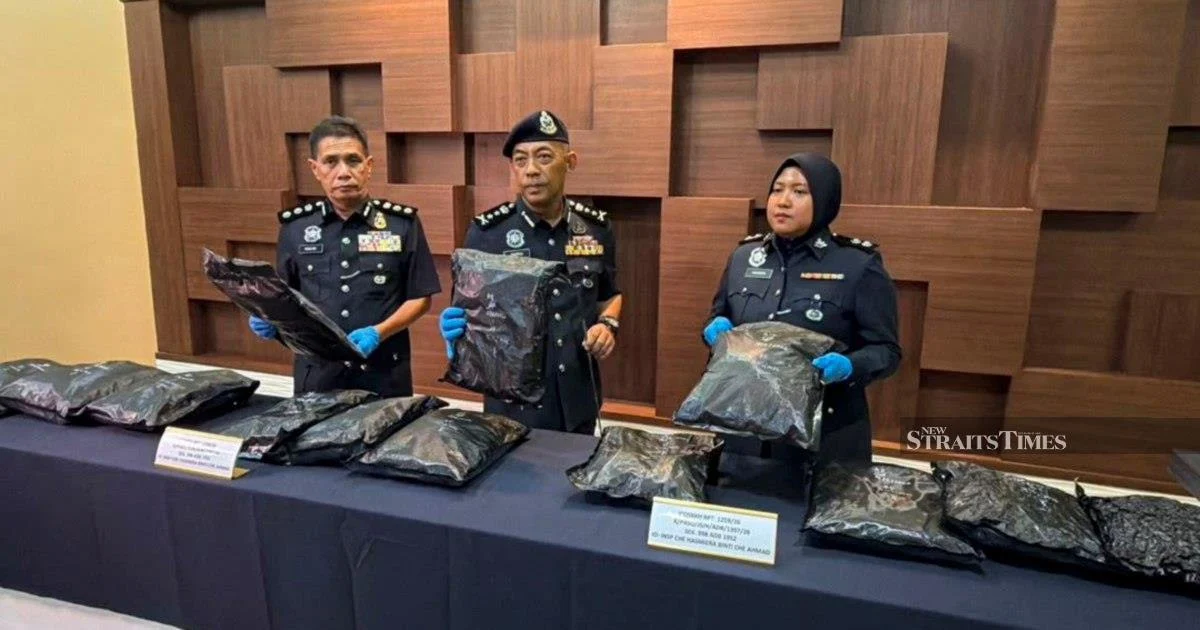
A private higher education student has been apprehended at one of Malaysia's busiest border crossings whilst attempting to transport a substantial cannabis consignment with an estimated street value of RM1.17 million. The arrest, made on Monday at Bukit Kayu Hitam in Kedah, represents a significant narcotics interdiction in the northern corridor and underscores the persistent vulnerability of Malaysia's border regions to organised drug trafficking operations.
The detained individual, whose identity was not immediately disclosed, was intercepted whilst in possession of 14.63 kilograms of processed cannabis buds. The quantity and purity level suggest the shipment was destined for distribution rather than personal consumption, pointing to a larger trafficking network operating across the Thailand-Malaysia border. Authorities have indicated the student was acting in the capacity of a transporter or courier, a role commonly filled by individuals willing to carry narcotics across international boundaries for monetary compensation.
Bukit Kayu Hitam, located at the northern tip of the Perak-Kedah border junction and serving as a primary gateway to Thailand, has long been identified as a critical chokepoint for drug smuggling operations. The checkpoint processes hundreds of vehicles daily, creating both enforcement challenges and opportunities for traffickers seeking to exploit gaps in security protocols. The proximity to Thailand, where opium cultivation and methamphetamine production remain endemic issues, makes this corridor particularly attractive to criminal syndicates moving contraband southward into Malaysian territory.
The involvement of a university student in this smuggling attempt highlights a troubling trend observed by enforcement agencies across the region. Young adults enrolled in tertiary education institutions are increasingly being recruited by trafficking organisations, either through debt bondage, financial incentives, or coercion. The economic vulnerability of students, combined with their relative freedom of movement and lower perceived risk profile compared to professional smugglers, makes them valuable assets to criminal networks operating throughout Southeast Asia.
Cannabis trafficking into Malaysia carries severe legal consequences under the Dangerous Drugs Act 1952, with possession of quantities exceeding 200 grams presumed for trafficking purposes. Sentences for trafficking can extend to life imprisonment or capital punishment, depending on the offence's severity. The substantial weight of this seizure places the accused firmly within trafficking thresholds, exposing him to potentially decades-long custodial sentences or execution, depending on prosecution outcomes and judicial discretion.
The case reflects broader regional dynamics affecting drug enforcement across Southeast Asia. Thailand's recent moves toward cannabis decriminalisation, implemented from June 2018 onwards for medical and agricultural purposes, created regulatory ambiguity that traffickers have exploited. Although Thai authorities maintain strict controls on cannabis exports, the policy shift inadvertently facilitated the emergence of unregulated production and cross-border smuggling networks. Malaysian enforcement bodies have expressed concern that porous boundaries and inconsistent neighbouring country regulations enable traffickers to move contraband with relative impunity.
The arrest comes amid intensified border security operations across the northern corridor. Malaysian enforcement agencies have stepped up patrols and scanning protocols at major crossing points, partly in response to escalating narcotics seizures throughout 2023 and 2024. The Bukit Kayu Hitam checkpoint underwent infrastructure improvements aimed at enhancing detection capabilities, including upgraded scanning equipment and expanded personnel deployment. This particular seizure demonstrates that despite enhanced measures, significant quantities of contraband continue reaching detection points, suggesting even larger volumes escape interdiction.
This incident provides valuable intelligence regarding trafficking methodologies and routing patterns. Law enforcement sources indicate that cannabis shipments increasingly move during peak traffic periods when checkpoint officers face overwhelming volumes, and through modified vehicle compartments designed to evade detection equipment. The recruitment of university-age couriers suggests traffickers are optimising their operational security by cycling personnel frequently and targeting individuals with minimal prior criminal histories.
The broader implications for Malaysia extend beyond narcotics enforcement into education policy and campus security. Universities and private higher education institutions have become target recruitment grounds for traffickers, who identify financially vulnerable students through social networks and exploit their circumstances. Educational authorities have been encouraged to enhance awareness programmes regarding trafficking recruitment tactics and peer identification of individuals displaying indicators of involvement in illicit activities.
Regional cooperation mechanisms remain instrumental in addressing cross-border trafficking. The establishment of joint task forces between Malaysian and Thai authorities, underpinned by bilateral agreements and intelligence-sharing protocols, has improved interdiction rates at major crossing points. However, resource constraints, jurisdictional limitations, and political considerations sometimes impede coordinated operations. This seizure underscores the necessity for sustained investment in border infrastructure, personnel training, and inter-agency coordination mechanisms.
Investigators will likely focus on identifying the broader smuggling network behind this attempted transportation. The scale of the consignment suggests the accused was operating within a structured organisation with established supply chains, distribution networks, and financial mechanisms. Analysis of the accused's communications, financial transactions, and personal associations may reveal additional participants operating at various levels of the trafficking hierarchy.