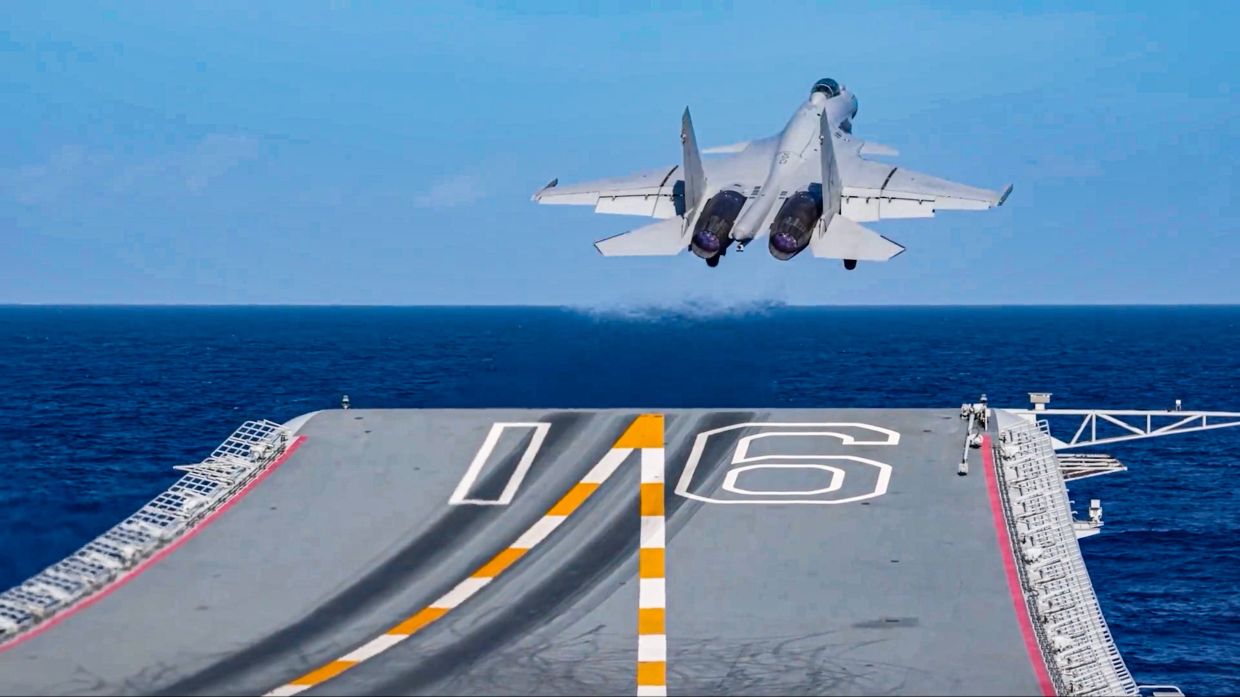
Beijing's ambitious expansion of its aircraft carrier fleet has triggered intensifying scrutiny among defence strategists, who increasingly question whether these costly vessels can operate safely across the wider Indo-Pacific without exposure to sophisticated submarine threats. While China invests heavily in modernising its navy, a critical gap in undersea surveillance and anti-submarine capabilities has emerged as a potential strategic weakness that could fundamentally limit how far from Chinese shores these carriers can venture.
The Centre for Strategic and International Studies in Washington recently published an analysis proposing a "cost-imposition" strategy to counter Chinese carrier operations. The approach encompasses multiple elements including land-based strike networks, satellite-guided air operations, cyber warfare, and drone swarm attacks. Yet among these various tactical options, submarine ambushes have drawn particular attention from military analysts who view undersea operations as the domain where China's navy faces its greatest vulnerability. The People's Liberation Army Navy, or PLAN, appears to lack the sophisticated detection and tracking systems necessary to shield high-value carrier groups from attack, particularly when operating beyond immediate proximity to Chinese territory.
Geography substantially reinforces this weakness. The Indo-Pacific's narrow maritime corridors, including crucial passages between island nations and through regional waterways, create natural chokepoints where opposing forces could concentrate their submarine assets. Rather than requiring a widespread defensive posture across vast ocean expanses, Allied forces could concentrate submarines and other weapons systems at these strategically significant gateways. As carrier groups transit these waterways, they would face coordinated threats from undersea platforms, complemented by long-range aircraft operations guided by satellite intelligence and communications disruption targeting PLAN sensor networks.
Christopher Sharman, a senior official at the US Naval War College's China Maritime Studies Institute, confirmed that China's undersea vulnerability remains substantial, though the weakness is not entirely static. The PLAN has indeed undertaken considerable investments in recent years aimed at improving its capacity to understand the underwater operating environment and predict subsurface conditions. Nevertheless, significant gaps persist, particularly in oceanographic knowledge that the US Navy possesses. Chinese military authors themselves have publicly acknowledged that China's meteorological and oceanographic data collection capabilities remain substantially inferior to American capabilities, creating a serious impediment to effective submarine and anti-submarine operations, most acutely beyond the First Island Chain demarcating China's immediate maritime sphere.
Recognising this gap, Beijing has pursued the ambitious Transparent Ocean programme, originally conceptualised over a decade ago, to establish a comprehensive network integrating satellites, oceanographic research vessels, floating buoys, underwater autonomous gliders, and seabed sensor arrays across strategically vital waters spanning the western Pacific, South China Sea, and Indian Ocean regions. Chinese officials and academic institutions have explicitly characterised this initiative as a national security priority. The Ocean University of China, which originally developed the concept, reports that implementation has established hundreds of deep-sea observation stations and expanded monitoring capabilities from the South China Sea well into the western Pacific.
Parallel to oceanographic intelligence gathering, the PLAN has undertaken substantial modernisation of its anti-submarine warfare capabilities. Defence researchers have documented the rapid expansion of fixed-wing maritime patrol aircraft and the deployment of Type 927 ocean surveillance ships equipped with sophisticated towed-array sonar systems. The Chinese military has also invested in upgrading sensor packages fitted to helicopter platforms dedicated to submarine hunting. These improvements indicate a systematic effort to enhance China's ability to detect and neutralise underwater threats, though analysts question whether such investments can adequately address the fundamental capability gap.
However, the challenge confronting Chinese planners extends well beyond merely protecting carrier fleets. Undersea warfare has become central to broader PLAN strategic objectives. Within the First Island Chain surrounding China's coast, submarine operations are essential to achieving PLAN goals for maintaining sea control during wartime. Beyond this perimeter and extending into the Indian Ocean, PLA strategists regard effective undersea warfare as necessary to counter American naval superiority and to complicate potential third-party military intervention in any conflict scenario involving Taiwan. This strategic orientation reveals how submarine capabilities have become intertwined with China's larger ambitions to dominate regional waters and prevent external powers from intervening in regional crises.
Chinese military-affiliated analysts have sometimes characterised the waters near China's coastline as a "wide-open door" through which potential adversaries could penetrate, reflecting anxiety about insufficient monitoring and control of these strategically vital regions. The challenge is compounded by the technological superiority of American submarines, which remain among the world's quietest and most difficult to detect. Adding complexity, Timothy Heath from defence research organisation Perceptum notes that any Taiwan conflict scenario involving Japanese military participation would substantially increase the threat environment, as Japan possesses formidable anti-ship capabilities and could target Chinese naval vessels operating in proximate waters.
These considerations raise fundamental questions about how China can practically deploy its expanding carrier fleet. While carrier aircraft could theoretically provide air cover for naval forces attempting to prevent third-party intervention in Taiwan-related scenarios, they might operate more effectively in the western Pacific where multiple defensive layers could provide protection. Yet Heath and other analysts caution against exposing these extraordinarily valuable and costly platforms to the multifaceted threats that exist in distant waters. The calculation suggests that land-based intermediate-range ballistic missiles represent more cost-effective instruments for threatening naval targets across the second island chain, rather than risking billion-dollar carrier platforms in demonstrably vulnerable positions.
Western defence planners have begun adjusting procurement strategies in response to these submarine-centric vulnerabilities. The Centre for Strategic and International Studies report advocates substantially increased investment in torpedoes, undersea autonomous vehicles, and missile production undertaken collaboratively with key regional partners including Japan and Australia. This reorientation reflects a recognition that submarine warfare may determine whether China's carrier ambitions can translate into effective operational capability or remain expensive platforms unable to venture far from Chinese protection without facing unacceptable risk. The submarine vulnerability thus encapsulates a broader strategic paradox: China's investments in advanced carrier platforms may deliver only limited strategic advantage if undersea threats constrain where these vessels can safely operate.

