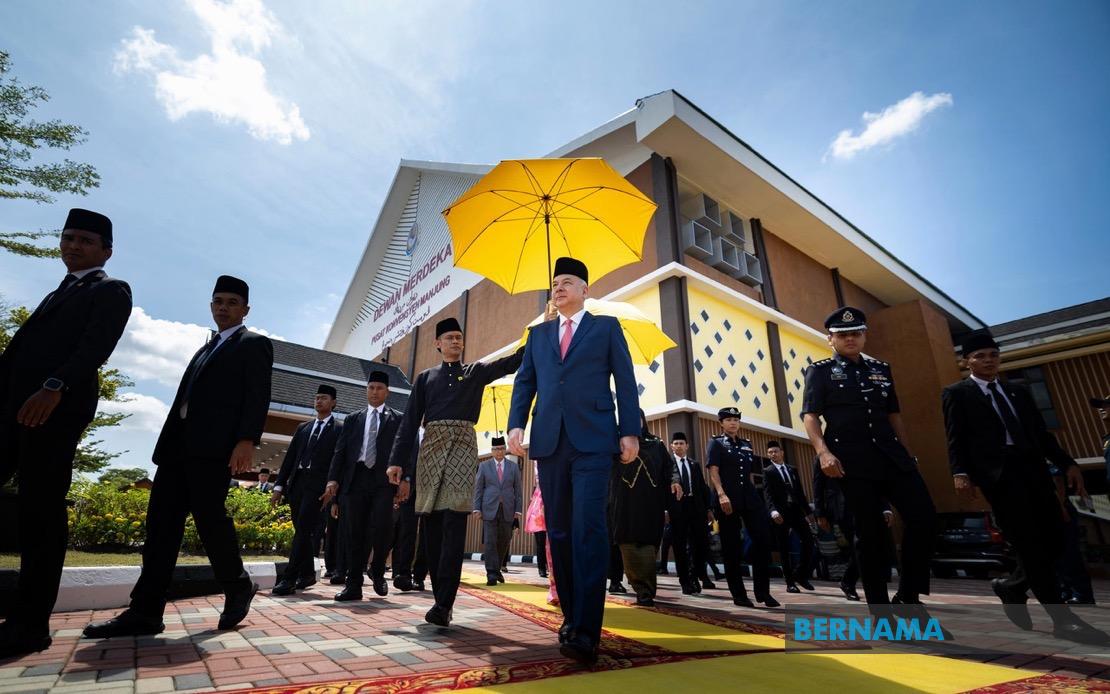
Sultan Nazrin Shah of Perak today officially inaugurated the Merdeka Hall at Manjung Municipal Council in Lumut, bringing to fruition a project that has spanned nearly a decade. The ceremony was attended by Raja Permaisuri Tuanku Zara Salim and Raja Di Hilir Raja Iskandar Dzurkarnain Sultan Idris Shah, underscoring the significance of the occasion for the state's royal household. The gathering also included Perak Menteri Besar Datuk Seri Saarani Mohamad and Higher Education Minister Datuk Seri Dr Zambry Abd Kadir, reflecting the collaborative nature of the initiative.
The completion of the 2,500-capacity venue represents a convergence of three significant milestones for the Manjung district. The earliest of these traces back to 2016, when the initial proposal for the hall's redevelopment gained traction following advocacy by the then-sitting Menteri Besar. This lengthy gestation period illustrates the complexities of securing and implementing major infrastructure projects in Malaysia, where alignment across multiple government levels and budget cycles often determines outcomes.
Simultaneously, Manjung Municipal Council is marking its silver jubilee this year. The body was first established as a district council on 1 January 1980 before being elevated to municipal status on 1 August 2001, a trajectory that reflects broader processes of administrative consolidation and governance expansion across peninsular Malaysia. The timing of the hall's opening to coincide with this anniversary provides symbolic weight to the occasion and reinforces the council's institutional evolution.
Menteri Besar Saarani emphasised that the RM12.7 million investment extends far beyond providing event infrastructure. Rather, the hall functions as an anchor facility for Manjung's aspirational identity transformation. The district has positioned itself to achieve Tourism and Maritime City status by 2030, a designation that would reshape its economic profile and positioning within Perak's broader development landscape. Such strategic rebranding initiatives have become increasingly common among Malaysian municipalities seeking to differentiate themselves in competitive intra-regional markets.
The Menteri Besar's remarks highlighted the project's longevity as evidence of sustained governance continuity between federal and state administrations. In Malaysian political contexts where transition of power at either level can introduce policy disruptions, the successful progression of a multi-year infrastructure project often signals either bipartisan consensus or institutional momentum sufficiently robust to transcend electoral cycles. The facility thus carries implications beyond its immediate functional utility.
Managing the symbolic dimensions of a structure named Merdeka Hall requires careful attention in contemporary Malaysia. Saarani positioned the nomenclature as a reminder that national independence represents an ongoing trust rather than a historical fait accompli. This framing resonates with periodic governmental calls for renewed commitment to constitutional principles and national cohesion, particularly when advanced by state-level leaders addressing local audiences.
The venue's intended purpose encompasses official functions, conferences, and community activities, suggesting a multipurpose design intended to serve diverse stakeholder groups within Manjung. Such spaces typically become focal points for district-level governance communication and civil society engagement, functioning as stages for both routine administrative proceedings and celebratory public gatherings. The 2,500 capacity indicates provision for substantial community assemblies, potentially accommodating district-wide forums or major cultural events.
For Malaysian readers tracking infrastructure development across peninsular states, the Merdeka Hall's completion illustrates patterns in how mid-tier municipalities mobilise development resources. The ability to secure federal allocation for a RM12.7 million facility depends on demonstrating alignment with national development priorities and navigating bureaucratic approval processes that often extend across multiple budget years. Manjung's successful navigation of this pathway offers lessons for other aspiring municipalities pursuing comparable facility development.
The hall's opening also reflects the ongoing importance of royal patronage in validating public infrastructure in Malaysia's constitutional monarchy framework. The attendance of multiple members of the Perak royal household signals institutional approval and elevates the occasion's ceremonial status. Such participation has become routine in Malaysian municipal affairs, yet continues to serve important functions in anchoring public projects within broader structures of legitimacy.
Looking forward, the Merdeka Hall's trajectory will likely influence Manjung's success in executing its 2030 tourism ambitions. Maritime and tourism-oriented development requires supporting infrastructure extending beyond docking facilities and heritage sites to encompass conference venues, hospitality spaces, and cultural programming facilities. The hall's capacity and multipurpose design position it as potentially central to hosting the business conferences, cultural festivals, and tourism industry events that typically characterise such development initiatives.
The project's evolution from initial conception in 2016 to realisation in 2024 underscores the extended timelines characterising major municipal infrastructure in Malaysia. Understanding these developmental trajectories matters for stakeholders across Perak and comparable states contemplating comparable initiatives. The coordination requirements, budget allocation processes, and political alignment necessary for success typically extend well beyond original planning horizons, requiring sustained institutional commitment across administrative transitions.

