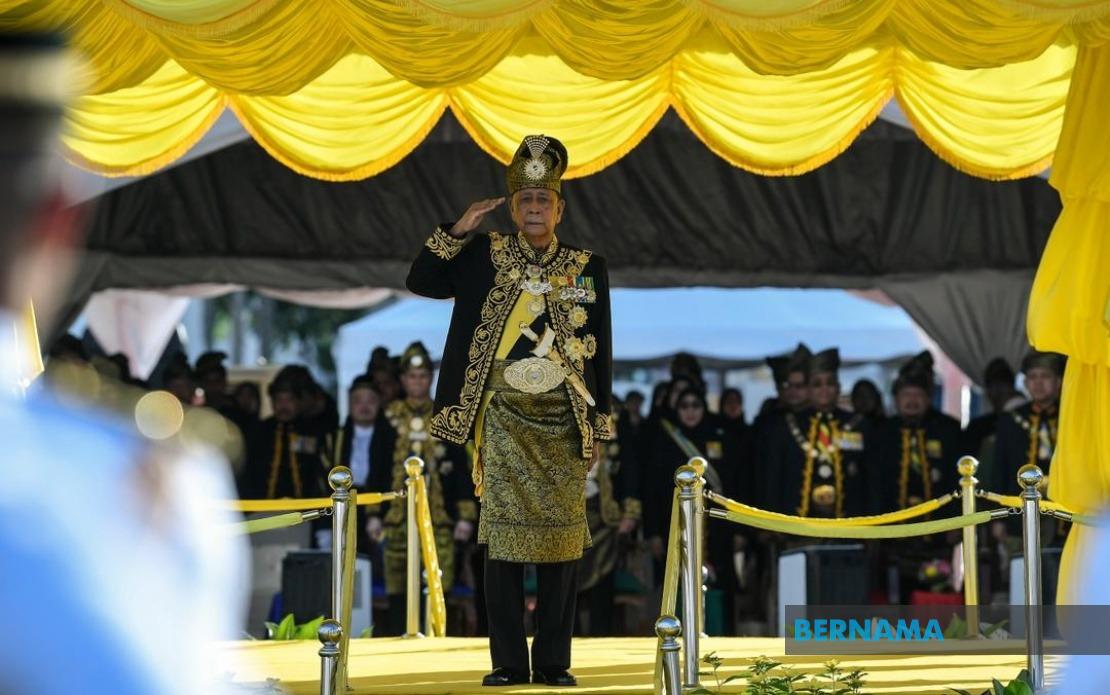
The Sultan of Kedah, Al Aminul Karim Sultan Sallehuddin Sultan Badlishah, was feted with a full ceremonial guard of honour at Dataran Medan Bandar in Alor Setar on July 5, marking the octogenarian royal's 84th birthday. The elaborate tribute underscored the significance placed by the state government on honouring the constitutional monarch, drawing together military units, government officials, and members of the royal household in a display of loyalty and respect.
The parade represented a significant ceremonial occasion for Kedah's administrative apparatus and defence establishment. Joining the Sultan at the event was Tengku Sarafudin Badlishah Sultan Sallehuddin, the Raja Muda of Kedah, positioning the heir apparent alongside his senior relative during this formal recognition of the ruler's advancing years. The presence of both the Sultan and Raja Muda underscored the continuity and stability of the state's constitutional monarchy.
State leadership turned out in force to pay respects to the long-reigning monarch. Kedah Menteri Besar Datuk Seri Muhammad Sanusi Md Nor and State Secretary Datuk Seri Norizan Khazali attended alongside members of the State Executive Council, reinforcing the formal nature of the occasion and the government's commitment to acknowledging the Sultan's position within Kedah's governance structure. Such attendance reflects the ceremonial protocols that bind Malaysia's state administrations to their respective sultans under the country's constitutional arrangement.
The military spectacle formed the centrepiece of the birthday observance. A contingent comprising 103 military personnel and three officers drawn from the 6th Battalion of the Royal Malay Regiment (RAMD) executed the parade formation, under the command of Major Muhammad Nasrullah Abdullah. This substantial deployment demonstrated the armed forces' participation in honouring the state's constitutional head, a tradition deeply embedded in Malaysia's military culture and ceremonial practices.
The parade itself followed time-honoured protocols for royal occasions in Malaysia. Lieutenant Mohamad Aiman Hanif Samsudin carried the colours, while Warrant Officer 1 Mohd Fairuz Ramli bore the regiment standard, both roles of considerable ceremonial importance within military traditions. The main guard of honour was accompanied by the RAMD Central Band, directed by Captain Muhamad Fauzee Japar with Sergeant Mohd Shahrilaizad Bakhtiar serving as assistant, providing the musical accompaniment that characterises formal military tributes in Malaysia.
The aerial component of the celebration showcased the Malaysian military's aviation assets in a manner befitting a royal occasion. Two EC120B helicopters from the Flying Training Institute (INSPEN) 2 conducted a ceremonial flypast in conjunction with three PC-7 MK II training aircraft from INSPEN 1, creating a dramatic visual element that elevated the celebration beyond ground-based formalities. Such aerial displays are reserved for occasions of national or state significance, underscoring the importance attached to the Sultan's milestone birthday.
Artillery personnel contributed to the ceremonial tableau through traditional means of honouring royalty. The 41st Battery of the Royal Artillery Regiment (Ceremonial) discharged a 21-gun salute, with Major Hafizan Md Ghani commanding the unit stationed at Sungai Buloh Camp in Selangor. The gun salute represented one of the most ancient and symbolic elements of the ceremony, a practice that dates back centuries in royal protocols and remains a cornerstone of how Malaysian states formally acknowledge their sovereigns.
The birthday celebration reflected broader patterns in how Malaysia's constitutional monarchies are publicly acknowledged. The scale of the military participation, the attendance of senior government officials, and the elaborate ceremonial arrangements all demonstrate how the institution of the Sultanate continues to be formally recognised and celebrated at the state level, even as Malaysia navigates contemporary governance challenges. For Kedah specifically, such occasions reinforce the Sultan's symbolic role within the state's constitutional framework.
Sultan Sallehuddin has reigned over Kedah for several decades, making him one of Malaysia's senior monarchs in terms of tenure. His 84th birthday celebration thus represents not merely a personal milestone but an acknowledgement of his long association with the state's governance and identity. The formal military and civilian tributes reflect the respect traditionally accorded to elder statesmen within Malaysia's constitutional hierarchy.
These ceremonial occasions serve multiple functions within Malaysia's political culture. Beyond personal tribute to the individual monarch, they reinforce public recognition of the Sultan's constitutional position, demonstrate the armed forces' loyalty to the state's institutions, and provide a visible expression of state unity and governance continuity. For Malaysian readers accustomed to such formal observances, the parade would have represented a routine but significant affirmation of institutional order and constitutional propriety within Kedah's administration.

