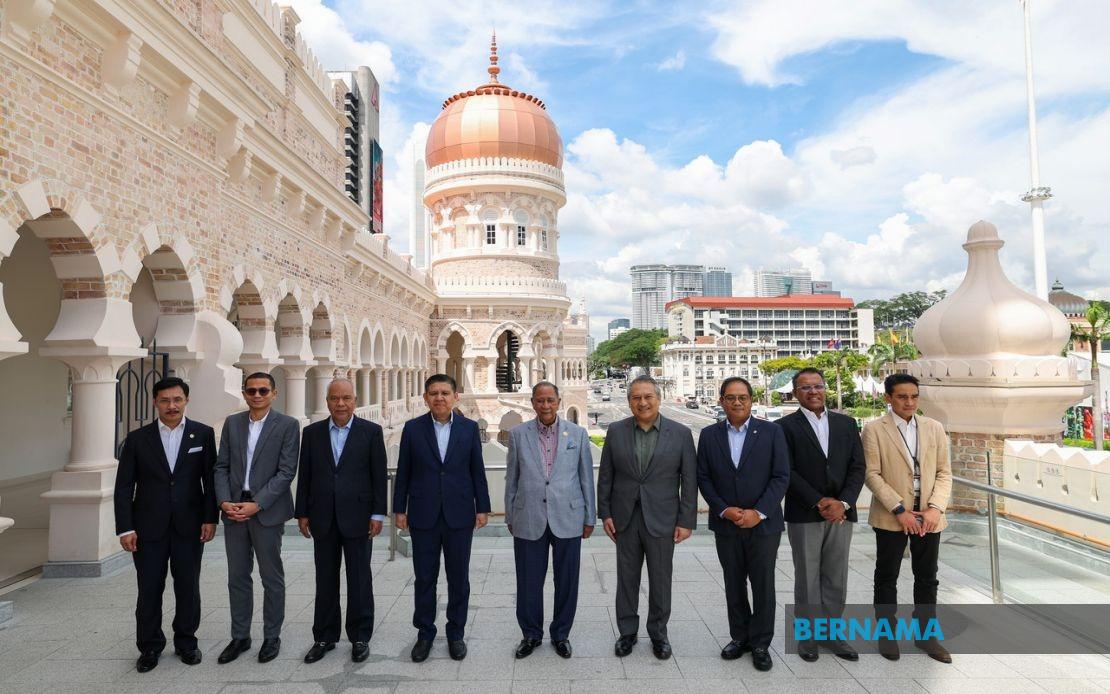
The Sultan of Kedah, Al Aminul Karim Sultan Sallehuddin Sultan Badlishah, spent an afternoon exploring the Sultan Abdul Samad Building in Kuala Lumpur on June 24, marking a significant recognition of ongoing heritage conservation efforts in the nation's capital. Arriving at approximately 10.30 am, His Royal Highness was warmly received by Khazanah Nasional managing director Datuk Amirul Feisal Wan Zahir, along with other senior officials from the state-owned investment company tasked with managing the restoration project.
The visit underscores the strategic importance that Malaysia's institutional leadership places on preserving tangible connections to the nation's founding era. Beyond its architectural significance, the Sultan Abdul Samad Building stands as a repository of pivotal moments in Malaysian independence, having served as the administrative epicentre during the nation's transition from colonial rule to self-governance. The structure's symbolic weight extends beyond its walls—it represents the physical manifestation of Malaysia's sovereignty and the institutional frameworks that emerged from the decolonisation process.
During his three-hour visit, the Sultan navigated through multiple galleries and exhibition spaces that have been thoughtfully curated to engage contemporary audiences. The Confluence Hall, which now functions as an interpretive centre documenting Kuala Lumpur's origins and urban evolution, provided the opening context for His Royal Highness's tour. Think City senior manager Mariana Isa guided the Sultan through the exhibits, explaining how the capital developed from a colonial trading settlement into a modern metropolitan centre, demonstrating how heritage conservation can simultaneously serve educational and cultural mandates.
The Visionary Hall presented a contrasting temporal perspective, offering scale models and interactive multimedia presentations that project Kuala Lumpur's anticipated future development trajectory. This dual narrative—connecting past achievement with future possibility—reflects contemporary best practices in heritage site management across Southeast Asia, where institutions balance preservation with dynamic engagement. The Sultan's deliberate progression through these spaces suggests an appreciation for how institutional memory can be rendered accessible and intellectually stimulating to diverse visitor populations.
A particular moment during the visit involved His Royal Highness stepping onto the elevated balcony overlooking the Porte Cochere, the distinctive arched carriage entrance that has welcomed dignitaries and officials for over a century. This architectural element remains one of the building's most photographed features, embodying the aesthetic confidence of late colonial design in the Malay Peninsula. The balcony vantage point offers visitors a perspective that reverses the typical historical gaze—rather than approaching the building as supplicants, visitors stand above and look outward across Kuala Lumpur's cityscape.
The Sultan concluded his tour with a visit to the School of Hard Knocks, an operational business incubator run by Royal Selangor, demonstrating how heritage buildings can serve contemporary commercial and educational purposes without sacrificing their historical integrity. This adaptive reuse strategy has become increasingly prevalent in major Southeast Asian cities, where real estate pressure necessitates that heritage sites generate ongoing revenue streams to sustain their conservation. A light luncheon preceded his departure at approximately 1.15 pm, suggesting a carefully choreographed programme designed to accommodate royal protocols while maintaining an unhurried, substantive engagement with the venue.
Khazanah Nasional's leadership has invested considerably in positioning the Sultan Abdul Samad Building as a flagship heritage destination. Since public opening on February 2, the venue has welcomed approximately 200,000 visitors, a figure suggesting sustained public interest in Malaysia's institutional heritage. Managing director Amirul Feisal characterised the Sultan's visit as recognition of preservation efforts that transcend conventional conservation—the organisation explicitly frames its work as maintaining not merely architectural fabric but rather the historical narratives essential to Malaysian national identity.
The restoration initiative acquired formal royal sanction when Yang di-Pertuan Agong Sultan Ibrahim officiated completion of Phase One restoration works on January 31, following eleven months of intensive conservation funded through the Khazanah Heritage Fund. This ceremonial acknowledgement elevated the project beyond technical preservation to constitute an act of institutional affirmation, signalling that heritage conservation aligns with the Crown's priorities for national cohesion and historical consciousness.
Historically designated as the Secretariat Building during the colonial period, the structure witnessed Malaysia's transformation from subordinate colonial territory to sovereign nation-state. The building's architectural narrative is inseparable from the pivotal events it accommodated—most significantly, the moment in 1957 when the Union Jack was lowered and the Federation of Malaya flag raised for the first time, a symbolic transaction that crystallised decades of nationalist struggle into a single, transformative instant. Every architectural detail thus carries resonance beyond aesthetic consideration, embodying political struggle and institutional emergence.
For Malaysian policymakers and cultural administrators, the Sultan of Kedah's visit represents validation that heritage preservation constitutes a legitimate governmental priority rather than a nostalgic indulgence. The Kedah sultanate's historical significance in Malaysian federalism—Kedah being among the most economically and politically consequential states—adds particular weight to this endorsement. The royal visitation creates a ripple effect throughout Malaysia's institutional landscape, subtly reinforcing the message that preservation efforts merit continued resource allocation and public attention.
The Sultan Abdul Samad Building's transformation into a functioning heritage destination reflects broader regional trends toward heritage tourism and the monetisation of historical consciousness. Within Southeast Asia, successful heritage sites increasingly operate as integrated cultural enterprises combining museum functions, commercial hospitality, educational programming, and archival research. The School of Hard Knocks partnership exemplifies this comprehensive approach, ensuring that historical buildings contribute substantively to contemporary economic and skills development imperatives.
Looking forward, the Khazanah-led conservation model may influence how other Malaysian institutions approach their own heritage assets. The February opening and subsequent 200,000-visitor threshold suggest authentic public appetite for engaging with Malaysia's modern historical period. This demand trajectory potentially justifies expanded conservation initiatives, particularly at sites documenting the twentieth-century constitutional and institutional developments that structured contemporary Malaysia. The Sultan's visit effectively endorses heritage preservation as a legitimate exercise of institutional stewardship, providing implicit permission for continued investment in these culturally essential but economically complex preservation projects.

