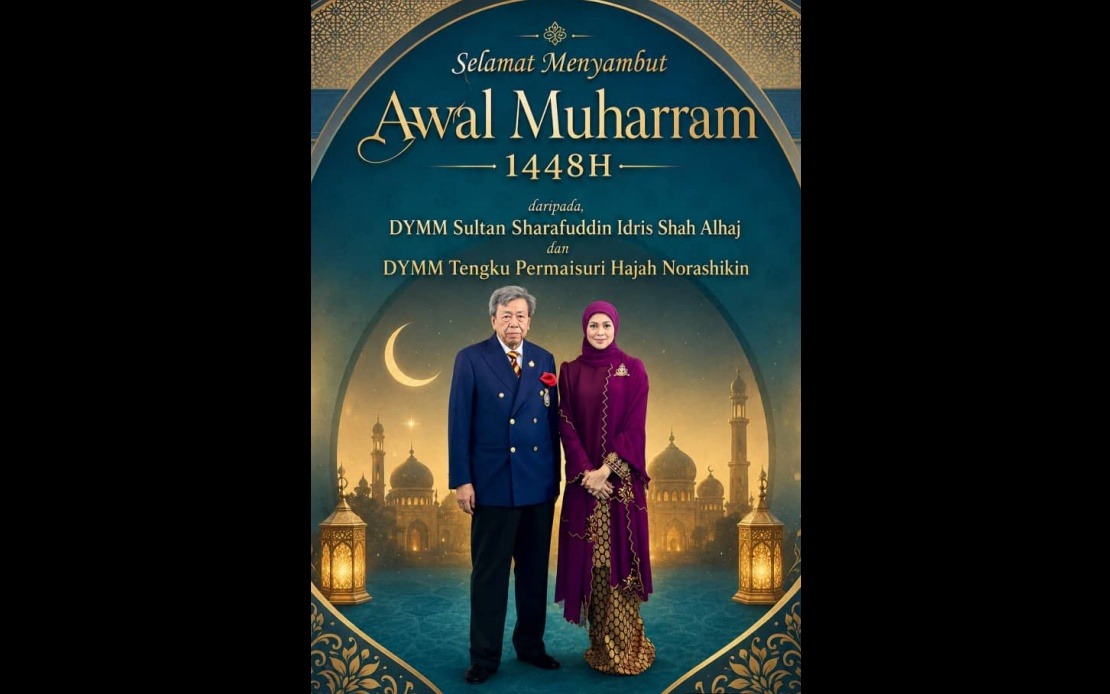
Sultan Sharafuddin Idris Shah has issued a timely reminder to the Muslim community about the deeper significance of Maal Hijrah, the Islamic New Year celebration marking 1448H, emphasizing that true observance extends far beyond ceremonial recognition. Speaking in Shah Alam on June 16, the Selangor ruler framed the occasion not as a mere commemoration of historical migration but as an opportunity for introspection and recommitment to the principles of collective strength and solidarity that should define Muslim societies.
The Sultan's message carries particular weight in the contemporary Malaysian context, where interfaith and intra-faith discussions frequently occupy public discourse. He drew inspiration from the counsel of his late father, Sultan Salahuddin Abdul Aziz Shah, whose emphasis on unity has remained a defining characteristic of the Selangor monarchy's approach to religious and social matters. This intergenerational continuity underscores how the message of harmonious coexistence has been woven into the institution's values and transmitted as a cornerstone principle for public leadership.
Central to his address was a sophisticated articulation of how disagreements should be managed within Muslim communities. The Sultan advocated for a model where differences of opinion, inevitable in any diverse society, are addressed through wisdom and respectful exchange rather than acrimonious public confrontation. This distinction between private resolution and public dispute reflects a nuanced understanding of how contemporary communication channels—particularly social media—can amplify divisions and create perceptions of widespread discord that may not reflect underlying unity.
The ruler explicitly outlined the protocol for constructive engagement, stipulating that criticism and advice, when necessary, should be delivered with graciousness and propriety rather than aggression or ridicule. This framework acknowledges that correction and improvement are legitimate activities within communities, but insists they function best when conducted within established norms of civility. The emphasis on manner and approach suggests that the substance of concerns matters less than the respectful vehicle through which they are conveyed, a principle increasingly relevant as Malaysian society navigates complex social questions.
Sultan Sharafuddin warned against allowing internal disagreements to metastasize into public spectacles that risk exposing vulnerabilities to external actors. His observation that adversaries and opportunists may exploit visible divisions within Muslim communities addresses a genuine strategic concern facing religious minorities globally, where internal cohesion directly affects the community's capacity to advocate effectively for its interests and rights. The point is particularly salient in Southeast Asia, where religious tensions occasionally emerge from perceptions of disunity or weakness within specific faith communities.
The Sultan's framing of dispute resolution through private channels guided by mutual respect and collaborative problem-solving represents an appeal to established traditions of conflict resolution while employing contemporary language about inclusivity and stakeholder engagement. This approach acknowledges that resolving matters away from public scrutiny does not require suppressing legitimate grievances but rather conducting their resolution through mechanisms more conducive to finding genuinely satisfactory outcomes rather than scoring rhetorical victories.
Invoking the spirit of Hijrah itself provided theological grounding for his political message. The concept of Hijrah, while historically referencing the Prophet Muhammad's migration to Medina, has long been understood metaphorically as a spiritual and moral transformation. The Sultan positioned this reimagining to suggest that Muslims should undertake an internal migration of sorts, moving from divisiveness toward cohesion, from grievance toward reconciliation, and from narrow self-interest toward communal welfare. This reinterpretation makes the Islamic calendar transition a prompt for behavioral and attitudinal renewal.
The explicit call to subordinate personal and factional interests to the larger good of religion, nation, and ethnicity reflects consciousness of contemporary tensions between individual assertion and collective responsibility. In the Malaysian context, where diverse communities navigate shared citizenship while maintaining distinct religious identities, this articulation of hierarchy carries implications beyond purely Muslim affairs. The Sultan's framework suggests that when sectarian or individual interests threaten broader social stability, principled prioritization of the collective becomes not merely advisable but obligatory.
The ruler's hope that the new Islamic year would catalyze renewed commitment to unity and harmony extended the message beyond the specifically Muslim audience to encompass Malaysian society more broadly. This inclusive language acknowledges that social peace benefits all residents regardless of faith, and that Muslim leadership in promoting harmony serves national interests. The invocation of blessings, peace, and prosperity for all reflects the constitutional role of Malaysia's sultans as custodians of Islam while maintaining commitment to the country's multifaith character.
Historically, Maal Hijrah has provided Malaysian Islamic leaders with occasions to address contemporary challenges through the lens of religious principle. Sultan Sharafuddin's contribution to this tradition demonstrates how traditional institutions continue attempting to shape public discourse around unity and constructive engagement. Whether these appeals translate into changed behavior during moments of controversy remains uncertain, but they establish normative frameworks against which public conduct can be evaluated and toward which community members can be called to account.
The Sultan's remarks implicitly critique the tendency of some commentators and participants in public debates to prioritize winning arguments over maintaining relationships or pursuing sustainable solutions. This critique gains force from his institutional position and religious authority, suggesting that dignity and communal cohesion should outweigh the temporary satisfaction of public victory. For Malaysian and Southeast Asian readers observing rising polarization in multiple registers—religious, political, and social—his measured call for wisdom-guided discourse offers a counterweight to more confrontational voices.
The message also carries practical implications for how Malaysia's Muslim-majority society addresses urgent policy questions, from education to economic justice to interfaith relations. If taken seriously, the Sultan's framework would require government agencies, religious institutions, and civil society organizations to build greater capacity for facilitated dialogue and collaborative problem-solving, moving beyond both enforced consensus and unmediated public dispute. The challenge lies in translating these principled exhortations into institutional practices and behavioral change.