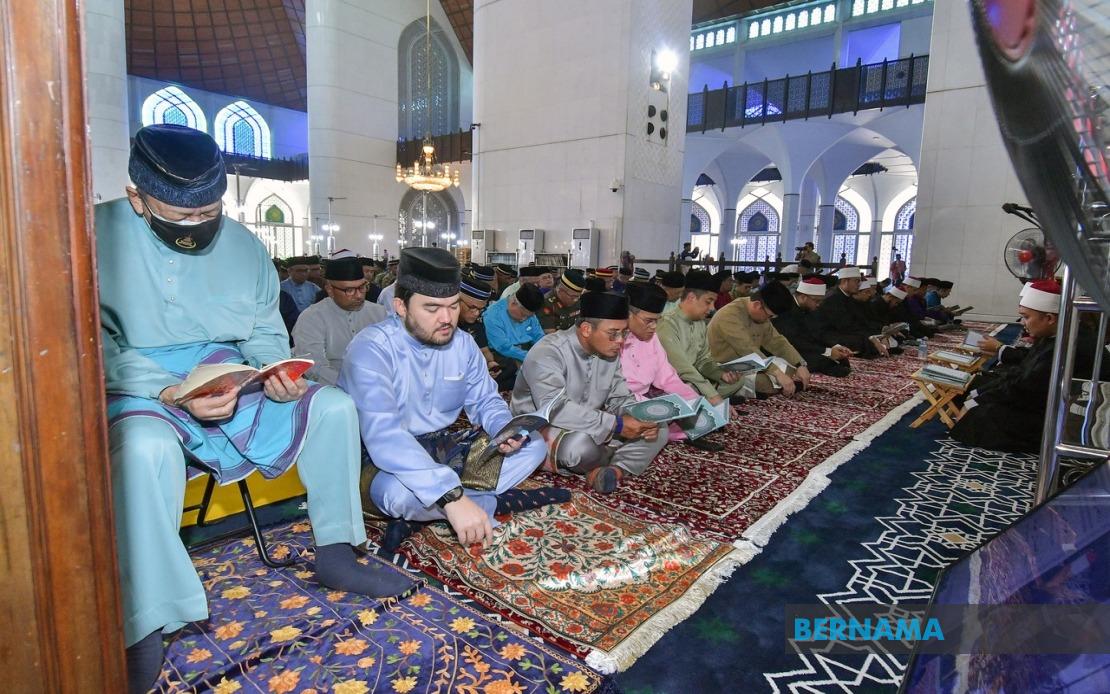
Sultan Sharafuddin Idris Shah, the Sultan of Selangor, participated in a Surah Yassin recitation and tahlil session on August 28 at Masjid Sultan Salahuddin Abdul Aziz Shah in Shah Alam, marking a significant religious observance ahead of Malaysia's National Day celebrations. The Raja Muda of Selangor, Tengku Amir Shah Sultan Sharafuddin Idris Shah, joined the monarch in attendance, underscoring the royal family's commitment to leading communal religious practices during important national periods.
The event drew considerable participation from the broader Selangor community, with approximately 1,000 worshippers present. Notably, the gathering included members of the security forces stationed throughout Selangor, demonstrating the inclusive nature of the religious observance and the role state institutions play in honouring religious and national occasions. The presence of uniformed personnel alongside civilians reflected the cross-sectional character of national celebrations in Malaysia.
Selangor Menteri Besar Datuk Seri Amirudin Shari received His Royal Highness upon arrival at the mosque, alongside Dr Mohammad Fahmi Ngah, chairman of the State Islamic Affairs and Innovation Culture Committee. This arrangement typified the formal protocols that accompany royal religious engagements, where state administrators coordinate with religious leadership to ensure proper ceremonial conduct. The attendance of senior government officials highlighted the intertwined nature of governance and religious observance in Selangor's institutional framework.
The mosque's leadership also featured prominently, with Datuk Mohd Shahzihan Ahmad, director of the Selangor Islamic Religious Department (JAIS), and Datuk Salehuddin Saidin, chairman of the Selangor Islamic Religious Council (MAIS), participating in welcoming proceedings. These organisations function as critical pillars of religious administration in the state, overseeing everything from Islamic education to halal certification and religious affairs coordination. Their participation underscored how religious institutions and government bodies collaborate during high-profile events.
Following the Surah Yassin recitation, Sultan Sharafuddin performed Friday prayers alongside the assembled congregation. The mosque's Grand Imam Muhammad Farhan Wijaya delivered the sermon, choosing a thematic message titled "Merdeka Daripada Belenggu Kerakusan," which translates to "Freedom from the Shackles of Greed." This carefully selected topic demonstrated how religious discourse during National Day observances often incorporates broader social and moral dimensions, connecting spiritual teachings to national values and aspirations.
The sermon's emphasis on freedom from greed carried particular resonance within the context of Malaysia MADANI, the broader governance framework adopted by the current administration. The MADANI concept, which emphasises prosperity, stability, and justice, provides the philosophical underpinning for how religious and national values are being integrated at the state level. By framing religious messages around such themes, religious leaders reinforce alignment between spiritual principles and government development objectives.
Selangor's state-level National Day celebrations were scheduled for August 30 at Kajang Stadium, commencing at 8 pm, operating under the overarching theme "Malaysia MADANI: Kesejahteraan Dinikmati" (Malaysia MADANI: Shared Prosperity). This thematic consistency, with religious observances preceding the official celebrations, reflected a deliberate approach to structuring National Day programming that acknowledges the spiritual dimensions of national identity alongside civic celebrations. The sequencing allowed for contemplation of national values through religious practice before the larger commemorative festivities.
The attendance of the Sultan at such religious observances carries significance beyond ceremonial requirements in the Malaysian context. As constitutional monarchs, Selangor's rulers serve as guardians not only of state affairs but also of Islamic practice and values within their jurisdiction. Royal participation in congregational worship signals the importance placed on religious observance and provides visible leadership in upholding Islamic principles at state level, particularly during occasions emphasising national unity and shared values.
The gathering at Masjid Sultan Salahuddin Abdul Aziz Shah also reflected the strategic location and significance of this religious institution within Selangor's landscape. As one of the state's major mosques, it frequently serves as a venue for high-profile religious and state occasions, accommodating large congregations and facilitating the coordination of multiple stakeholder groups. The mosque's capacity to host diverse participants, from security personnel to government officials and the general public, makes it an appropriate setting for events symbolising state-wide religious participation.
The timing of these religious observances immediately before National Day celebrations illustrates how Malaysian states integrate spiritual reflection into patriotic commemoration. Rather than treating these dimensions separately, the programming allows citizens to ground their understanding of national identity in religious and moral frameworks. This approach reflects Malaysia's constitutional recognition of Islam's special position while acknowledging the importance of ethical and spiritual foundations for national cohesion and development.
Looking forward, the sequence of events from the mosque observance to the stadium celebrations provided a comprehensive National Day programme spanning spiritual, administrative, and civic dimensions. For Selangor, this integrated approach to celebrating merdeka reinforced how the state balances modern governance structures with traditional religious values, presenting a model for how diverse Malaysian communities can unite around shared national purpose while respecting religious and spiritual dimensions of collective identity.

