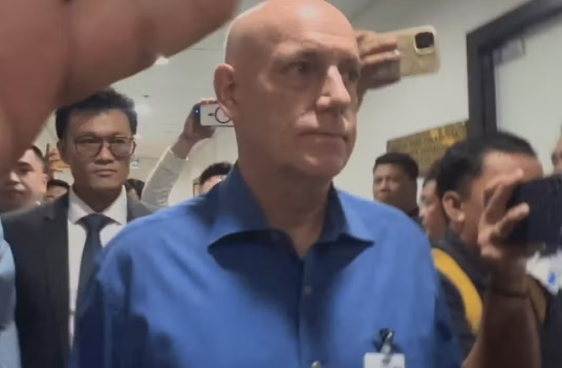
Tab Baldwin, the former head coach of Ateneo de Manila University's men's basketball programme, presented himself before the National Bureau of Investigation on Tuesday afternoon following repeated delays that had frustrated investigators pursuing answers in a tragic incident that claimed two young athletes' lives. Baldwin arrived at the NBI Homicide Division headquarters around 1:45 pm accompanied by his legal representative Karl David, entering the bureau's offices under heightened scrutiny as authorities intensified their examination of circumstances surrounding the deaths of Rene Baterbonia and Divine Adili.
The appearance marked a significant development in a case that has drawn considerable attention within Philippine sporting circles and beyond, representing Baldwin's first direct engagement with the NBI after he had previously defaulted on two consecutive scheduled sessions. The former coach's initial no-show on June 16 prompted his legal team to submit explanatory documentation, with his counsel asserting that Baldwin was not in appropriate physical or mental condition to participate in investigative proceedings at that time. This explanation did little to ease the bureau's frustration, particularly as time remained a critical factor in gathering coherent narratives from key participants.
Just days earlier, Baldwin had similarly missed a second appointment with the NBI on June 19, though records indicate he was simultaneously engaged with another investigative agency that same day. This scheduling conflict, whether inadvertent or strategic, further complicated the bureau's timeline and raised questions about the coordination between multiple investigation units operating simultaneously. The Philippine National Police-Criminal Investigation and Detection Group had apparently secured Baldwin's participation for their own questioning, creating an unusual situation wherein the former coach was simultaneously pursued by two separate law enforcement bodies with overlapping jurisdictions.
The investigation itself stems from a deeply troubling incident that unfolded during what was intended as a routine team-building activity in Dipaculao, Aurora, earlier in June. Two Ateneo basketball players—Baterbonia and Adili—lost their lives in a drowning incident during this event, transforming what should have been a bonding experience into a tragedy that would spark multiple investigations and significant institutional scrutiny. The circumstances surrounding their deaths remain contested, and investigators from both the NBI and the PNP have been working independently and sometimes in parallel to establish precisely what transpired during those fatal moments.
A key investigative objective centres on reconciling the narratives that Baldwin provided to different agencies. NBI Director Melvin Matibag explicitly stated that investigators would conduct a detailed comparison between Baldwin's statement submitted to the NBI with testimony he previously delivered to the CIDG during their Friday questioning session. This comparative analysis represents standard investigative methodology designed to identify inconsistencies, contradictions, or newly recalled details that might illuminate what occurred. Such discrepancies, if identified, could prove crucial in establishing whether any individual actions or inactions contributed to or potentially exacerbated the tragedy.
The presence of separate investigations by both the NBI and the PNP underscores the gravity with which Philippine authorities are treating this matter, suggesting that questions of potential criminal liability extend beyond simple accident classification. The fact that multiple investigative units have opened files indicates serious institutional concern about whether proper safety protocols were observed, whether adequate supervision existed, or whether any individual negligence or misconduct contributed to the students' deaths. This dual-track approach, while sometimes appearing redundant, can serve investigative purposes by allowing cross-verification of facts and providing different perspectives on the evidence.
For the Philippine sporting community and particularly for the University Athletic Association of the Philippines, which oversees collegiate athletics across major universities, this incident has raised urgent questions about athlete safety during team activities. Schools and coaches nationwide will likely face renewed scrutiny regarding emergency preparedness, safety equipment, medical personnel availability, and supervision protocols during team outings. The Ateneo case may well trigger policy reviews across institutions grappling with how to balance team cohesion activities with appropriate safeguards against preventable tragedy.
Baldwin's engagement with investigations also carries implications for Ateneo's institutional standing and reputation. The university, one of the Philippines' most prestigious educational institutions with a storied athletic programme, confronts both the immediate pastoral challenge of supporting grieving families and the longer-term institutional challenge of examining its athletic department's operational procedures. How the university addresses findings emerging from the NBI and PNP investigations will significantly shape its credibility and the confidence of students and parents in its commitment to participant welfare.
The bureau has publicly committed to concluding its investigative phase within the current week, establishing a definitive timeline for preliminary findings. This deadline reflects a recognition that momentum in death investigations diminishes as time progresses, and that the families of Baterbonia and Adili deserve reasonably prompt clarification regarding official conclusions about what led to their children's deaths. Whether this timeline proves achievable depends largely on the quality and completeness of information that emerges from ongoing witness interviews, forensic examination, and statements from key participants like Baldwin.
As Baldwin's questioning proceeded at the NBI headquarters, the broader implications of this case rippled through Philippine society. The incident represents a painful reminder that institutional capacity to prevent tragedy remains imperfect, and that even relatively simple team activities can end catastrophically without adequate preparation and safety consciousness. The investigation's ultimate findings will likely inform not just potential legal consequences but also systemic improvements that might prevent similar incidents at other institutions across the archipelago.

