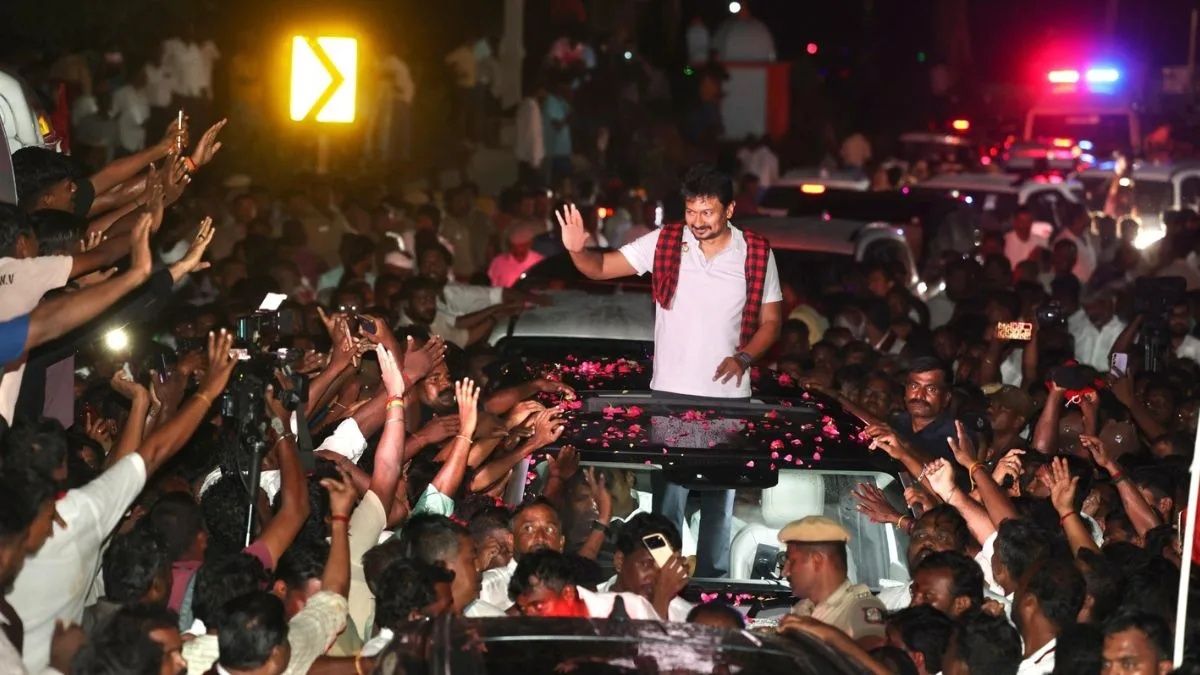
Tamil Nadu's Opposition Leader Udhayanidhi Stalin walked free on station bail late Tuesday evening after spending hours in police custody in connection with controversial remarks he made during a recent public gathering. The former deputy chief minister's release came after intensive questioning by authorities investigating allegations that his statements carried offensive undertones directed at popular Tamil actress Trisha Krishnan. The incident has ignited a significant political dispute between the DMK opposition and Tamil Nadu Chief Minister Vijay's newly-formed TVK government, highlighting growing tensions between the two rival political forces vying for control in the southern state.
The controversy originated during a DMK rally held in Thanjavur, where Stalin was addressing supporters about the contentious Cauvery water dispute and Karnataka's proposed Mekedatu dam project—longstanding issues that carry substantial weight among Tamil Nadu voters and rival state administrations. When a supporter in the crowd interjected by calling out Trisha's name, reportedly in reference to her known proximity to Chief Minister Vijay, Stalin paused momentarily, smiled, and responded with the phrase, "Wherever water comes, whether it comes or not, water should come there." While Stalin has maintained that his comment pertained solely to water distribution matters, political opponents and sections of the public interpreted the statement as containing sexual innuendo aimed at the actress.
The TVK government moved swiftly to escalate the matter beyond the initial political backlash. Party officials filed a formal police complaint characterizing Stalin's remarks as constituting verbal harassment and the objectification of a woman, framing the dispute as a gender rights issue rather than mere political theatre. The ruling party subsequently approached the National Commission for Women, India's statutory body tasked with investigating complaints related to women's welfare and dignity, attempting to lend institutional gravitas to their accusations. This multi-pronged approach suggested that the TVK viewed the controversy as an opportunity to damage the opposition leader's credibility and demonstrate their commitment to protecting women's honour—a position that resonates with sections of the electorate concerned about civility in public discourse.
Authorities arrested Stalin from his Chennai residence on Wednesday morning, transporting him to the Sengipatti police station where he underwent extended questioning throughout the day. The detention period allowed investigators to document his statement regarding the nature and intent behind his words, though the substantive outcome remained contentious. Hundreds of DMK supporters congregated outside the police station to greet their leader upon his release, transforming what might have been a routine administrative procedure into a public demonstration of party solidarity. The assembled crowd energetically chanted slogans critical of Chief Minister Vijay and his TVK administration, underscoring the party's messaging that Stalin's arrest represented governmental overreach rather than legitimate law enforcement.
At a press conference following his release, Stalin categorically denied any wrongful intent behind his remarks, characterising his words as entirely innocent and directed exclusively at the water distribution matter at hand. He positioned his arrest as a deliberate diversion tactic employed by the TVK government to deflect attention from substantive governance failures and policy disputes. Stalin's statement reflected a rhetorical strategy common in Indian politics whereby opposition figures reframe legal actions against them as political persecution designed to suppress legitimate criticism. By arguing that his sole motivation was defending farmers' interests regarding water allocation—a sympathetic political position in agrarian Tamil Nadu—Stalin attempted to redirect the narrative away from the specific phrasing of his remarks and toward broader questions about governmental legitimacy and accountability.
The episode illuminates the fractious nature of Tamil Nadu's current political landscape, where Chief Minister Vijay's recently-established TVK has rapidly positioned itself as a challenger to the traditionally dominant DMK. Though Vijay's party secured a decisive election victory, the opposition remains organizationally potent and enjoys substantial grassroots support in many constituencies. Political scientists observing Tamil Nadu note that personality-driven politics often supersedes policy discussions in the state, and personal conduct or perceived disrespect toward prominent figures can trigger disproportionate political responses. The Trisha remarks controversy exemplifies how a momentary utterance during a protest can metastasize into a full-scale political and legal confrontation, potentially shifting public perception and influencing electoral calculations.
From a broader Southeast Asian perspective, the incident reflects patterns visible across the region's democracies where opposition leaders face legal challenges that their supporters characterise as politically motivated. Thailand, Philippines, and Indonesia have all witnessed comparable situations where government critics encounter arrest or prosecution following statements deemed offensive to state figures or their associates. The Tamil Nadu episode demonstrates how contentious elections and divided governments can produce an environment where aggressive legal tactics become normalized as instruments of political competition, complicating the distinction between legitimate law enforcement and partisan weaponization of state institutions.
The National Commission for Women's involvement adds another dimension, illustrating how gender protection mechanisms—ostensibly designed to safeguard vulnerable populations from genuine harassment—can be instrumentalized within partisan disputes. While the Commission serves the legitimate purpose of investigating authentic cases of women's mistreatment, its involvement in politically charged disagreements risks diluting its credibility and transforming it into an arena for factional conflict. This phenomenon has emerged elsewhere in India and the region, where various statutory bodies designed to protect specific constituencies occasionally find themselves entangled in political disputes that exceed their institutional mandates.
Strictly from a legal standpoint, the case hinges on whether Stalin's remarks constitute criminal harassment or represent protected political speech. Station bail, the procedural mechanism through which Stalin was released, typically permits further investigation without requiring the accused's continued detention. This suggests that prosecutors believe sufficient evidence exists to proceed with the case while also recognizing that circumstances did not warrant extended custody. The trajectory of this legal process will likely depend on how courts ultimately interpret the contested remarks and the degree to which judges prove willing to engage with highly contentious determinations about the meaning of ambiguous statements made in politically charged contexts.
The ruling TVK's aggressive response strategy carries potential political risks alongside its apparent short-term benefits. While the government can claim responsiveness to women's safety concerns, sustained prosecution of a prominent opposition leader could crystallize public perception of the administration as vengeful and intolerant of criticism. The DMK, conversely, has benefited from a rallying moment for its supporters, demonstrating that the party remains mobilized and capable of mounting coordinated responses to perceived governmental overreach. As Tamil Nadu navigates its first non-DMK administration in many years, this incident has established early patterns regarding how the government will exercise its authority and how opposition forces will contest that exercise.
Looking forward, the case's resolution will carry implications extending well beyond the specific individuals involved. The outcome will signal whether Tamil Nadu's courts will permit considerable governmental discretion in determining what constitutes offensive speech, or whether judges will enforce more rigorous protections for political expression, even when that expression proves controversial or in questionable taste. The precedent established could influence how police and prosecutors approach similar complaints filed during India's volatile electoral cycles, affecting the broader health of democratic discourse throughout the nation.

