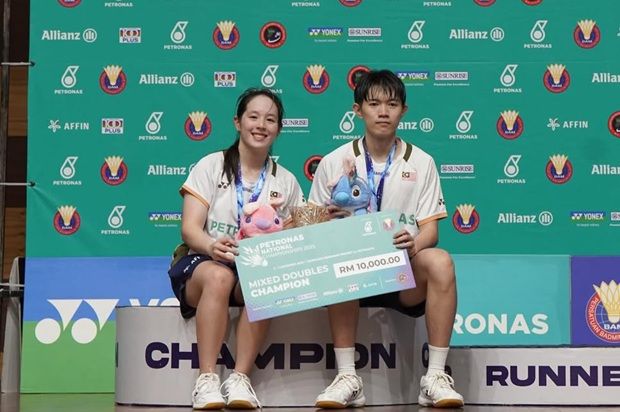
Clarissa San steps into the most significant competition of her badminton career next week at the Japan Open, carrying with her the reassuring counsel of her new mixed doubles partner Chen Tang Jie to keep nerves at bay and savour the experience. The 20-year-old has been handed an unexpected opportunity following the injury setback that sidelined original partner Toh Ee Wei, who sustained an anterior cruciate ligament injury and is currently in Melbourne undertaking recovery work. Rather than viewing the disruption as a setback, Clarissa has embraced the chance to pair with Tang Jie at one of the Badminton World Federation's most prestigious events on the international calendar.
The pairing represents a significant step up for Clarissa, whose previous experience has been confined to lower-tier tournaments. Mixed doubles head coach Nova Widianto and Tang Jie have worked methodically to prepare her mentally for the intensity of competing at such an elevated level, instilling confidence that extends beyond tactical preparation. Their repeated message remains consistent: avoid allowing anxiety to cloud judgment, trust in the preparation that has been invested, and approach each match with a mindset focused on enjoyment rather than outcome. This psychological scaffolding has proven valuable for Clarissa, who has responded positively to the supportive environment being created around her development.
Clarissa's own reflections on the partnership underscore the value she derives from Tang Jie's presence. She characterises him as playing a dual role—functioning simultaneously as a mentor figure offering technical guidance and as an older brother providing emotional support. When mistakes occur during matches, rather than criticism or frustration, Tang Jie responds with constructive guidance that helps her understand what went wrong and how to adjust. This approach contrasts sharply with the pressure-laden environments some developing athletes encounter, where errors are treated as failures rather than learning opportunities. For a player making her debut at this level, such support proves instrumental in building both confidence and resilience.
Their opening challenge will test them immediately against Taiwan's Yang Po-hsuan and Hu Ling-fang, a pairing that will provide an early indication of how well the Malaysian duo has integrated their games. Clarissa has deliberately maintained modest expectations heading into the tournament, preferring to focus on translating training performance into match situations rather than pursuing ambitious results. This measured approach reflects maturity in how she frames her participation—recognising that this represents a learning experience more than a tournament to be won outright.
Clarissa's assessment of her own development acknowledges substantial room for improvement across multiple facets of her game. Rather than viewing such gaps as sources of discouragement, she frames them as natural aspects of her evolution as a player. Tang Jie's mentorship extends to helping her navigate this developmental phase with perspective, reassuring her that growth occurs incrementally rather than in quantum leaps. The partnership itself serves as accelerant to her progression, given Tang Jie's experience and understanding of what succeeding at the highest levels demands.
The Japan Open represents the first in a sequence of tournaments the partnership will navigate together. Clarissa has articulated a clear intention to maximise the learning available across these events, understanding that consistency in competition is where true development occurs. She balances ambition to win matches with realistic acknowledgment of where she currently stands relative to established pairings. This balanced perspective should serve her well through the inevitable moments of self-doubt that arise when facing world-class opposition.
Malaysia's broader badminton representation at the Japan Open encompasses several mixed doubles combinations, each facing distinct challenges according to seeding and opponent strength. Jimmy Wong and Cheng Su Yin will open their campaign against Japan's Yuichi Shimogami and Sayaka Hobara, while independent pairing Goh Soon Huat and Shevon Lai Jemie face American combination Chen Zhi Yi and Francesca Corbett. Wong Tien Ci and Lim Chiew Sien have drawn a formidable first-round opponent in China's fifth-seeded pairing of Guo Xinwa and Chen Fanghui, a test that will immediately expose any deficiencies in their preparation.
The depth of Malaysian mixed doubles talent attempting to make impressions at the Japan Open highlights the competitive nature of developing viable partnerships in this discipline. Injuries like Toh Ee Wei's disrupt carefully constructed plans and force rapid adjustments, yet they simultaneously create opportunities for emerging players to gain exposure at levels otherwise inaccessible. Clarissa's emergence as a result of these circumstances may ultimately prove fortuitous, depending on how she capitalises on the platform being provided. Her willingness to embrace learning over chasing results suggests she possesses the mental framework necessary to extract maximum value from this unexpected opportunity, with Tang Jie's steady hand guiding her through the noise and intensity of international badminton's premier tournament.

