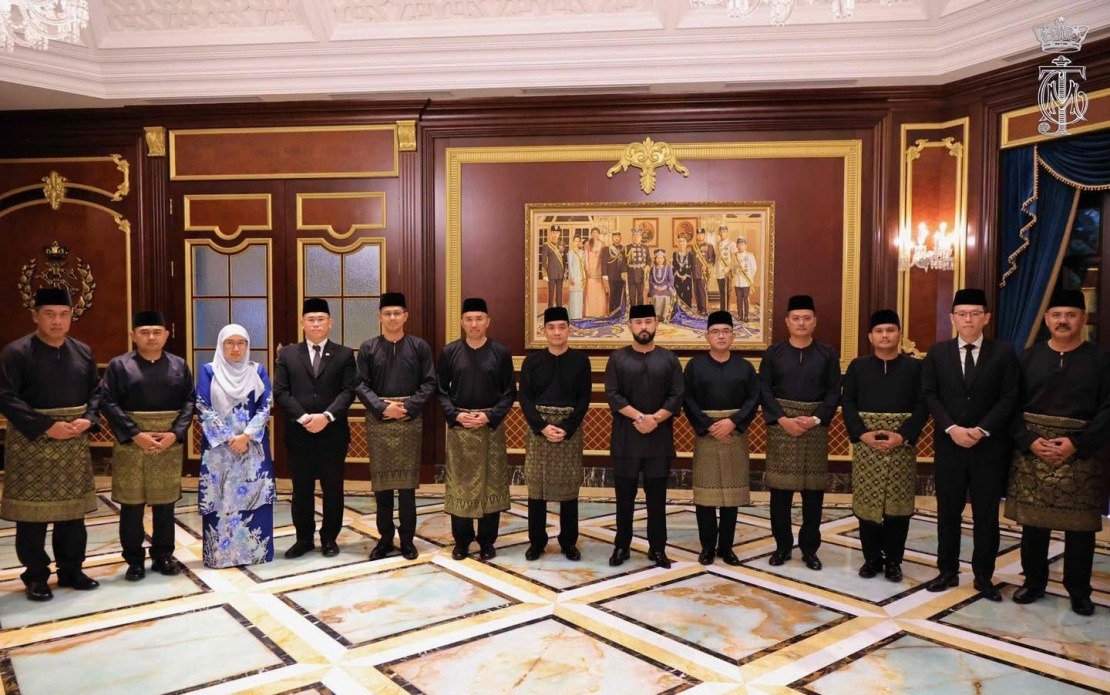
Ten state assemblymen from Johor took their oaths of office on July 18 as members of the Johor State Executive Council, marking the formal establishment of the cabinet following Barisan Nasional's commanding electoral victory. The ceremony took place at Istana Bukit Serene before Tunku Mahkota Ismail, the Regent of Johor, and was attended by Menteri Besar Datuk Onn Hafiz Ghazi alongside senior state officials including State Secretary Datuk Mohammed Ridha Abd Kadir.
The new executive council comprises a mix of experienced and newly elevated assemblymen, reflecting both continuity and fresh representation within the state administration. Among those taking their positions are Mohd Hairi Mad Shah from Larkin, Datuk Mohd Jafni Md Shukor representing Bukit Permai, Mohd Fared Mohd Khalid from Semerah, Ling Tian Soon from Yong Peng, Lee Ting Han from Paloh, and Mohamad Fazli Mohamad Salleh representing Bukit Pasir. These six members bring institutional knowledge and established legislative credentials to the cabinet table, having already built relationships with their constituencies through previous parliamentary work.
Four newcomers to the Exco represent a generational shift within Johor's governance structure. Md Israk Abdullah from Kukup, P. Pannir Selvam from Perling, Hasrunizah Hassan representing Pulai Sebatang, and Muhammad Naqib Md Ghazali from Panti are making their debuts in the state executive council. Their appointment signals an effort to incorporate emerging voices and perspectives from various districts, while also diversifying the demographic composition of the leadership team to better reflect Johor's constituent populations.
The cabinet formation comes just days after Onn Hafiz was reinstated as Menteri Besar for his second consecutive term, a development that underscores the electorate's confidence in his leadership during the 16th Johor state election held in recent weeks. Onn Hafiz, who represents the Machap constituency himself, secured his own seat with an impressive majority of 15,375 votes, demonstrating substantial personal support among his constituents and reinforcing his political standing within both the state and the broader Barisan Nasional coalition.
Barisan Nasional's electoral performance in Johor represents a significant political outcome within the Malaysian context, where state-level contests increasingly serve as bellwethers for national political sentiment. The coalition secured 48 out of 56 state assembly seats, translating to a supermajority that provides Onn Hafiz with considerable legislative flexibility in implementing policy initiatives without dependence on opposition support or independent assemblymen. This commanding mandate reflects the voting public's preference for political stability and continuity in Johor's administration.
The size and composition of the ten-member Exco reflects contemporary governance practices in Malaysian state administrations, where executive councils typically range between nine and twelve members depending on the state's size and administrative requirements. By appointing ten members, Onn Hafiz has created sufficient cabinet depth to distribute portfolios across various policy domains while maintaining manageable coordination and decision-making processes. The balance between retaining experienced members and promoting new talent suggests a strategic approach to governance that values both stability and renewal.
Johor's political landscape holds particular significance for the broader Malaysian federation given the state's economic importance, substantial population, and historical prominence within both Barisan Nasional and Malaysian politics generally. The state accounts for considerable economic output within the Southeast Asian context and maintains substantial port and industrial infrastructure. Political stability and effective governance in Johor therefore have cascading implications for regional trade patterns, investment decisions, and broader economic performance within Malaysia's southern corridor.
The swearing-in ceremony itself represents a formal constitutional moment wherein individual assemblymen transition from legislative roles to executive responsibility. Taking the oath before the Regent emphasizes the ceremonial and constitutional dimensions of executive authority in Malaysian states, where the ruler or regent serves as a constitutional check on executive power. This procedure underscores that state executives operate within a framework of constitutional monarchy that distinguishes Malaysian governance from purely parliamentary systems elsewhere in the region.
Looking forward, the configuration of Onn Hafiz's cabinet will shape policy priorities and resource allocation across critical areas including infrastructure development, education, health services, and economic incentives for investors. The geographic diversity of the Exco members—drawn from constituencies spanning urban centres like Larkin and peripheral districts like Kukup—suggests potential for balanced consideration of urban and rural development needs. The inclusion of newly appointed members may also bring fresh perspectives on contemporary challenges including digital transformation, environmental sustainability, and youth employment within Johor's development strategy.

