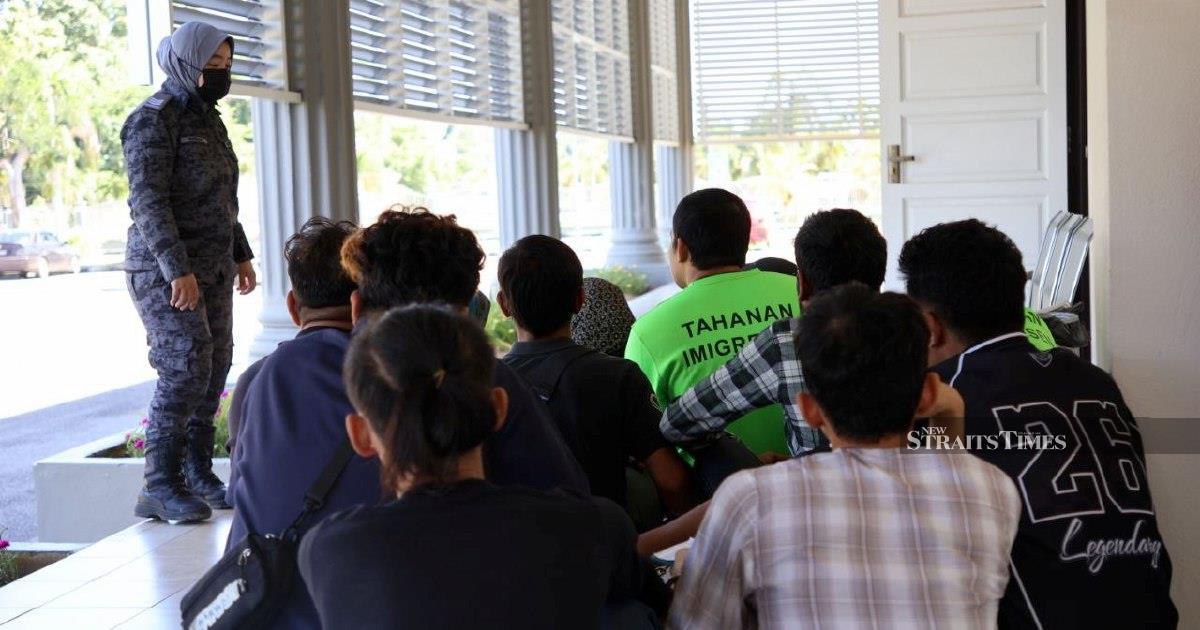
A total of ten undocumented migrants appeared before Pasir Mas Sessions Court to face charges stemming from immigration violations, with three of the accused being foreign women. The defendants are accused of various breaches of Malaysia's immigration laws, including overstaying beyond permitted duration, fraudulently using social visit passes, and entering the country through illegal means.
The proceedings in Pasir Mas reflect ongoing enforcement efforts by Malaysian immigration authorities against undocumented residence. The issue of immigration violations has long been a significant concern for law enforcement agencies across the country, as irregular migration continues to present administrative and security challenges. Immigration authorities have intensified operations in recent years to identify and process individuals who remain in Malaysia beyond their authorised stay or who have entered through unofficial channels.
Overstaying represents one of the most common immigration offences in Malaysia. Individuals granted temporary entry through social visit passes or other temporary permits are expected to depart upon expiration of their authorisation. However, many overstayers remain undocumented within communities for extended periods, sometimes engaging in informal employment or relying on social networks for support. The misuse of social visit passes compounds the problem, as these documents are often transferred, altered, or shared among individuals who lack legitimate entitlements to remain in the country.
Illegal entry into Malaysia occurs through various routes, particularly along the lengthy land borders with Thailand and across maritime boundaries. Smuggling networks facilitate unauthorised crossings, often charging migrants substantial fees while providing minimal safety measures. The defendants' appearance in court underscores the multi-faceted nature of Malaysia's irregular migration challenge, which involves not only the migrants themselves but also the networks that facilitate unlawful entry.
The presence of three women among the ten accused reflects broader patterns in regional migration, where women constitute an increasing proportion of undocumented migrants. Female migrants frequently face heightened vulnerabilities, including exploitation in informal sectors and exposure to trafficking networks. The prosecution of these cases, while necessary for immigration compliance, also highlights the importance of distinguishing between purely administrative violations and cases involving trafficking or coercion.
Malaysia's approach to immigration enforcement typically involves charge sheets detailing specific violations, with penalties ranging from fines to imprisonment depending on the severity and circumstances. Overstaying charges can result in substantial penalties, while cases involving document fraud or organised smuggling may attract more serious sanctions. Courts assess individual circumstances, including duration of overstaying, evidence of employment, family ties, and cooperation with authorities when determining appropriate outcomes.
The Pasir Mas jurisdiction covers the northern Kelantan district bordering Thailand, making it a focal point for border-related immigration matters. The region has consistently experienced high volumes of irregular migration due to its geographic position. Local enforcement agencies regularly conduct operations targeting undocumented migrants and those involved in facilitating illegal entry, with the court system processing resultant cases.
These prosecutions occur within the broader context of Southeast Asian migration patterns. The region experiences substantial cross-border movement driven by economic disparities, employment opportunities in urban centres and plantation sectors, and family reunification objectives. Malaysia, as the largest economy in mainland Southeast Asia, remains a primary destination for regional migrants seeking employment. However, the gap between labour demand and official migration pathways often incentivises irregular entry and overstaying.
For Malaysian employers and communities, the presence of undocumented migrants creates complex dynamics. While some sectors rely substantially on irregular migrant labour, the absence of formal documentation creates risks for workers, complicates wage negotiations, and undermines labour standards enforcement. Immigration violations also create administrative burdens for local authorities managing public services and maintaining security.
The court proceedings represent standard immigration enforcement mechanisms, though they raise broader questions about Malaysia's migration management strategy. While prosecution of violations maintains legal order, policymakers increasingly recognise the need to balance enforcement with regularisation pathways that bring migrants within formal systems. Several Malaysian states have implemented voluntary disclosure programmes allowing overstayers to depart without penalties, combining enforcement with pragmatic management.
These cases also occur against changing employment landscapes in Malaysia. The post-pandemic economy has seen shifting demand for migrant labour across sectors, with some industries facing labour shortages whilst others have contracted. Understanding the circumstances of individual cases—whether defendants sought employment, fell into vulnerability, or deliberately violated immigration rules—provides insight into irregular migration drivers.
The prosecutions will likely proceed through standard sentencing procedures, with outcomes recorded in immigration enforcement statistics. However, the broader significance extends to regional dialogue regarding migration governance. Malaysia, as a major destination country, increasingly engages with source countries on bilateral agreements improving legal migration pathways, worker protections, and coordinated law enforcement against smuggling networks.

