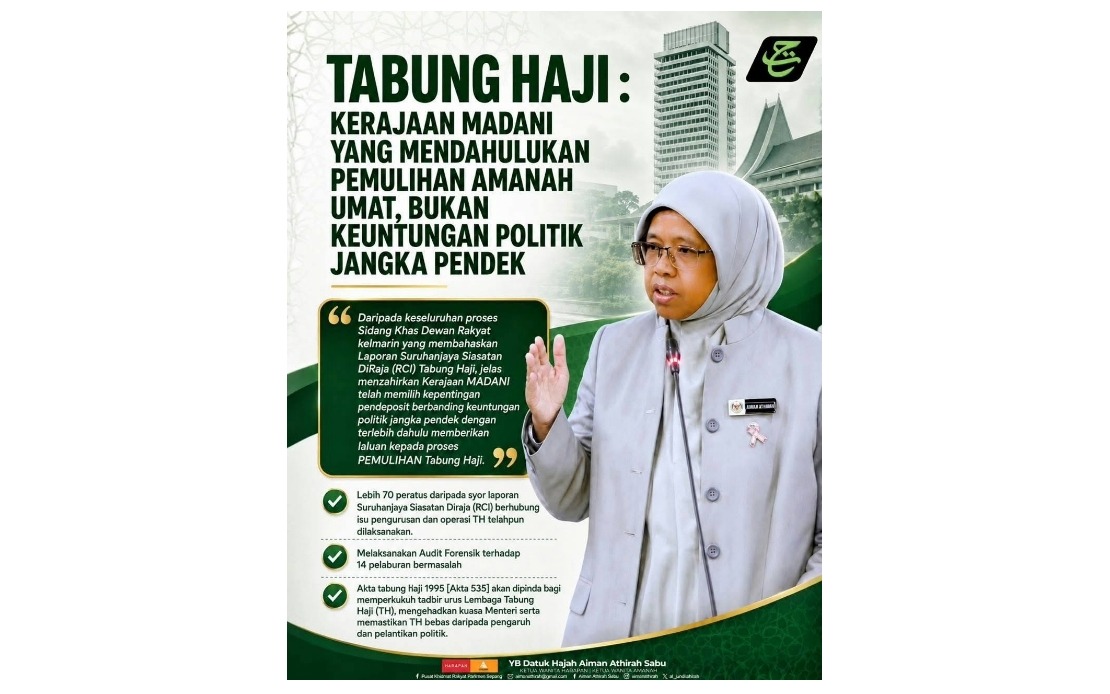
The government's measured approach to releasing the Tabung Haji Royal Commission of Inquiry report reflects a deliberate choice to safeguard the institution's stability rather than capitalise on political opportunities, according to Datuk Aiman Athirah Sabu, Deputy Minister of Housing and Local Government. In a statement addressing ongoing criticism about the timing of the disclosure, she argued that the custodians of public trust must weigh immediate political advantage against the protection of a financial institution serving over 10 million depositors with their accumulated savings for pilgrimage.
The rationale underpinning the government's caution becomes clearer when examining the institutional fragility that nearly engulfed Tabung Haji in 2018. That year saw panic-driven withdrawals exceeding RM6 billion as governance failures came to light, demonstrating the precarious confidence upon which a savings institution depends. The memory of those turbulent months continues to shape policy thinking, with officials acutely aware that premature or poorly managed disclosure of damaging findings could trigger similar destabilisation. For an institution inextricably linked to Islamic worship—managing funds intended for the fifth pillar of Islam—the stakes extend beyond financial metrics into the realm of collective spiritual aspiration.
Aiman Athirah's defence acknowledges the criticism from opposition quarters, particularly from PAS and Parti Wawasan Negara, which have questioned why the RCI's conclusions remain restricted. However, she contends that such critiques overlook the distinction between transparency obligations and fiduciary responsibility. The government, she suggests, must address concerns with empirical evidence and substantive accountability rather than succumb to partisan narratives that weaponise institutional vulnerability for electoral benefit. Her implicit message to opposition voices is that responsible governance sometimes requires postponing narrative advantage in service of institutional preservation.
The gravity of the underlying governance breakdown received royal acknowledgement when His Majesty Sultan Ibrahim, King of Malaysia, called for thorough investigation, elevating the matter beyond routine regulatory failures. This intervention signalled that the issues within Tabung Haji represented not merely administrative shortcomings but systemic weaknesses with implications for millions of ordinary Malaysians entrusting their religious and financial futures to the institution. Such royal concern lent weight to arguments for stabilisation before full disclosure, as hasty revelation without concurrent remedial action might amplify public anxiety.
Progress in implementing recommendations has become central to the government's narrative justifying the disclosure timeline. During a special parliamentary sitting, Minister in the Prime Minister's Department (Religious Affairs) Dr Zulkifli Hasan revealed that over 70 per cent of RCI recommendations concerning Tabung Haji's governance and operations had already been executed. This implementation rate suggests that the government invested the intervening period not in evasion but in concrete corrective measures. The undertaking of forensic audits examining 14 troubled investments represents substantive investigative work designed to ensure comprehensive answers and transparent identification of weaknesses—a foundation from which to build restored confidence.
The scale of Tabung Haji's investment losses emerged during parliamentary proceedings, with Second Finance Minister Datuk Seri Amir Hamzah Azizan detailing nearly RM13 billion in impairments across 14 problematic investments, of which seven suffered total losses. The government absorbed RM10.2 billion of this damage through the Urusharta Jamaah Sdn Bhd rescue mechanism initiated in 2018, while the institution itself carried RM2.6 billion in impairment charges between 2018 and 2025 on investments remaining under active management. These figures underscore both the severity of past failures and the scale of remedial financial commitments undertaken.
Legislative reform forms another pillar of the stabilisation strategy. The government has committed to amending the Tabung Haji Act 1995 to strengthen institutional governance, circumscribe ministerial discretion, and insulate Tabung Haji from political interference and politicised appointments. Such structural changes aim to prevent repetition of the governance weaknesses that precipitated the crisis, addressing root causes rather than merely treating symptoms. For Malaysian depositors and the broader public, these proposed amendments signal intent to restructure institutional architecture around professional independence rather than political convenience.
Financial recovery metrics provide encouraging indicators of stabilisation progress. Tabung Haji recorded investment income reaching RM4.64 billion in 2025, marking a historic high, while dividend distributions expanded from 1.25 per cent in 2018 to 3.5 per cent in 2025. Simultaneously, the government maintained the pilgrimage cost at RM33,000 across three consecutive seasons despite mounting operational expenses, demonstrating commitment to accessibility for ordinary Muslims. These improvements in both institutional profitability and depositor returns suggest that the corrective strategy has yielded tangible benefits within the intervening years.
Aiman Athirah's intervention carries particular significance for Malaysian understanding of institutional governance priorities. By framing the disclosure decision as a deliberate choice to privilege depositor welfare over political positioning, she articulates a philosophy of governance accountability that extends beyond administrative competence. The argument implicitly endorses the notion that institutions serving millions of ordinary citizens require stewardship insulated from immediate electoral considerations. This philosophical stance, whether persuasive or contestable, reflects broader debates within ASEAN democracies about balancing transparency with institutional stability.
Criticism that the government has subordinated transparency to tactical advantage has also drawn sharp response. Opposition lawmakers' walkout from the special parliamentary sitting drew rebuke for irresponsibility, with Aiman Athirah suggesting that genuine accountability demands engagement with facts and evidence rather than performative protest. This characterisation of parliamentary opposition reflects the administration's view that critics have prioritised symbolic action over substantive scrutiny of the detailed remedial work undertaken.
For Malaysian depositors and financial sector observers, the underlying question concerns whether measured disclosure tied to concurrent institutional strengthening represents prudent management or problematic opacity. The government's position holds that stability and confidence restoration must precede full public revelation of institutional damage. Critics counter that extended non-disclosure, regardless of justification, violates principles of timely transparency. This tension between fiduciary caution and democratic accountability will likely define ongoing discussions about the RCI report's contents and the optimal balance between institutional protection and public disclosure obligations.

