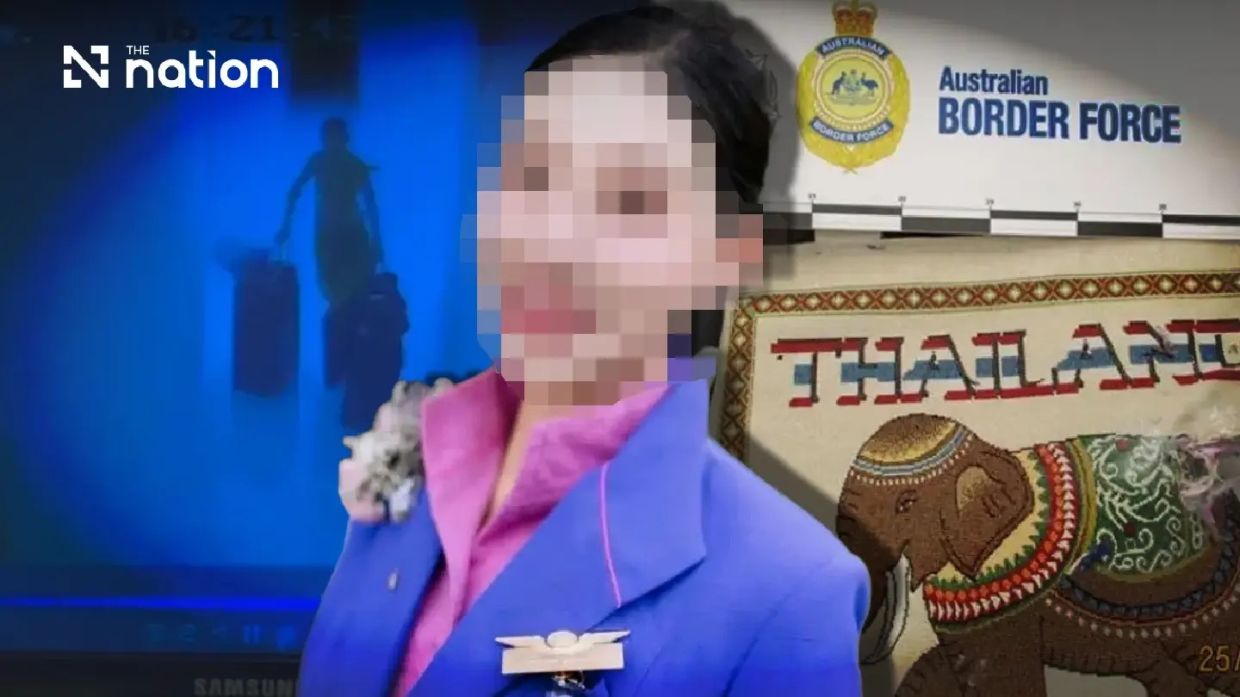
Thai narcotics authorities are pursuing an expanding investigation into the detention of a flight attendant discovered with 900 grammes of heroin at Melbourne Airport, with officials now convinced the case represents just one strand of a much larger transnational criminal operation originating from drug-producing regions along the Thailand-Laos border. The woman, detained since her arrest in Australia, has not yet been formally charged, and Thai officials are working closely with Australian police to determine whether she was a knowing participant or an unwitting victim of an elaborate smuggling scheme orchestrated by international scam networks.
Areepak Ngernbamroong, a deputy secretary-general at Thailand's Office of the Narcotics Control Board (ONCB), outlined the evolving scope of the investigation during a Monday briefing, noting that coordinated arrests in Bangkok had yielded more than 26 kilogrammes of heroin and pointed to a sophisticated, internationally-operating criminal enterprise. The Department of Special Investigation (DSI) has assumed primary responsibility for the interconnected cases, reflecting official assessment that the operation transcends ordinary drug trafficking and involves elements of organised crime coordinated across multiple countries. This administrative realignment signals Thai authorities' concern that a single airline employee's unwitting cooperation with smugglers may have exposed a much deeper network.
The operational model that emerged from witness statements and forensic evidence suggests that criminal syndicates exploit international travel patterns by recruiting flight attendants and frequent overseas travellers through social media deception. Metropolitan Police officials revealed that the scammers deploy false social media profiles offering substantial payments for individuals willing to transport parcels across international borders. A delivery rider connected to the Bangkok arrests reportedly confessed to executing similar deliveries on three or four previous occasions, indicating the smugglers had refined their recruitment and execution procedures into a repeatable methodology. The network employed two distinct smuggling channels—postal delivery for smaller quantities and direct hand-to-hand transfer for larger shipments—suggesting operational sophistication and risk management awareness.
The flight attendant's boyfriend provided investigators with a detailed account of the final stages before the drugs reached her suitcase, describing how she received a parcel box containing elephant-patterned bags that passed through Thai airport security without triggering alarms. After inspecting each bag and finding nothing suspicious during initial examination, she packed all items into her luggage for the journey to Australia. Thai security personnel apparently detected no irregularities when the suitcase traversed the airport X-ray machine, raising uncomfortable questions about screening procedures and whether the heroin was concealed in a manner specifically designed to evade detection technology. This procedural failure during the outbound Thai security check has become a focal point for understanding how the contraband progressed to its final destination.
Australian authorities identified the intended recipient as an individual known as Dear, a Thai national with approximately ten years of residency in Australia whose current citizenship status remains unclear to Thai investigators. The ONCB confirmed that Dear has served as the receiving end-point for multiple similar shipments, with Thai authorities already providing Australian Federal Police with documentary evidence linking this person to the smuggling operation. Officials believe the Australian arm of the network operates as a substantial independent unit not exclusively composed of Thai nationals, suggesting the criminal enterprise may represent a complex, multinational trafficking corridor rather than a simplistic point-to-point drug movement. The AFP's expanded investigation into identifying the ultimate drug recipients and distribution networks in Australia will determine whether the operation encompasses retail-level street dealing or supplies to larger wholesale distributors.
Payment mechanisms remain incompletely understood by Thai investigators, though mobile phone evidence recovered by Australian police indicates a figure of 8,800 baht (approximately US$264) connected to the flight attendant. Conflicting Thai witness statements reference two separate transfers of 1,700 baht each—allegedly triggered respectively upon receiving the parcel and obtaining an air ticket—but banking records for the flight attendant show no corresponding transactions and provide insufficient account balances to reconcile the conflicting narratives. This evidentiary gap has become unexpectedly significant, as investigators cannot definitively establish whether she received any compensation whatsoever, potentially supporting contentions that she was genuinely deceived rather than a knowing conspirator seeking profit.
The circumstances surrounding the delivery rider's involvement further complicate culpability assessments. Officials noted that the rider executed similar deliveries to other individuals on three to four occasions prior to this particular engagement, yet this marked the first time he had delivered items specifically to the flight attendant. This detail permits interpretation suggesting she was an untargeted victim selected through general recruitment messaging rather than a repeat collaborator vetted through previous successful transactions. The combination of inconsistent payment records, the rider's apparent unfamiliarity with her, and her thorough inspection of the parcel contents before packing creates an evidentiary scenario that, while not conclusive, supports preliminary hypotheses that she genuinely lacked awareness of the heroin's presence. Thai authorities have committed to forwarding this exculpatory material to Australian legal representatives through diplomatic channels.
The investigation's geographical dimensions reveal how enforcement pressure in northern Thailand has systematically redirected smuggling operations toward more vulnerable frontier regions. Narcotics operations traditionally attempted moving drugs southward through Thailand's mountainous northern provinces, but intensified interdiction efforts forced criminal networks to adopt alternative routes through the north-east where the Mekong River separates Thailand from Laos across relatively modest distances. The vast, lengthy river boundary in provinces including Nakhon Phanom, Bueng Kan, Loei, and Nong Khai presents formidable monitoring challenges, permitting occasional shipments to traverse into Thailand despite official vigilance. Thai authorities emphasised that this geographic shift does not reflect Laotian governmental negligence, noting continuous intelligence sharing and coordination with Laotian counterparts in tackling transnational trafficking.
The Golden Triangle—the lawless frontier region where Thailand, Laos, and Myanmar converge—remains the investigative focal point as officials trace the heroin's originating source. This geographically remote area has long functioned as a primary manufacturing zone for Southeast Asian narcotics, with various armed militias and organised syndicates controlling production and initial distribution networks. The drugs involved in the flight attendant's case may represent merely one commercial transaction within a vastly more expansive operation, with primary production occurring in Myanmar or Laos before passing through multiple intermediaries, consolidation points, and regional distribution nodes before reaching recruitment networks that targeted the Thai airline employee. Understanding whether the Golden Triangle syndicate directly orchestrated the international smuggling or whether Thai and Australian intermediaries operated semi-autonomously will require sustained intelligence collaboration between multiple governments.
The case has crystallised official concern that globalisation, cheap international air travel, and social media recruitment create unprecedented opportunities for criminal networks to exploit ordinary citizens. The flight attendant's apparent status as a victim of deception rather than a professional smuggler represents a concerning vulnerability within international transport security architectures. If investigations ultimately establish her innocence, the incident will illustrate how sophisticated criminal enterprises can weaponise technological anonymity and financial inducements to recruit unwitting participants, potentially transforming any traveller into an involuntary drugs courier. This dimension has prompted Thai authorities to initiate broader public awareness campaigns warning citizens about deceptive social media recruitment schemes offering overseas payment opportunities. The case remains politically sensitive for Thailand as its citizens abroad face potential imprisonment, and the ONCB's careful coordination with Australian authorities signals recognition that the flight attendant's legal fate will significantly influence bilateral narcotics cooperation and public confidence in Thai government protection for overseas nationals.

