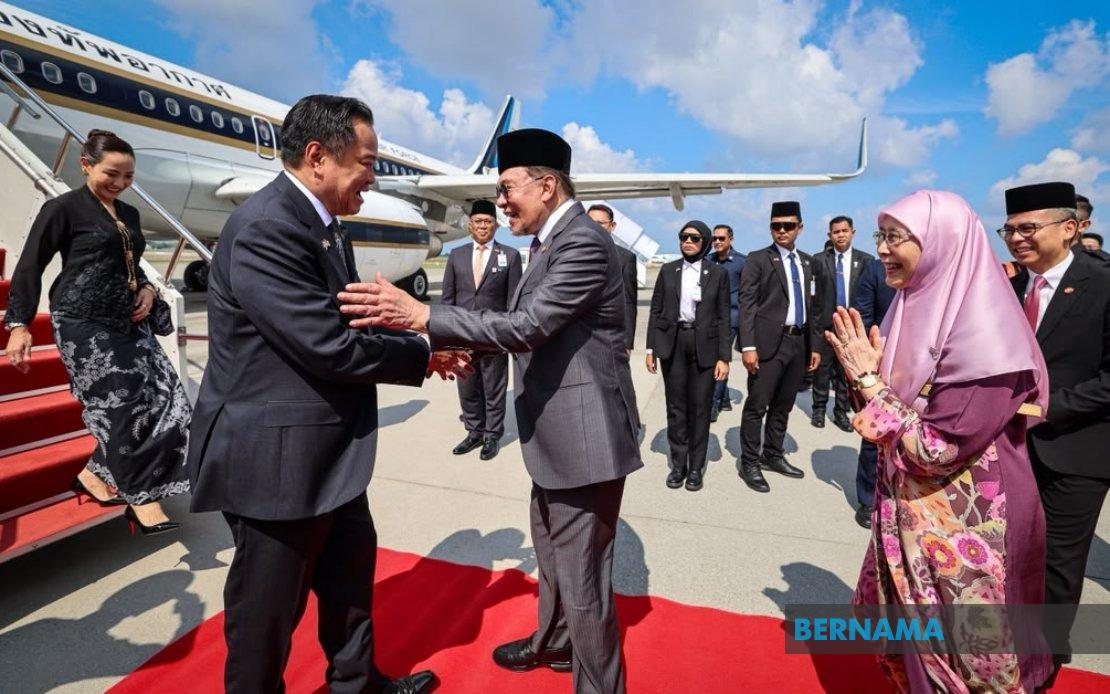
Thailand's Prime Minister Anutin Charnvirakul touched down at Kuala Lumpur International Airport on July 9, marking his first official visit to Malaysia since his reappointment to the top position in March 2026. The Thai leader, accompanied by his spouse Thananon Charnvirakul, was accorded a formal state reception at the Bunga Raya Complex, where he was greeted by Malaysian Prime Minister Datuk Seri Anwar Ibrahim in a carefully choreographed diplomatic ceremony befitting his standing.
The arrival formalities underscored the significance both nations attach to their relationship. A guard of honour comprising 34 officers and personnel from the First Battalion of the Royal Ranger Regiment, led by Major Muhammad Nur Addeen Mustaza, lined the tarmac as the national anthems of both countries resonated through the terminal. The presence of Anwar's wife, Datuk Seri Dr Wan Azizah Wan Ismail, and Communications Minister Datuk Fahmi Fadzil, who served as the receiving minister, reflected Malaysia's commitment to treating this engagement as a matter of considerable diplomatic importance.
The two-day programme has been structured to address multiple dimensions of the Malaysia-Thailand relationship. The centrepiece involves bilateral talks at Perdana Putra, where Anwar and Anutin are expected to review the trajectory of their nations' engagement and chart pathways for enhanced cooperation. A state luncheon at the Seri Perdana Complex will provide an additional opportunity for the leaders to discuss shared concerns and mutual interests in an informal setting, a traditional feature of high-level diplomatic visits in the region.
A particularly significant element of the visit centres on agricultural collaboration. The two premiers are scheduled to witness the signing of a memorandum of understanding on agricultural cooperation, a move that acknowledges both countries' recognition of the sector's importance to their economies and food security concerns. For Malaysia, this development carries particular resonance given the country's ongoing efforts to enhance agricultural productivity and diversify its farming base through regional partnerships.
On July 10, the bilateral engagement will shift to Kedah's Bukit Kayu Hitam, where both prime ministers will jointly officiate the opening of a crucial cross-border infrastructure project. The road linking the Immigration, Customs, Quarantine and Security Complex in Bukit Kayu Hitam with Thailand's corresponding Customs, Immigration and Quarantine Complex in Sadao represents tangible progress in facilitating smoother trade and people-to-people movement across the border. Such infrastructure improvements are essential to reducing bottlenecks that have historically constrained commerce between the neighbouring countries.
The economic relationship between Malaysia and Thailand has demonstrated sustained strength and growth trajectory. During 2025, Thailand positioned itself as Malaysia's sixth-largest trading partner globally and the second-largest among ASEAN member states, a testament to the depth of commercial ties binding the two economies. The bilateral trade volume reached RM118.57 billion (US$27.73 billion) for the full year, reflecting robust demand across multiple sectors.
More recent figures suggest this momentum has continued into 2026. During the first quarter of the year, from January through March, bilateral trade between Malaysia and Thailand climbed to RM31.33 billion (US$7.90 billion), representing a notable increase from the corresponding period in 2025, which had recorded RM27.35 billion (US$6.15 billion). This year-on-year growth of approximately 14.5 percent indicates that the commercial relationship remains dynamic and expanding despite broader global economic uncertainties.
For Malaysia, the timing of this visit carries strategic implications. As the country continues to navigate regional geopolitical complexities and seeks to strengthen its ASEAN credentials, deepening ties with Thailand—a fellow member and significant economic partner—serves multiple objectives. Enhanced cooperation in agriculture, trade facilitation, and cross-border infrastructure contributes to regional integration and demonstrates commitment to mutually beneficial development.
Thailand's perspective on this engagement is equally consequential. With Anutin's government focused on consolidating its position and advancing national development priorities, cultivating stronger relationships with neighbouring economies provides both diplomatic validation and practical economic benefits. Agricultural cooperation, in particular, aligns with Thailand's strategic interests in food security and export competitiveness, areas where complementarity with Malaysia offers genuine advantages.
The infrastructure project being inaugurated during this visit exemplifies how practical, ground-level cooperation translates abstract diplomatic commitments into tangible benefits for businesses and citizens crossing the border. The improved ICQS-CIQ linkage should facilitate faster customs clearance, reduce transaction costs for traders, and enhance the competitiveness of goods moving between the two nations. Such improvements accumulate over time, driving investment decisions and trade volume expansion.
Beyond the immediate bilateral agenda, this visit reflects broader patterns of ASEAN engagement. Both Malaysia and Thailand share interests in maintaining regional stability, addressing transnational challenges, and ensuring that the association remains relevant and cohesive amid shifting global dynamics. The personal relationship between Anwar and Anutin, demonstrated through this high-level exchange, contributes to the informal networks of trust and understanding that facilitate cooperation at the ASEAN level.
The agricultural memorandum of understanding carries particular significance for Southeast Asia, a region increasingly focused on food security amid climate change and population growth. Malaysia and Thailand, both major agricultural producers with distinct production portfolios, can benefit from knowledge sharing, technology transfer, and coordinated approaches to market development. Such cooperation extends beyond commercial interests to address shared vulnerabilities in food systems and supply chain resilience.
Looking forward, this visit establishes momentum for sustained engagement between the two countries. The personal touch added by the inclusion of spouses and the comprehensive programme spanning formal ceremonies, bilateral meetings, and infrastructure inaugurations suggests that both governments view this relationship as sufficiently important to warrant significant diplomatic investment. As Southeast Asia navigates an increasingly complex international environment, strengthened Malaysia-Thailand relations serve as a stabilising force within ASEAN and contribute to regional prosperity and security.

